


Connecting a new dishwasher isn't just about sliding it into place. The real secret to a smooth, leak-free installation happens before you even touch the new appliance. It’s all about preparation—getting the space ready, shutting everything down safely, and having the right gear on hand. This guide will walk you through the process, but if you hit a snag, professional help is just a call away.
Getting Your Kitchen Ready for the New Dishwasher
A successful installation starts with a little bit of prep work. Taking the time now to prepare your kitchen is the single best way to avoid those classic DIY frustrations, like finding out the new unit doesn't fit or realizing you're missing a crucial part halfway through the project.
Think of it as setting the stage. Rushing this initial phase often leads to much bigger headaches, from water damage caused by a leaky connection to an unexpected trip to the hardware store right when you're in the middle of things.
Safely Disconnecting Your Old Dishwasher
First things first: safety. Before you even think about touching a hose or a wire, you have to remember that your old dishwasher is hooked up to both your home's plumbing and its electrical system. Mishandling this can be dangerous.
Your number one priority is to turn off the power. Find the circuit breaker for your dishwasher in your home's main electrical panel and flip it to the "OFF" position. Don't just trust the switch. Grab a voltage tester and check the dishwasher's junction box to be absolutely certain there’s no power.
Next, shut off the water. Under your kitchen sink, you should find a small valve on the hot water pipe that leads to the dishwasher. Turn it clockwise all the way to close it. If for some reason you don't have a dedicated shutoff valve, you’ll have to turn off the main water supply for the entire house.
Pro Tip: Before you start unscrewing any hoses, place a shallow pan and some old towels under the sink and in front of the dishwasher. There's always some leftover water in the lines, and this simple step will save you from mopping up a mess.
Once you’re positive the power and water are off, you can go ahead and disconnect the drain hose, the water supply line, and the electrical wiring from the old unit.
Measuring the Space and Gathering Your Tools
With the old dishwasher out of the way, it’s time to break out the tape measure. Check the height, width, and depth of the cabinet opening. Write these numbers down and double-check them against your new dishwasher's specifications to make sure you have a perfect fit. Most standard dishwashers are built for a 24-inch wide opening, but it never hurts to confirm.
A little organization now will make the actual connection process go so much faster. For a more detailed walkthrough of the entire process, you might find this practical guide on how to install a dishwasher helpful.
Laying out all your tools and parts beforehand is non-negotiable. If you're new to this kind of project, our guide on professional appliance installation in Edmonton offers more insight into what the pros keep in their toolkits.
Here’s a checklist to get you started.
Essential Tools and Materials Checklist
Gather these items before you begin to ensure a smooth, uninterrupted installation process.
| Item Category | Specific Tools/Materials | Pro Tip |
|---|---|---|
| Hand Tools | Adjustable wrench, Pliers, Screwdriver set (Phillips & flathead), Utility knife | A multi-bit screwdriver can save you time rummaging through a toolbox. |
| Safety Gear | Safety glasses, Work gloves, Non-contact voltage tester | The voltage tester is non-negotiable. Always confirm the power is off directly at the source. |
| Connection Supplies | New braided steel water supply line, Wire nuts (correct size), Teflon tape | Never reuse an old water line. A new one is cheap insurance against a future leak. |
Having everything you need within arm's reach means you can focus on the task at hand without any frustrating interruptions.
Connecting the Water Supply Line for a Leak-Free Seal
A solid, secure water connection is the heart of any dishwasher installation. This is the one spot where a tiny mistake can turn into a slow, silent drip that causes serious water damage over time. But with the right parts and a bit of know-how, you can get a professional, leak-free seal that will hold up for years.
First, let's talk about the supply line itself. While you might see old copper tubing, the modern standard is a braided stainless steel hose. These are fantastic—they're flexible, incredibly durable, and highly resistant to bursting. For the peace of mind they offer, they're the only way to go.
And a quick pro tip: never reuse an old supply line, no matter how good it looks. The rubber gaskets inside degrade over time, and you can't see the hidden weak spots that might be developing. A new hose is a cheap investment that protects you from a very expensive problem.
Creating a Watertight Seal
The secret to a drip-free connection isn't about brute force; it’s about prepping the threads correctly. This is where Teflon tape (or plumber's tape) is your best friend.
When you’re ready to connect the hose, you'll want to wrap the male threads on your fittings with Teflon tape. Here’s how to do it right:
- Wrap in the right direction: Always wrap the tape clockwise—the same direction the nut will turn to tighten. If you go counter-clockwise, the tape will just bunch up and unravel as you tighten the fitting.
- Use the right amount: Generally, three to four wraps are perfect. Too little won't create a good seal, but too much can actually stop the threads from grabbing on properly.
- Keep it clean: Make sure the tape lies flat and covers all the threads, but don’t let it hang over the end of the fitting. You don't want little pieces breaking off and getting into your water line.
Getting a truly watertight connection also means you have the right fittings for the job and understand the different plumbing thread types. Most dishwasher supply lines use either compression or pipe thread fittings, but double-checking that they match your home’s plumbing is a crucial step.
The Hand-Tighten Plus a Quarter-Turn Technique
One of the most common mistakes we see is over-tightening the connections. It’s easy to do, but it can strip the soft brass threads on the fittings or even crack the plastic inlet valve on the dishwasher itself. That creates a leak that you can't fix without replacing parts.
Instead, follow the method the pros use:
- Start by hand: Screw the nut onto the fitting by hand until it’s snug. You should be able to get it most of the way on without needing any tools.
- Use a wrench: Once it's hand-tight, grab an adjustable wrench and give it one final, gentle quarter-turn. That’s almost always all it takes to compress the gasket and create a perfect seal.
Resisting the urge to give it "one more turn for good luck" is a key skill. The goal is a snug, secure fit—not a crushed one. A quarter-turn is typically all it takes to prevent issues like the dishwasher not getting water.
Routing the Water Line Correctly
With your connections made, it's time to route the water line from the shutoff valve under the sink over to the dishwasher's inlet valve. The path you choose matters.
Avoid any sharp kinks or tight bends in the hose. These can restrict water flow and seriously impact your dishwasher's cleaning power. The line should have gentle curves and enough slack so you can pull the dishwasher out for servicing in the future without having to disconnect everything.
Getting these connections right is more important than ever. Dishwashers are a standard feature in most homes. In fact, Statistics Canada reports that 59.2% of Canadian households now own a dishwasher, which just shows how common these appliances are across Alberta.
If you run into any trouble here—a connection that just won't stop dripping or if you're not sure about your home's plumbing—it's a good time to pause. If the water supply seems to be the problem, you can learn more about what to do if your dishwasher is not getting water in our article. Nailing this step is fundamental to a successful installation.
Setting Up the Drain Hose to Prevent Backflow
Getting clean, hot water into your dishwasher is only half the battle. Getting the dirty water out is just as important, and a poorly set-up drain hose is one of the most common reasons we get called out for a repair. A bad connection can lead to nasty odours, dirty water flowing back into the dishwasher, and dishes that just never seem to get clean.
The good news is that setting it up correctly is pretty simple. In Alberta, your dishwasher drain will almost always connect in one of two ways: either directly to your garbage disposal or to the sink's plumbing using a "high loop."
Both methods are designed to stop dirty sink water from siphoning back into your dishwasher. It’s a simple but absolutely critical step to make sure every wash cycle starts with fresh, clean water.
Connecting to a Garbage Disposal
If you have a garbage disposal, it almost certainly has a dedicated inlet port just for the dishwasher drain hose. This is the most straightforward way to connect it, but there's one small detail that trips up many DIY installers.
New garbage disposals are shipped with a plastic knockout plug sealing this inlet. If you hook up the hose without removing that plug, the water has nowhere to go. Your dishwasher will fill up, try to drain, and you'll be left with a messy puddle.
Here’s how to remove it properly:
- Take a screwdriver or a small punch and place its tip inside the disposal’s dishwasher inlet.
- Give it a gentle but firm tap with a hammer. You'll feel the plastic plug pop out and drop into the main grinding chamber.
- Make sure the disposal is unplugged, then reach inside and fish out that small plastic disc.
With the plug gone, you're ready to connect the hose. Just slide the metal hose clamp over the end of the rubber hose, push the hose firmly onto the disposal's inlet, and tighten the clamp securely with a screwdriver.
A common rookie mistake is forgetting to retrieve that little plastic plug from inside the disposal. It's small, but it can cause a jam or make a terrible racket the first time you turn the unit on. Always remember to fish it out!
Creating a High Loop for a Standard Sink Drain
No garbage disposal? No problem. You'll be connecting the drain hose to a special Y-branch tailpiece on your sink’s drainpipe. But you can't just run the hose straight to it—you have to create what's called a "high loop" to prevent backflow. This isn't just a suggestion; it's a requirement in most plumbing codes.
A high loop is exactly what it sounds like. You need to loop the flexible drain hose up as high as it can possibly go under your countertop before it curves back down to connect to the sink drain. This creates a natural air gap, using gravity to make it impossible for gross water from your sink to flow backward into the clean dishwasher.
To secure it, use a simple strap or clamp to fasten the highest point of the hose loop directly to the underside of the countertop. The key is that the top of this loop must be higher than the connection point on the sink drain.
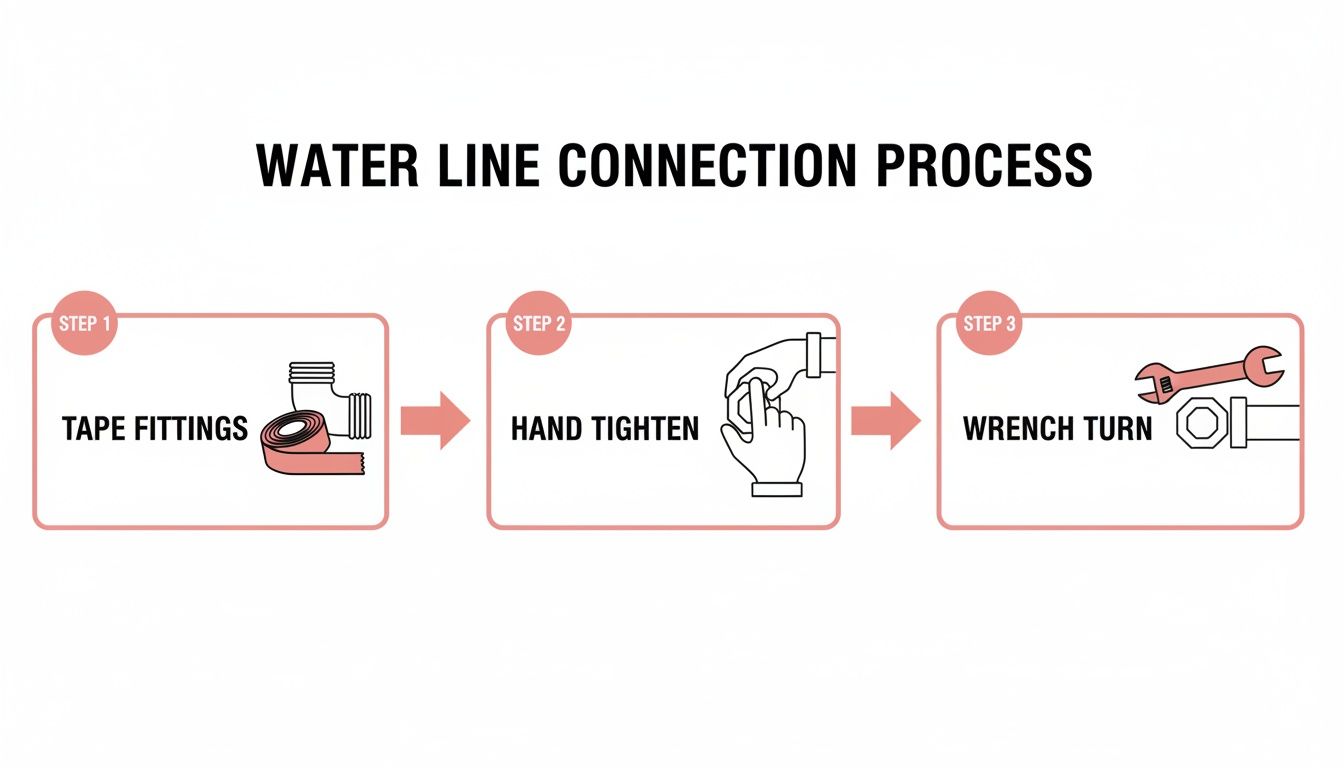
This diagram shows the basic principle for a watertight seal—prepare the fitting, hand-tighten first to avoid mistakes, and then give it a final, gentle turn with a wrench. This applies just as much to your drain connection as it does to the water supply line.
Alberta Plumbing Code Considerations
While the high loop is standard practice, some local codes can have slightly different rules. In certain areas, an air gap device might be required. This is a small chrome fitting mounted on your countertop or sink that creates a physical break between the dishwasher hose and the sink plumbing.
You don't see them as often in newer homes around Alberta, but it's always smart to be aware of the local regulations. For the vast majority of homes in Calgary and Edmonton, a properly secured high loop is perfectly code-compliant. If you’re ever in doubt, a quick call to a professional can give you peace of mind.
If you’ve done everything right but are still having drainage problems, the issue might not be the connection itself. You can find more troubleshooting tips in our guide on what to do when your dishwasher is not draining. A proper drain setup is the final piece of the puzzle, ensuring your new appliance works perfectly from the very first wash.
Handling the Electrical Connection Safely
Of all the steps involved in hooking up a dishwasher, this is the one that demands the most respect. A plumbing mistake might cause a puddle, but getting the electrical wrong can have far more serious consequences. Always, always put safety first here.
In most Alberta homes, dishwashers are powered in one of two ways: they're either hardwired straight into a dedicated circuit or they plug into a nearby electrical outlet. Both are perfectly safe when done by the book, but the approach is a little different for each.
The absolute golden rule, no matter the method, is to make sure the power is completely off. Head to your main breaker panel, find the circuit labelled for the dishwasher, and flip it to the OFF position. Don't just trust the label—grab a non-contact voltage tester and hold it right up to the wires you'll be working with. Only when that tester stays silent should you proceed.
Understanding a Hardwired Connection
Hardwiring is a common and traditional method. It's where the dishwasher's own electrical wires are connected directly to your home's wiring inside a small junction box, which you'll usually find at the front of the unit, just behind the lower kick plate.
The job is essentially a colour-matching exercise, securing the wires together inside the junction box. It's a system electricians have trusted for decades:
- The black wire (the "hot" one) from the dishwasher connects to the black wire from the wall.
- The white wire (the "neutral") connects to the corresponding white wire.
- The green or bare copper wire (the "ground") connects to the ground wire in your home's circuit.
You'll use wire nuts to make these connections. Just hold the stripped ends of the two matching wires parallel to each other, push a wire nut over them, and twist it clockwise until it's snug and tight. Give each wire a gentle tug to be sure the connection is solid and no bare copper is showing.
A Pro Tip on Safety: Never assume the wiring in your wall is correct, especially in an older home. Before you even touch the breaker, use your voltage tester to confirm which wire is hot. This simple verification step can prevent a very dangerous mix-up.
Using a Plug-In Connection
Many newer installations favour a standard power cord and plug, which definitely simplifies things. The cord attaches to the dishwasher's junction box just like with hardwiring, but the other end just plugs into a regular wall outlet.
This isn't just any old outlet, though. The Canadian Electrical Code, which is law in Alberta, has some strict rules for this setup:
- It must be a dedicated circuit, meaning your dishwasher isn't sharing power with your toaster or anything else.
- The outlet must have GFCI protection (Ground Fault Circuit Interrupter). This is a critical safety feature that shuts off power instantly if it detects a fault, preventing shocks in a wet area like under a sink.
- It should be accessible, which usually means it's located in the adjacent cabinet.
Getting the electrical right is fundamental for your dishwasher's performance and, more importantly, its safety. This standard of care applies everywhere, even in commercial kitchens where Alberta Health Services enforces strict guidelines on sanitation that rely on perfectly functioning, safely powered dishwashers. You can see how serious these standards are by checking out Alberta's dishwashing requirements.
The entire electrical system is designed with safety in mind. Components like fuses are there to protect your appliance from things like power surges. To get a better handle on how these little devices work, take a look at our guide on why appliances need fuses.
Whether you're dealing with a hardwired setup or a simple plug, a secure and correct electrical connection is non-negotiable. It ensures your new appliance runs perfectly and keeps your home safe from any electrical hazards.
Finalizing the Installation and Performing a Leak Test
You’ve got the water, drain, and electrical lines hooked up. Nice work—you’re in the home stretch now. All that’s left is to get the dishwasher positioned just right, lock it in place, and run a crucial test to make sure every single connection is watertight.
Let’s start by carefully sliding the dishwasher back into its cabinet. Go slow here. The last thing you want is for a hose or the power cord to get pinched or kinked behind the unit. A restricted line will cause headaches right away.
Leveling and Securing the Dishwasher
A dishwasher that wobbles isn't just a minor annoyance; those vibrations create extra noise and can cause parts to wear out prematurely. Taking a few minutes to get it perfectly level is a small step that pays off big time.
Most dishwashers have adjustable feet at the front corners, and often one in the back. You can usually turn the front feet with a wrench or pliers. Some brands, like many Bosch models, make it even easier with a centre screw at the front that adjusts the rear leg.
Grab a small level to check your work:
- First, place the level on the inside of the door frame to check it side-to-side. Tweak the feet until the bubble is perfectly centred.
- Next, lay the level on the top edge of the open door to check it from front to back.
Once it's perfectly level and sitting squarely in the opening, it's time to anchor it. Your dishwasher came with a couple of small mounting brackets. These secure the top of the unit to the underside of your countertop, stopping it from tipping forward when you pull out a heavy, dish-filled rack.
Just attach the brackets to the slots on top of the dishwasher frame, then drive the screws up into the countertop. Double-check that you're using the right length screws—you definitely don't want to punch through the top of your counter.
Expert Insight: Take a second to eyeball the gap between the dishwasher and the cabinet on both sides. A nice, even gap doesn't just look more professional; it confirms the unit is sitting straight, which helps the door align and seal properly.
The All-Important Leak Test
This is the moment of truth. Before you clean up your tools and declare victory, you have to be 100% sure there are no leaks. Even a tiny, slow drip can go unnoticed for weeks, quietly causing major water damage to your floors and cabinets.
Follow this sequence exactly to do it right:
- Turn the Water On: Slowly open the hot water shutoff valve all the way.
- Check the Supply Line: Immediately grab a flashlight and a dry paper towel. Check the connection at the shutoff valve and where the line connects to the dishwasher’s water inlet. Wiping each fitting with the paper towel is a great trick—it’ll show even the smallest hint of moisture.
- Restore Power: Go back to your breaker panel and flip the dishwasher's circuit breaker back to the ON position.
- Run a Test Cycle: Start a short wash or rinse cycle on the machine. This gets the water flowing and pressurizes the whole system.
- Inspect Everything Again: While the dishwasher fills, re-check the water supply connections. Then, when it drains for the first time, get your flashlight and carefully inspect the drain hose connection at the garbage disposal or sink drain.
If you see any drips at all, shut everything off right away and fix the connection. Usually, it just means a fitting needs another quarter-turn to get it snug. If you're still having trouble, our guide on a dishwasher leaking from the bottom has more troubleshooting tips.
This final check is what separates a good DIY job from a potential disaster. It's the last step to ensuring your new appliance is a welcome, worry-free addition to your kitchen for years to come.
When It’s Time to Call a Professional Installer
Taking on a dishwasher installation yourself can be a really satisfying project. But knowing when to put the tools down and call in an expert is just as important. It’s the smartest way to stop a simple appliance swap from spiraling into a full-blown, expensive home repair disaster.
If your kitchen has never had a dishwasher before, this is your cue to stop. You're almost certainly going to need professional plumbing and electrical work to get the job done right. We're talking new water lines, a proper drain connection, and a dedicated GFCI circuit. This isn't just a simple hookup; it’s a project that demands a licensed tradesperson to make sure everything is safe and meets Alberta's building codes.
Red Flags for DIYers
Sometimes, even what seems like a straightforward replacement can throw you a curveball. Here are a few warning signs that it’s time to call for backup:
- Old Plumbing: Take a good look at the shutoff valve under your sink. If it looks ancient or is covered in corrosion, don't touch it. Trying to force it could cause it to snap right off, and you’ll have a serious leak on your hands.
- Complex Connections: High-end dishwasher models can be a bit fussy. They sometimes come with unique or unfamiliar fittings that need special tools or know-how to connect properly without causing damage.
- You're Just Not Feeling It: If you’re not comfortable with basic plumbing, or if the thought of household electrical wiring makes you nervous, this isn't the project to learn on. A mistake with water or electricity can have serious consequences.
A professional installation isn’t just about getting the job done—it's about guaranteeing it's done right. You’re preventing leaks, electrical hazards, and performance headaches down the road. Think of it as an investment in your peace of mind.
Need appliance repair? Visit RepairMyAppliance.ca or call 587-416-5888 for fast, professional service.
FAQ: Common Questions About Dishwasher Connections
When you're getting ready to install a new dishwasher, a few questions always seem to pop up. We hear them all the time from homeowners around Alberta. Here are the straight answers to make sure your installation is safe, correct, and gives you sparkling clean dishes every time.
Can I Connect a Dishwasher to the Cold Water Line?
This is a common one, but the answer is a firm no. Your dishwasher is designed to connect directly to your hot water line for a reason.
Think about it—trying to wash a greasy pan with cold water just doesn't work. The same goes for your dishwasher. It relies on that initial blast of hot water from your home’s water heater to dissolve detergent properly and cut through stubborn food and grease.
If you hook it up to the cold line, your dishes will never get truly clean. Plus, you’ll force the dishwasher’s internal heater to work overtime just to get the water up to temperature. That puts a massive strain on the appliance and can seriously shorten its lifespan.
What Is a High Loop and Why Does My Dishwasher Need One?
A "high loop" might sound technical, but it’s one of the simplest and most important parts of the drain setup. It’s just a matter of looping the flexible drain hose up as high as it can go under your sink—right up against the bottom of the countertop—and securing it there before it connects down to the drain or garbage disposer.
So, why bother? This simple bend creates a natural air gap using gravity. It’s your best defence against dirty, contaminated water from your sink siphoning back into your dishwasher. Without a high loop, all that gunk you just rinsed off other dishes could end up right back inside your machine, leaving a film on your supposedly "clean" dishes.
It's a small step that makes a huge difference in hygiene.
Does a Dishwasher Need Its Own Circuit in Alberta?
Yes, absolutely. This isn't just a suggestion; it's a strict safety requirement under the Canadian Electrical Code, which is the law here in Alberta. Your built-in dishwasher must be on its own dedicated 15-amp circuit.
This rule is in place to prevent circuit overloads. Your kitchen is full of high-draw appliances. Imagine running the dishwasher while someone makes tea with an electric kettle and someone else uses the microwave. Without a dedicated circuit, you’d be constantly tripping the breaker.
More importantly, it’s a critical safety measure that reduces the risk of electrical hazards. If you have any doubts about your kitchen’s wiring, don't guess. The safest and smartest move is to call a licensed electrician to check it out.