
When your fridge stops cooling or your washing machine springs a leak, your first instinct is to grab your phone and search Google Maps for help. You need someone fast. But in that moment of panic, scammers are waiting, hoping you’ll click on the first promising result without a second thought.
Before you call, take a moment to look for the classic red flags: a generic business name like "Appliance Repair," an address that looks like a house on Street View, or a sudden flood of vague 5-star reviews. These simple checks take less than a minute and are your best defense against hiring a fake company that could take your money and leave you with a still-broken appliance.
Your First Line of Defense Against Repair Scams
A broken appliance creates a sense of urgency, and scammers prey on that pressure. They create convincing—but completely fake—Google Maps listings designed to look like a local, trustworthy repair service. Their goal is simple: get your call, collect a "deposit" for a job they'll never do, or send an unqualified handyman who could make the problem even worse.
Spending just 30 seconds looking closer can save you from weeks of headaches and hundreds of dollars. This isn't about a deep, time-consuming investigation. It’s about spotting the obvious patterns that fraudulent listings share because they're thrown together quickly and in large numbers.
The 30-Second Gut Check
Before you even think about hitting the "call" button, perform this quick scan of the company's Google listing. You're looking for immediate red flags that signal something isn't right.
- Vague Business Names: Scammers use generic, keyword-stuffed names like "Appliance Repair Near Me" or "Best Calgary Appliance Service." Legitimate businesses almost always have a unique, brandable name.
- A Sketchy Address: Does the listing show a physical address? If it does, use Google Street View to check it out. If you see a residential house, a UPS Store, or a vacant lot, that's a massive warning sign. Real repair companies operate from commercial or industrial spaces.
- A Flood of Perfect Reviews: Be skeptical of a company with dozens of 5-star reviews all posted within the last few weeks. Genuine customer feedback accumulates slowly over months or years, and it's rarely flawless.
This flowchart breaks down the simple process for that initial gut check. It’s all about quickly identifying whether you should dig deeper or just move on to the next option.
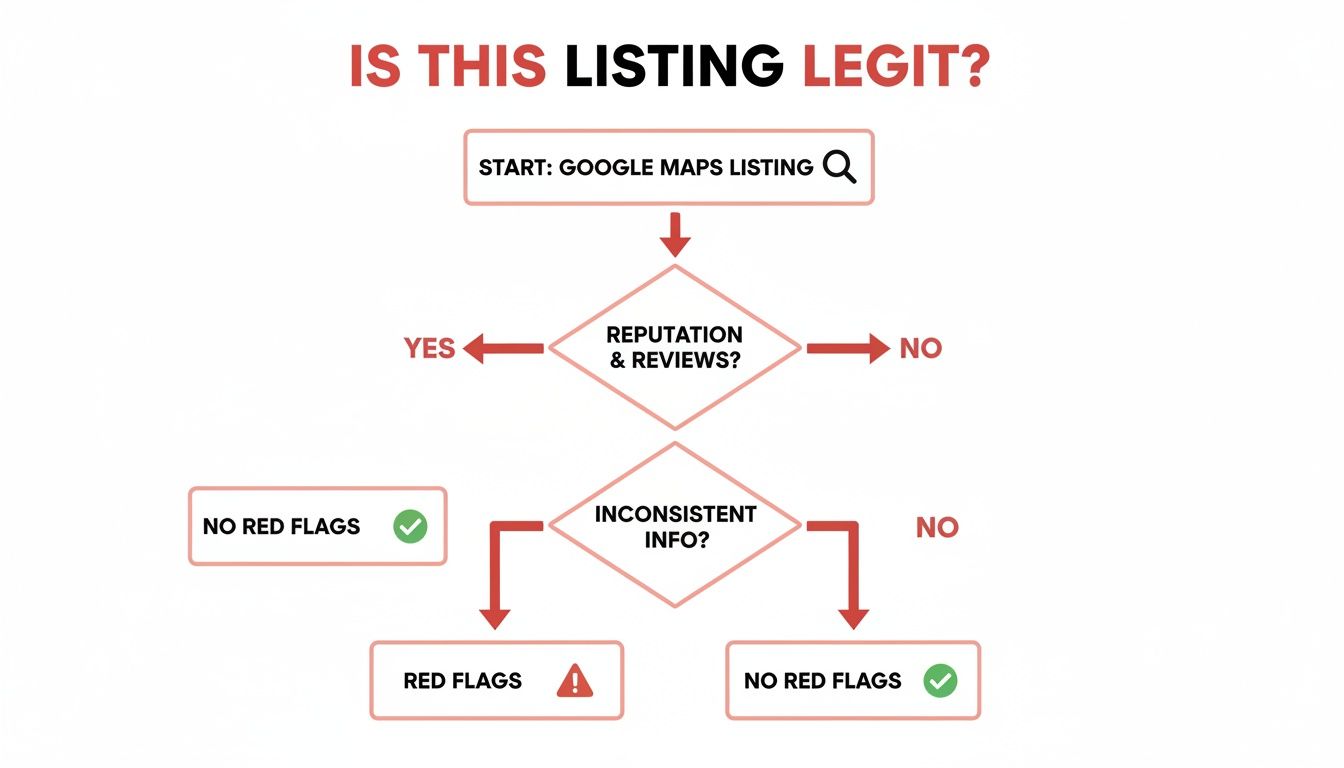
Finding even one or two of these warning signs is enough reason to be cautious and find another company.
Here’s a quick summary of those immediate red flags to keep in mind.
Quick Red Flag Checklist for Google Maps Listings
| Red Flag | What to Look For | Why It's Suspicious |
|---|---|---|
| Generic Name | Names like "Appliance Service," "Calgary Repairs," or keyword-heavy phrases. | Legitimate businesses invest in a unique brand. Generic names are easy to create in bulk and abandon. |
| No Physical Address | The listing only shows a service area but no specific location you can look up. | This often means they have no real home base and are harder to hold accountable if something goes wrong. |
| Residential/Odd Address | Using Google Street View to check the address reveals a house, a PO box, or an empty field. | Professional repair companies operate from commercial or industrial locations, not a suburban bungalow. |
| Sudden Review Spike | A large number of 5-star reviews all appearing within a very short timeframe (e.g., the same week). | Authentic reviews accumulate over time. A sudden surge strongly suggests they were purchased or faked. |
| Vague, Similar Reviews | Reviews that say things like "Great service!" or "Fixed it fast!" with no specific details. | Fake reviews are often written from a template and lack personal details about the job, the technician, or the appliance. |
Paying attention to these small details at the start can save you from a major headache later.
Real-World Consequences of Fake Listings
This isn't just a "what if" scenario—it’s a real problem with serious financial consequences for homeowners like you.
For example, a widespread scam in California involved fake companies impersonating real ones. These fraudsters created copycat listings and slick websites that actually ranked high in Google searches. The state's Department of Consumer Affairs ended up with over 1,200 complaints about these types of fake home service listings. A key giveaway? The so-called "technicians" would show up in unmarked vans, not the branded vehicles the real company used.
Your best defense is a healthy dose of skepticism. If a listing feels "off" or just a little too good to be true, it probably is. Trust your instincts and find a company with a more established and verifiable presence.
Learning how to spot these initial red flags is a vital skill. For a deeper look into what makes a service truly reliable, take a look at our guide on what to expect from Calgary's trusted appliance repair services. It's all about building confidence before you ever pick up the phone.
Putting a Suspicious Business Profile Under the Microscope
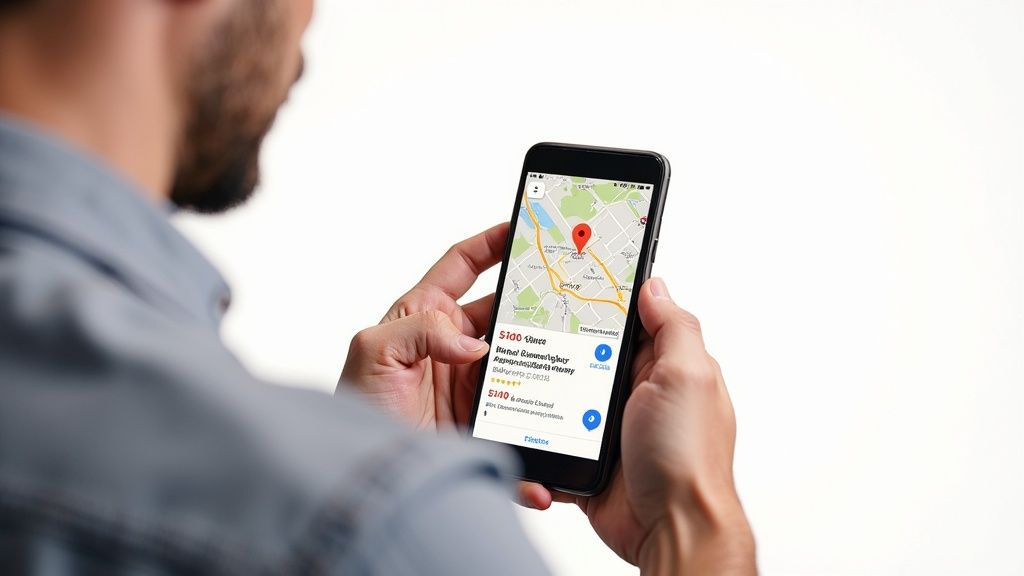
So, a company’s profile passed your quick 30-second gut check. Now it’s time to dig a little deeper. Scammers are getting slick at creating profiles that look real at first glance, but their digital storefronts often fall apart once you start poking around.
Think of a Google Business Profile as a company's resume. Every part of it tells a story, and you're looking for the parts that just don't add up.
The best tool you have right at your fingertips is Google Street View. Any real appliance repair business needs a physical space for parts, tools, and their service vans. That almost always means they’re operating out of a commercial or industrial location, not someone's garage.
Check Out the Physical Address
This is where you can often spot a fake immediately. Drag that little yellow Street View person onto the map and take a virtual stroll around their supposed headquarters. What you find—or don't find—is incredibly telling.
- Residential Homes: If the pin drops you in front of a suburban house, an apartment complex, or a condo, that's a massive red flag. Legitimate, insured repair companies don't run their operations out of a basement or a spare bedroom.
- Mail Drops & Co-working Spaces: Scammers love using virtual office addresses to fake a local presence. If the address turns out to be a UPS Store, a post office, or a generic office building with zero signage for the company, you should be very skeptical.
- Vacant Lots: It sounds ridiculous, but it happens. Some scammers don't even bother finding a real building and will list an empty field as their main office.
Expert Insight: A real business is proud of where they work. You'll see clear signage on the building, maybe a branded van or two in the parking lot—things that scream "we are a professional service." If there is absolutely zero physical evidence that a business exists at that address, it's a strong signal to back away.
This problem is so widespread it’s become a well-known scam tactic. For a deeper dive into how this affects consumers, it’s worth understanding the impact of fake Google My Business profiles.
Scrutinize Photos and Business Descriptions
After you've checked out the address, head over to their photos. Real businesses love to show off their actual team, their branded vans, and maybe even some pictures of their technicians on the job. Scammers? They lean heavily on generic stock photos.
Be on the lookout for these warning signs in their photo gallery:
- Perfectly Polished Stock Photos: Are the "technicians" wearing flawless, unbranded uniforms and smiling in a workshop that looks like a movie set? These are almost certainly stock images you can find anywhere online.
- No Branded Vehicles: A serious repair company invests in branding its service vans. If all you see are glossy pictures of new appliances or more stock photos, they're probably hiding the fact that they just use unmarked personal cars.
- Mismatched Scenery: Always check if the photos actually look like they were taken in your area. A picture of a technician with palm trees in the background is a dead giveaway if you're in the middle of a Calgary winter.
Finally, read the business description carefully. Scammers often stuff this section with a laundry list of keywords like "best appliance repair," "fastest service," and every appliance brand under the sun. A real company's description will talk about their history, their qualifications (like being licensed and insured), and what makes them different.
Vague promises and a lack of specific, verifiable credentials are the hallmarks of a shady operation. If you just want a reliable fix without playing detective, our team offers professional same-day appliance repair with service you can trust.
How to Tell Real Reviews from Fake Ones
Reviews are today's word-of-mouth, and scammers know just how much weight a good recommendation carries. A page full of glowing five-star praise can create a powerful, yet completely unearned, sense of trust. This makes it dangerously easy for a bogus company to look like a trusted local business.
That's why the first step in spotting a fake is learning to be a review detective. It’s not about the overall star rating; it’s about the patterns, the language, and the timing that give the game away.
The Anatomy of a Fake Review
Fake reviews are usually pretty formulaic. Why? Because they're often written in bulk by people who have never actually used the service. They're designed to inflate a listing's rating fast, but they almost always leave behind a trail of obvious clues.
A massive red flag is a sudden flood of positive reviews. If a company profile has 50 reviews that all mysteriously appeared within a two-week span, you should be suspicious. Real feedback from happy customers trickles in organically over months, even years—not in one big, coordinated dump.
Keep an eye out for these other common signs:
- Vague, Generic Praise: Comments like "Great service!" or "Fast and friendly!" are classic filler. A real customer will usually drop specific details, like the technician's name, the appliance they fixed, or something unique about the experience.
- Copy-Paste Language: As you scroll, do you notice the same phrases popping up over and over? Scammers often rely on a script, which results in a dozen reviews that all sound eerily similar.
- Ghostly Reviewer Profiles: Click on the name of the person who left the review. If their profile shows they've only ever left one review—for this company—it's a huge warning sign. Real people tend to review multiple places over time.
Key Takeaway: The timing of reviews can tell you more than the content itself. A healthy, legitimate business profile shows a natural, steady stream of feedback, not a sudden explosion of perfect ratings.
How to Spot a Genuinely Good Company
Now that you know what to look for in a fake, let's flip the script. Authentic reviews paint a much more realistic picture of a business, warts and all. Even the best companies have an off day, and how they respond to that says everything.
A real company's review profile usually has:
- A Mix of Ratings: A 4.8-star average from 150 reviews is often far more believable than a perfect 5.0 from 30. A healthy mix of four- and five-star reviews, maybe with an occasional lower rating, feels much more human.
- Detailed Stories: Real customers tell their stories. You'll see things like, "Dave managed to find a rare part for our old Maytag dryer," or, "They came out the same day to fix our leaking dishwasher." Specifics like these are tough to invent.
- Photos and Videos: It's becoming more common for customers to upload a photo of their repaired appliance or even the technician's van. This kind of user-generated content is a strong sign that a real transaction took place.
The scale of these scams is genuinely alarming. Google recently filed a lawsuit against a network that created thousands of fake business profiles using doctored photos and fabricated reviews, all posted from the same IP addresses. Victims of these schemes were out an average of $350 per incident. You can discover more insights about Google's GBP crackdown on ApplianceMarketingPros.com to see how these operations work. This is exactly why taking a minute to check the reviews is so important.
A quick way to get a feel for what’s real and what’s not is to compare them side-by-side.
Authentic vs. Fake Review Characteristics
This table breaks down the key differences to help you quickly tell genuine customer feedback from fabricated praise.
| Characteristic | Authentic Review Signs | Fake Review Signs |
|---|---|---|
| Language & Detail | Specifics are mentioned (technician's name, appliance, issue). Describes a personal experience. | Vague and generic ("Great service!"). Uses emotional but empty words. |
| Timing | Reviews appear steadily over months or years. Natural, organic flow. | A large number of reviews appear in a very short period (days or weeks). |
| Reviewer Profile | The user has reviewed other local businesses over time. Profile looks active. | The user has only one review, or all reviews are for similar fake businesses. |
| Rating Pattern | A mix of 4- and 5-star ratings, with occasional lower scores. Realistic average (e.g., 4.7). | A perfect 5.0 score or an overwhelming number of 5-star reviews with no variation. |
| Response from Owner | The business owner responds professionally to both positive and negative reviews. | No owner responses, or aggressive/defensive replies to any negative feedback. |
Seeing these characteristics in action makes it much easier to trust your gut when a listing just doesn't feel right.
The Importance of Negative Reviews
Don't run from a company just because you see a couple of bad reviews. In fact, a profile with zero criticism is often a bigger red flag. The real test of a company’s character is how they handle it when something goes wrong.
Look for a business that responds publicly to negative feedback, apologizes for the customer's experience, and offers a solution. A thoughtful, professional response shows they value their reputation and stand behind their work. On the flip side, a company that ignores unhappy customers or gets defensive is showing you exactly how they’ll treat you if your repair hits a snag.
Verifying Credentials Beyond Google Maps

A convincing Google Maps profile is just the first step. Scammers are great at faking a listing, but they almost always fall short when it comes to building an entire professional identity that holds up under pressure. A legitimate business exists far beyond its Google pin, and this is where you can easily separate the real pros from the phonies.
Your next move is to get off Google and investigate their digital footprint. Any real, established company will have a professional website that acts as their home base. This shouldn't be a flimsy landing page; it should be a resource that builds your confidence in them.
Start with a simple check: does the website's contact info match what's on the Google listing? Look for the exact same phone number and business address. Any difference is an immediate red flag—it points to either a sloppy operation or someone deliberately trying to mislead you.
Digging into Licensing and Insurance
A professional website should do more than just list services—it should proudly display its credentials. This is non-negotiable. Look for an "About Us" or "Why Choose Us" page that clearly states the company is fully licensed and insured.
Scammers almost never mention this. Why? Because they don't have it. Insurance is your safety net. If an uninsured technician damages your expensive appliance, floods your kitchen, or gets hurt on your property, you could be on the hook for the entire bill.
Expert Insight: Think of insurance as the company's promise of accountability. A legitimate business invests in this protection because they stand behind their work and protect their clients. The absence of this information is a silent admission that they operate without a safety net.
This check is your best defence against fly-by-night operators who can cause thousands in damages and then simply disappear, leaving you with no way to recover your losses. For anyone in Alberta, this step is absolutely critical.
The Importance of Alberta-Specific Certifications
In Alberta, appliance repair is a recognized, skilled trade with specific standards. When you’re checking out a company, you want to see that their technicians hold a Journeyman Appliance Service Technician ticket. This certification is a powerful sign of legitimacy and genuine skill.
Here's why this matters so much:
- Verified Expertise: A Journeyman has completed years of apprenticeship training and passed tough exams. They’ve proven they can safely diagnose and repair complex modern appliances.
- Adherence to Safety Codes: Certified techs are trained in provincial electrical and gas fitting codes. This ensures repairs are done correctly, preventing potential fire hazards or further damage.
- Professional Accountability: Holding a provincial ticket means the technician is a registered professional. This brings a level of accountability that an uncertified handyman just can't offer.
If a company’s website is quiet about certified technicians, ask them directly when you call. A vague answer or any hesitation is your cue to hang up and find someone else. Choosing a certified pro is a smart move, similar to understanding why professional Sub-Zero appliance repair over DIY attempts is so important—expertise makes all the difference.
Cross-Referencing with Official Registries
Your final check is to verify the business itself. Any legitimate company operating in Alberta has to be registered with the province. You can cross-reference the company's name on official government or consumer protection websites.
This confirms the business is legally recognized and not just a phantom name cooked up for a Google listing. It might take a few extra minutes, but it provides peace of mind that you're dealing with a real, accountable company. Scammers count on you skipping this step, so taking the time to verify is one of your strongest moves.
Spotting Red Flags During Your First Call
You’ve done your digital homework, and a company looks promising on paper. Now for the real test: the first phone call. This is where a scammer’s carefully built online facade often starts to show cracks.
Listen carefully to how they pick up the phone. A professional, legitimate business will almost always answer with their name. Think, "Thank you for calling Repair My Appliance, how can I help you?" Scammers, on the other hand, often use a generic, vague greeting like "Appliance service" or just a simple "Hello?"
That generic opening is a massive red flag. Why? Because they're likely running dozens of fake listings under different names and have no idea which one you’re actually calling. Your first impression on the phone can tell you nearly everything you need to know.
Evasive Answers to Simple Questions
Once they're on the line, it’s your turn to ask a few direct questions. A real company will have no problem answering them. A scammer will dodge, deflect, or give you the runaround because they’re making it all up on the spot.
Here are the essential questions to ask and the warning signs to listen for:
- "Can you confirm your business address and licence number?"
- Good Answer: They’ll give you a verifiable commercial address without hesitation and confirm they are licensed and insured.
- Red Flag: They get defensive, claim "we're a mobile-only service," or flat-out refuse to provide a physical address. This is a classic tactic to hide the fact that they have no real headquarters.
- "What are your diagnostic or service call fees?"
- Good Answer: They’ll clearly state their fee—for example, "$95 service call fee"—and often explain that it gets waived if you go ahead with the repair.
- Red Flag: They get cagey about pricing, saying "it depends" without giving you a standard fee, or they push you for your credit card details before even discussing costs.
- "Do you use your own technicians or subcontractors?"
- Good Answer: "All our technicians are in-house employees who are fully insured and background-checked."
- Red Flag: They admit to using subcontractors but can't tell you if those workers are properly insured or licensed. This means a total stranger with zero accountability could be showing up at your door.
Their reaction to these straightforward questions is incredibly telling. A professional business expects these inquiries and is happy to provide answers that build your confidence.
Expert Tip: Pay attention to the sounds in the background. If you hear a noisy call centre, a blaring TV, or other household chaos, it’s a good sign you’re not talking to a dedicated local business. Legitimate companies operate from a professional environment.
Pressure Tactics and Unprofessional Booking
The final warning signs pop up when you try to schedule the appointment. Scammers thrive on creating a false sense of urgency, pushing you to make a decision before you have time to think.
Be extremely wary of anyone demanding a large upfront payment over the phone, especially if they ask for cash, before a technician has even seen the appliance. A reliable company only requires payment after the work is done or after a detailed diagnosis has been provided and approved by you.
A chaotic booking process is another major issue. A legitimate company will:
- Give you a clear appointment window (e.g., "between 1 PM and 4 PM").
- Send a confirmation email or text message that includes the company's name and contact details.
- Explain their policies, including any guarantees on their work.
If the person on the phone is disorganized, won't give you a straight answer on timing, or refuses to send a written confirmation, you're dealing with a fly-by-night operation. This lack of professionalism is a direct reflection of the kind of service you can expect. For comparison, it's always a good idea to understand what a proper appliance repair warranty should cover. Any hesitation to discuss their warranty is another huge sign to hang up and move on.
What to Do When You Find a Fake Company
It's frustrating to discover a fake listing on Google Maps, especially when you're just trying to get an appliance fixed. But taking action is the best way to protect yourself and others in your community. Your report helps clean up local search results, making it much harder for scammers to find their next target.
The most direct and effective step is to report the phony business profile straight to Google. It’s easier than you might think and is the fastest way to get a harmful listing removed.

Reporting the Fake Profile to Google
Google actually relies on people like you to flag these fraudulent listings. When you report a fake company, you’re alerting their moderation team to take a closer look.
Here’s how to do it:
- Find the Listing: Pull up the company’s profile on Google Maps.
- Suggest an Edit: Look for and click the “Suggest an edit” option.
- Mark It for Removal: You'll see an option to “Close or remove.” Go ahead and select that.
- Pick Your Reason: A list will pop up. Choose the one that fits best, like “Doesn’t exist here,” “Spam, fake, or offensive,” or “Duplicate of another place.”
- Add the Details: This is where you can really help. Add a quick, clear note explaining why it's fake. Mention things like a vacant lot at the address, stock photos, or a flood of suspicious reviews. The more specific you are, the better.
If you come across a listing with obviously fake reviews, it's also worth knowing how to dispute a Google review. This helps protect other consumers from being misled.
Taking It a Step Further
Reporting the listing to Google is the critical first step, but for persistent issues, you can also escalate it to consumer protection agencies. These organizations are great at tracking fraud patterns and can take broader action against repeat offenders.
Consider reporting the business to:
- The Better Business Bureau (BBB): Their Scam Tracker is an excellent tool for warning others in the community about shady operations.
- Provincial Consumer Protection: Here in Alberta, that's Service Alberta. They handle complaints about unfair business practices and have the authority to investigate.
Important Takeaway: Your actions really do matter. Every report you file makes it tougher for scammers to operate. You’re not just solving a problem for yourself; you're helping keep the online space safer for everyone. When in doubt, always stick with verified local appliance experts who have a real, proven track record.
What If You’ve Already Been Scammed?
If you've unfortunately already paid a fraudulent company, you need to act fast to minimize the damage.
Your first call should be to your bank or credit card company to dispute the charge. Explain the situation clearly and provide any proof you have, like screenshots of the listing or text messages. In most cases, they can reverse the payment through a chargeback.
Frequently Asked Questions
Why Are There So Many Fake Appliance Repair Listings on Google Maps?
It comes down to a simple, frustrating reason: it's cheap and easy for scammers to do. They prey on the urgency of a broken appliance, knowing that when your fridge stops cooling, you need help fast and might not have time to do a deep dive into every company.
Scammers can throw up a fake address and a handful of bogus reviews in minutes, creating the illusion of a legitimate local business. This lets them hook unsuspecting customers, collect a "deposit" for a job they never show up for, or send an unqualified person who does more harm than good and then disappears.
Can I Trust a Company That Uses a Call Centre?
This is a tricky one. While a call centre isn't an automatic red flag—many large, legitimate national companies use them to manage their calls—it should definitely make you pause and ask a few more questions. Scammers love hiding behind generic call centres because it masks their real location and makes them harder to trace.
Here’s how you can tell the difference. Ask specific, targeted questions and listen carefully to the answers. Try something like, "Can you please confirm your local business address for me?" or "Are your technicians directly employed and insured by your company, or are they subcontractors?" Any hesitation, deflection, or vague response is a major warning sign. A real company will have these answers ready.
What Should I Do If a Technician Arrives in an Unmarked Van?
Proceed with extreme caution. A professional, established appliance repair company almost always invests in branded vehicles and uniforms. It’s part of their identity and a sign of accountability. An unmarked van often points to a subcontractor or an unlicensed operator who likely isn't covered by the company's insurance.
You are well within your rights to protect your home and your property. Before you let them inside, ask to see company-issued identification. In Alberta, you can also ask for proof of their credentials, like a Journeyman ticket. If they can’t or won’t provide these, your safest bet is to politely refuse the service and call a company you can verify.
Need appliance repair? Visit RepairMyAppliance.ca or call 587-416-5888 for fast, professional service.