
It's a frustrating moment: dinner is prepped, the family is hungry, and you open the oven door only to be met with cold air. A broken oven throws your whole routine off, and it's a problem we see all the time here in Edmonton.
Most often, the culprit behind an oven not heating is a straightforward component failure—a burnt-out bake element in an electric oven or a faulty igniter in a gas one. In our experience, these two parts are responsible for the majority of repair calls. This guide will walk you through how to identify the problem, what you can safely check yourself, and when it’s time to call a professional for oven repair in Edmonton.
Common Reasons Your Oven Stays Cold
When your dinner plans get derailed by a cold oven, it’s almost always because a single component has failed. Understanding the likely cause can help you decide whether it's a simple fix you can handle or if it's time to call in a pro for an oven repair in Edmonton. The cause is usually more straightforward than you might think, ranging from simple glitches to parts that have just worn out over time.
Identifying the Problem
An oven is a system of parts working together. When one fails, the whole show stops. Here are the usual suspects we encounter:
- Failed Heating Element: The bake and broil elements in electric ovens do all the heavy lifting. A visual check is often revealing—look for obvious blisters, breaks, or spots that simply aren't glowing red hot like they should.
- Faulty Igniter: In a gas oven, the igniter is a small but critical part that must get extremely hot to open the gas valve. If it's weak or broken, that valve stays shut, and you get no heat.
- Malfunctioning Temperature Sensor: This small probe monitors the oven's internal temperature. If it fails or is touching the oven wall, it will send incorrect signals to the control board, disrupting the heating cycle.
- Blown Thermal Fuse: This is a safety feature designed to cut power if the oven overheats. Once it blows, the oven won't turn on at all until the fuse is replaced.
A Common Edmonton Issue
If this is happening to you, you're not alone. Here in Edmonton, an oven that won't heat is one of the top three most common appliance repairs we handle, making up about 28% of all our oven-related service requests. This statistic shows just how frequently homeowners face this issue, especially when they need their oven most. You can see more insights from local repair shops over on the Better Business Bureau.
Expert Tip: Before assuming the worst, double-check your oven's settings. You'd be surprised how often we find an oven accidentally set to "Demo Mode" or "Sabbath Mode," which disables all heating functions. A quick look at your user manual could save you a service call.
To help you narrow down the issue, we've put together a quick diagnostic chart. It breaks down the common symptoms, likely causes, and whether it’s a job for you or time to call a professional.
Quick Diagnostic Chart For Oven Heating Problems
This table can act as your first step in troubleshooting. Match your oven's behavior to the symptoms below to get a better idea of what you might be dealing with.
| Symptom | Potential Cause | DIY Fix Possible? | When to Call a Pro |
|---|---|---|---|
| Oven is completely dead | Blown thermal fuse or control board issue | Unlikely | Immediately. Electrical issues are best left to experts. |
| Broil works, but bake doesn't | Burnt-out bake element | Yes, for experienced DIYers | If you're not comfortable working with electrical wiring. |
| Oven doesn't reach temperature | Faulty temperature sensor or thermostat | Sometimes | If the sensor is hard to access or requires calibration. |
| Gas oven won't light (no glow) | Defective igniter | No | Always. Never attempt DIY repairs on gas appliances. |
Remember, this chart is a guide. If you're ever in doubt, the safest and fastest way to get your oven working again is to have a certified technician take a look.
Critical Safety Checks Before You Begin
Before you even think about grabbing a screwdriver or trying to figure out what’s wrong with your oven, we need to talk about safety. This isn't just a friendly tip—it's the most important part of any appliance repair. Ovens are serious business, whether they're electric or gas, and skipping these initial checks can lead to major injuries or even more damage to your appliance.
Let’s start with electric ovens. Simply turning it off at the console isn't enough. You must go to your home's circuit breaker panel. Find the breaker that controls your oven and flip it to the "off" position. This is the only way to be absolutely sure there’s no risk of electric shock.
For a gas oven, your first move is different but just as crucial. You'll need to find the gas shut-off valve, which is typically located on the pipe behind the appliance. Turn the handle a quarter-turn so it’s perpendicular to the gas line—this will completely cut off the gas supply.
Preparing Your Workspace
With the power or gas safely disconnected, a few more steps will set you up for a smooth and safe inspection.
First, give your oven plenty of time to cool down. Even if it wasn't heating up properly, some internal parts can hold onto a surprising amount of heat. Don't rush this step.
Next, get some basic protective gear. A good pair of work gloves is essential to protect your hands from the sharp metal edges you'll find inside almost every oven. Ensure your workspace is clear and well-lit to prevent any accidental slips or fumbles.
Finally, a critical note for gas oven owners: if you smell that distinct rotten egg scent of natural gas at any point, stop everything you're doing immediately. Your safety and your family's safety come first. We've put together a detailed guide on exactly what to do when you smell gas, and it’s a must-read before you start inspecting your gas oven.
Practical DIY Troubleshooting You Can Do Today
Alright, with the safety checks handled, let's roll up our sleeves and figure out why your oven is giving you the cold shoulder. You don't need a truck full of specialized tools for this part; a keen eye is often all it takes to spot the problem. This initial hands-on look will help you narrow down the issue and decide what to do next for an effective oven not heating repair Edmonton residents can count on.
This simple infographic is your pre-flight checklist. Don't skip these steps.
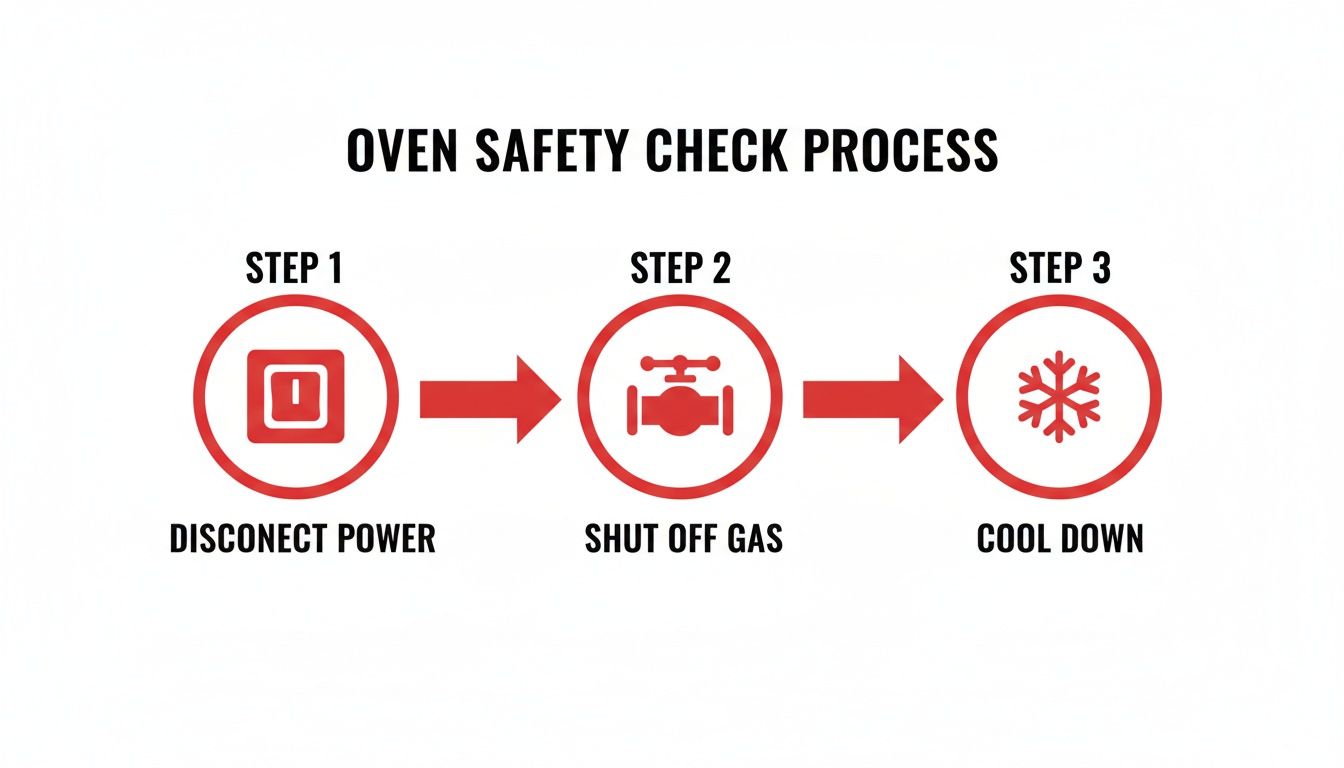
Seriously, follow this three-step process—unplugging it, shutting off the gas, and letting it cool down completely. It’s the only way to create a safe environment for you to start poking around.
Inspecting Your Electric Oven Elements
If you have an electric oven, the heating elements are the first place to look. More often than not, a burnout here is the cause of your trouble. Open the oven door and give both the top and bottom elements a good, hard look.
- Look for Visible Damage: Get a flashlight and examine the bake element (at the bottom) and the broil element (at the top). You’re looking for any blisters, bubbles, cracks, or sections that are completely broken apart. Any of these are a dead giveaway.
- Check for an Unhealthy Glow: If nothing looks physically wrong, you can (very carefully!) reconnect the power. Turn the oven on to bake for just a minute or two and watch the bottom element. It should glow a consistent, bright cherry red across its entire length. If you see dark spots or areas that don't light up at all, you've found your culprit.
A damaged element needs to be replaced. If you're comfortable with a bit of DIY, this is often a straightforward job that can get your oven back in business fast.
Expert Insight: Don't be fooled if an element looks perfect. They can burn out internally without showing any physical signs of damage. If it looks fine but doesn't glow red when you turn the oven on, it has failed and needs replacing.
Checking Your Gas Oven Igniter
For gas ovens, the igniter is the usual suspect. In our experience, a weak or failed igniter is the number one reason a gas oven won’t heat up.
To check it, start your oven and watch the igniter—it’s a small, often rectangular component located near the gas burner tube. Within about 30 to 90 seconds, you should see it start glowing a bright, vibrant orange-yellow. If it stays dark, or only manages a dull, faint red glow, it's not getting hot enough to signal the gas valve to open.
That’s a classic sign of a bad igniter. While replacing it isn't the most complex repair, any work on a gas appliance carries risks. We always recommend leaving this one to a certified professional to ensure it’s done safely and correctly.
Simple Oversights That Stop the Heat
Before you start ordering parts, let’s make sure it’s not something simple. We've seen these surprisingly common little things cause a lot of unnecessary headaches.
- "Demo Mode" or "Sabbath Mode": Most modern ovens have special modes that shut off the heating functions entirely. These are used in showrooms or for religious observances. A quick button press by accident can activate them. Check your oven's display and user manual to make sure you're not in one of these modes.
- Loose Temperature Probe: See that thin metal rod inside your oven, usually near the top back? That's the temperature sensor. It can easily get knocked loose when you're cleaning. If it's not securely mounted or is touching the oven wall, it can't read the temperature correctly and will prevent the oven from heating properly. Just make sure it’s snug in its clip.
If your troubleshooting steps didn't solve the mystery, it’s a good sign that a specific component inside the oven has failed. Knowing what these parts are does more than just demystify the repair process—it helps you have a much clearer conversation with a technician about your oven not heating repair in Edmonton.
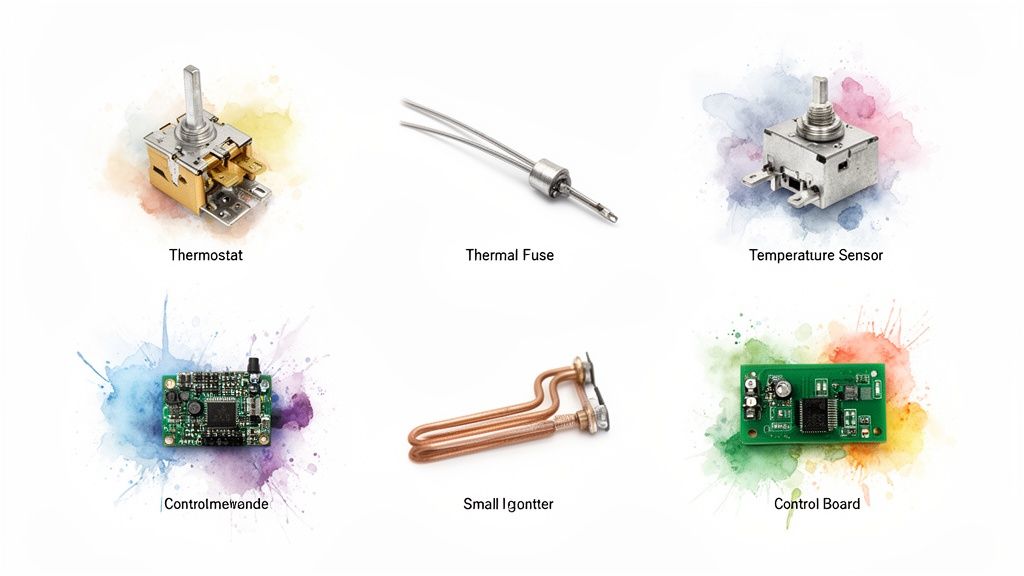
These internal parts have to work together perfectly to regulate heat. When one fails, the whole system can grind to a halt. Let's take a look at the usual suspects.
The Thermal Fuse
You can think of the thermal fuse as your oven's emergency brake. It’s a small but critical safety device designed to blow and cut all power if the internal temperature gets dangerously high, helping to prevent a potential fire.
A blown thermal fuse is a one-and-done deal; once it trips, it has to be replaced for the oven to power on again. While the fuse itself is an inexpensive part, its failure often points to a deeper issue, like a faulty thermostat or a blocked vent that caused the overheating in the first place.
The Thermostat And Temperature Sensor
The thermostat and temperature sensor are the dynamic duo of heat regulation. The temperature sensor is a small probe that constantly reads the actual temperature inside the oven cavity. The thermostat then uses those readings to control the power going to the heating elements.
When either of these parts starts to fail, you'll see erratic temperature swings. Your oven might get way too hot, never reach the temperature you set, or bake everything unevenly. Based on repair data here in Edmonton, a surprising 37% of oven heating failures stem from thermostat malfunctions.
A faulty temperature sensor can trick the oven into thinking it's much hotter or colder than it really is. If you want to get into the details, our guide on how an oven sensor works explains its critical role.
The Main Control Board
The main control board (sometimes called an electronic control board or ERC) is the oven's brain. It takes your commands from the keypad, interprets data from the temperature sensor, and sends power to the right components at the right time.
A failing control board can cause all sorts of confusing symptoms, from a dead display screen to the oven simply refusing to heat. Because it's a complex and often expensive part, it's usually the last thing a technician diagnoses after ruling out simpler, more common failures.
Oven Part Failure Breakdown: Cost And Complexity
To give you a clearer picture, here’s a quick breakdown of these common failures and what you might expect for a repair here in Edmonton.
| Component | Common Symptom | Average Repair Cost (Edmonton) | DIY Difficulty |
|---|---|---|---|
| Thermal Fuse | Oven is completely dead; no lights or power. | $150 – $250 | Low |
| Thermostat | Oven overheats or won't reach temperature. | $200 – $350 | Medium |
| Temperature Sensor | Inaccurate temperatures; error codes on display. | $175 – $275 | Low to Medium |
| Main Control Board | Unresponsive controls, display issues, no heat. | $400 – $700+ | High (Not Recommended) |
This table highlights why getting the right diagnosis from the start is so important. Swapping out a simple sensor is a world away from a costly control board replacement.
When To Call A Professional For Oven Repair In Edmonton
While it's great to troubleshoot some oven issues yourself, the most important skill is knowing your limits. Certain red flags mean it's time to put down the tools and pick up the phone. Trying to tackle a complex repair without the right training can easily turn a simple fix into a much more expensive problem—or worse, a serious safety hazard.
Knowing what to look for is the key to getting your oven repaired safely and correctly. If you run into any of the following situations, take it as a clear signal that you need a professional for your oven not heating repair in Edmonton.
Absolute No-Go Scenarios
Some symptoms are non-negotiable and demand immediate expert attention. These are definitely not the time for guesswork or a YouTube tutorial.
- You Smell Gas: This is the big one. If you have a gas oven and catch that distinct smell of sulphur or rotten eggs, stop everything. Don't touch any light switches or electrical outlets. Shut off the gas supply immediately, open your windows, and get everyone outside. Once you're in a safe location, call your gas company and a certified technician.
- Visible Sparks or Arcing: Seeing sparks inside your oven is a major warning sign, especially from the wiring or control panel. This points to a serious electrical fault and is a significant fire risk. A licensed technician is needed to handle this safely.
- Complex Error Codes: Sure, some basic error codes can be cleared with a simple reset. But if you're seeing persistent or obscure codes on your oven's display, it often means the electronic control board is failing. These diagnostics require specialized tools and knowledge to interpret them correctly.
Professional Guarantee: A certified technician doesn’t just bring their expertise; they bring accountability. Their work is backed by a warranty on both parts and labour, giving you peace of mind that the job was done right the first time.
The Value Of An Expert Diagnosis
Beyond the major safety issues, calling a professional brings an efficiency and accuracy that can save you a lot of time and money. An experienced technician can pinpoint the exact cause of the problem quickly, which means you avoid the frustrating and costly trial-and-error of buying and replacing the wrong parts.
Here in Edmonton, the appliance repair industry has seen a 12% year-over-year increase in oven service calls, and heating failures make up a whopping 32% of those calls. It just goes to show how common—and disruptive—these problems are for homeowners.
When you call a professional, you're also ensuring that the repair uses high-quality, manufacturer-approved parts and is completed according to all safety standards. If you're curious about how modern repair shops handle scheduling and customer calls so efficiently, learning how an appliance repair answering service works can offer some interesting insights.
For expert help with any of your home appliances, you can check out our full range of kitchen appliance repair services in Edmonton.
Your Top Edmonton Oven Repair Questions Answered
When your oven suddenly gives up, it's natural for a bunch of questions to pop into your head. Homeowners all over Edmonton tend to ask us the same things about repair costs, timelines, and whether it even makes sense to fix an older appliance. We’ve pulled together the most common questions we get to give you clear, straightforward answers.
Our goal is to cut through the confusion and help you make a solid decision for your home.
How Much Will an Oven Heating Element Repair Cost in Edmonton?
For a typical oven heating element repair in Edmonton, you can expect the cost to land somewhere between $150 and $300. This range covers both the new part and the professional installation. The final price can shift a bit depending on your oven's brand and model, as some elements are trickier to get to than others.
At Repair My Appliance, we're all about transparent pricing. You'll always get a clear, upfront quote before we touch a single tool, so you know exactly what to expect. Plus, we waive the service call fee with every completed repair—you only pay for the fix, not the visit.
Is It Worth Fixing an Oven That’s Over 10 Years Old?
More often than not, yes. A great rule of thumb is this: if the repair costs less than half the price of a new, comparable oven, it’s a smart move. A simple fix on a well-built older model can easily tack on several more years to its life, saving you from the much bigger expense of a replacement.
Our technicians don't just fix things; they give you the full picture. We’ll provide an honest assessment of your oven's condition, lay out the pros and cons, and help you decide whether to repair or replace. No pressure, just good advice.
How Quickly Can You Fix My Oven in Edmonton?
We get it—a broken oven throws a major wrench in your daily life. That's why we're committed to providing same-day or next-day service across Edmonton and the surrounding communities.
Our service vans are like warehouses on wheels, stocked with the most common parts for all major oven brands. This preparation means we complete over 85% of repairs on the very first visit. We aim to get your kitchen back up and running in no time.
Expert Takeaway: An experienced technician can usually pinpoint an oven heating issue in less than 15 minutes. With the right parts already in the van, the entire job—from diagnosis to testing the new component—is often wrapped up in under an hour.
Can I Just Use the Broil Element if the Bake Element Is Broken?
It might seem like a clever workaround in a pinch, but we strongly advise against it for regular cooking. The broil element is designed for one thing: blasting intense, direct heat from the top. That's fantastic for searing a steak, but it’s a disaster for baking a cake or roasting vegetables.
If you try it, you'll almost certainly end up with food that's burnt to a crisp on top while staying completely raw or undercooked inside. This is a classic sign that your bake element or its controls have failed. To get back to even, reliable cooking and avoid causing more damage, you'll want to have a professional fix the root problem.
Ready to Get Your Oven Fixed Today?
Don't let a broken oven throw a wrench in your dinner plans. When you need a fast and reliable fix for an oven not heating in Edmonton, our team of certified technicians is ready to help. We’ll diagnose the problem, get it sorted out, and make sure your appliance is running safely and efficiently again. Plus, we stand behind our work with a solid warranty on all major brands.
We know how disruptive a broken appliance can be, especially when you have a household to feed. That's why we prioritize getting your kitchen back to normal as quickly as possible. We offer prompt scheduling, and for real emergencies, many homeowners can take advantage of our same-day appliance repair service to minimize the headache.
Our promise is simple: expert repairs with completely transparent, upfront pricing. We believe in honest service, which means the service call fee is always waived when you go ahead with the repair. You only pay for the solution, not just for the visit.
For reliable, expert appliance repair in Edmonton that you can count on, we're here to help you get back to cooking.
Need appliance repair? Visit RepairMyAppliance.ca or call 587-416-5888 for fast, professional service.