
A perfectly baked dish, a golden-brown roast, or a simple batch of cookies all depend on one critical factor: a precise and consistent oven temperature. When your oven fails to heat to the right temperature, it can turn culinary dreams into frustrating failures, leaving you with undercooked centres or burnt edges. It's one of the most common appliance issues homeowners face, but diagnosing the root cause can feel like guesswork.
Is it a simple calibration issue, or something more complex like a faulty heating element or a malfunctioning sensor? This guide is designed to eliminate that uncertainty. We will break down the top reasons why your oven isn’t heating to the right temperature, providing a clear roadmap to help you identify the problem and find a solution.
For each potential culprit, we detail the common symptoms, offer simple checks you can safely perform, and provide a realistic overview of the repair complexity. Understanding whether you're dealing with a worn-out door seal or a defective control board is the first step toward a solution. This comprehensive listicle provides the actionable insights you need to understand your appliance better and determine whether it’s a quick fix or time to call in a professional for same-day service.
1. Faulty Oven Thermostat
The oven thermostat is the brain of your oven's heating system. It acts as a temperature regulator, sensing the internal heat and telling the heating elements when to turn on and off to maintain the temperature you've set. When this critical component malfunctions, it loses its ability to accurately read the oven's temperature, leading to one of the most common reasons your oven isn’t heating to the right temperature. This can result in food being undercooked, burnt, or inconsistently cooked.
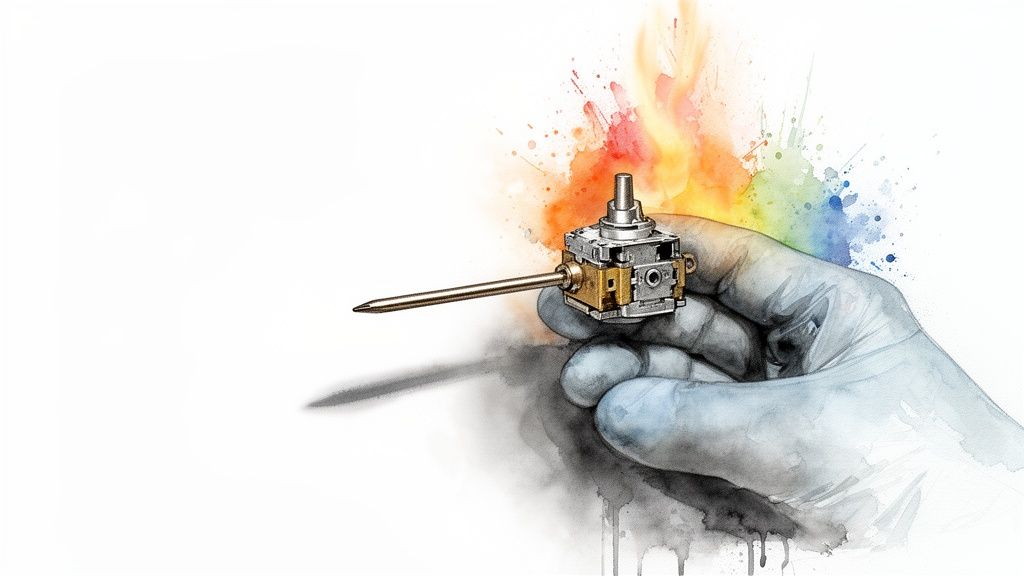
A failing thermostat can cause the oven to run too hot, not get hot enough, or fluctuate wildly during the cooking cycle. For example, you might set your oven to 350°F, but it either struggles to reach 300°F or overshoots to 400°F.
Symptoms and Simple Checks
- Obvious Temperature Mismatch: Your baked goods consistently come out burnt on the outside and raw on the inside, or they take much longer to cook than the recipe states.
- Inconsistent Heating: One dish cooks perfectly, while the next one at the same temperature setting is a disaster. This is a sign the thermostat isn't regulating the heat cycle properly.
- Heating Element Stays On/Off: The heating element either remains on continuously, causing the oven to overheat, or it doesn't turn on enough, preventing it from reaching the set temperature.
Pro Tip: Before calling for a repair, verify the issue with an independent oven thermometer. Place it in the centre of the oven, preheat to 350°F, and wait 20 minutes. If the thermometer reading is more than 25°F off from your set temperature, the thermostat is likely faulty.
Repair Complexity and When to Call a Professional
Replacing an oven thermostat is a moderately complex task. It involves disconnecting power, removing oven panels, and carefully handling sensitive electrical wiring. While some DIY enthusiasts may attempt it, an incorrect installation can damage the oven's control board or create a safety hazard.
A professional technician can typically diagnose and replace a faulty thermostat within an hour or two. Trusting a certified expert ensures the job is done safely and correctly, restoring your oven's reliability.
2. Defective Heating Element
In an electric oven, the heating elements are the workhorses responsible for generating heat. These components, typically seen as black coils at the top (broil) and bottom (bake) of the oven cavity, convert electrical current into radiant heat. When an element cracks, blisters, or breaks, its ability to produce heat is severely compromised or eliminated entirely. A defective heating element is often one of the more visually obvious reasons why your oven isn’t heating to the right temperature.
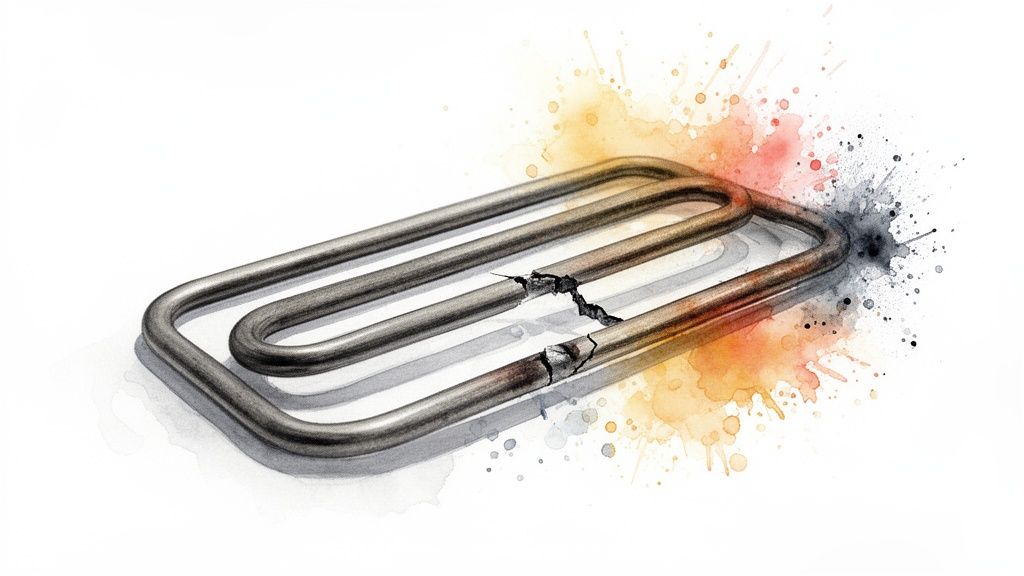
A broken bake element will prevent the oven from reaching temperature for baking, while a failed broil element will not glow red during the broiling cycle. Sometimes, the damage is a small crack that causes the element to heat unevenly, creating hot spots and leading to poorly cooked food.
Symptoms and Simple Checks
- Visible Damage: A simple visual inspection may reveal blisters, cracks, or a complete break in the element. In some cases, you might see a bright, fiery spot where the element has shorted out.
- Element Doesn't Glow Red: During a preheat cycle, a healthy heating element will glow a consistent, bright orange or red. If one of the elements remains black, it’s a clear sign of failure.
- Uneven Cooking: If the bottom of your food burns while the top is undercooked, the bake element is likely faulty. Conversely, if the broil function doesn't work at all, the top element is the culprit.
Pro Tip: To quickly diagnose the issue, test the bake and broil functions separately. If the oven heats on broil but not on bake, the bottom element is almost certainly the problem.
Repair Complexity and When to Call a Professional
Replacing a heating element is a task of low to moderate complexity, but it requires strict adherence to safety protocols. You must completely disconnect the oven from its power source at the circuit breaker before beginning. While many homeowners can perform this replacement, handling electrical components carries inherent risks. If a defective heating element is preventing your oven from reaching the correct temperature, you might need to look into options for replacement heaters.
A certified technician can ensure the correct part is installed safely and efficiently, often in under an hour. For guaranteed peace of mind, trust a professional from Repair My Appliance to restore your oven’s function correctly and safely.
3. Damaged or Stuck Igniter (Gas Ovens)
In a gas oven, the igniter is the essential component responsible for igniting the gas that flows into the burner. It functions as a glow-coil that must reach a specific high temperature to open the gas valve and ignite the fuel. When the igniter becomes weak, damaged, or stuck, it fails to perform this critical task, leading to a common reason why your oven isn't heating to the right temperature. This issue is specific to gas models and can result in no heat at all, intermittent heating, or an oven that takes an unusually long time to preheat.
Unlike electric ovens where heating elements are the primary concern, temperature problems in gas ovens often trace back to the ignition system. A failing igniter might glow but not get hot enough to trigger the gas valve, or it may be cracked and unable to function at all.
Symptoms and Simple Checks
- Extended Preheat Times: Your oven takes significantly longer than usual to reach the set temperature, sometimes 30 minutes or more.
- Oven Won't Heat at All: You set the temperature, hear a faint click, but the oven remains cold. The igniter is likely not getting hot enough to open the safety valve for gas flow.
- Intermittent Heating: The oven heats up initially but then fails to maintain the temperature. The igniter may be too weak to consistently re-ignite the burner during a cooking cycle.
- No Glow from Igniter: When you turn on the bake or broil function, you should be able to see a bright orange or yellow glow from the igniter. If there's no glow, the component has failed.
Pro Tip: Listen carefully when you first turn on your oven. You should hear a single "click" as the gas valve opens, followed by the "whoosh" of the gas igniting. If you hear repeated clicking sounds without ignition, it’s a strong signal that the igniter is failing.
Repair Complexity and When to Call a Professional
Replacing a gas oven igniter is a task that carries significant risk due to its connection to the gas line. While the part itself is often accessible, the process involves disconnecting the power, potentially shutting off the gas supply, and working with both electrical and gas components. An improper installation can lead to dangerous gas leaks or electrical shorts. For safety reasons, this repair is best left to certified professionals.
A technician from Repair My Appliance can safely diagnose the issue, source the correct igniter for your specific model, and install it correctly, often on the same day. Trusting an expert ensures your gas oven is repaired safely and effectively.
4. Temperature Sensor (RTD) Malfunction
Modern ovens rely on a sophisticated temperature sensor, often a Resistance Temperature Detector (RTD), to act as a digital thermometer. This component continuously measures the oven's internal temperature and communicates this data to the main control board. The board then uses this information to cycle the heating elements on or off. When the sensor malfunctions, it sends inaccurate readings, leading the control board to either underheat or overheat the oven. This is a common culprit behind why your oven isn’t heating to the right temperature.
Unlike older bimetallic thermostats, these electronic sensors offer superior precision but can fail without warning. A faulty sensor might tell the control board the oven is 350°F when it's only 275°F, causing the heating element to stay on too long and burn your food. Conversely, it might report a higher-than-actual temperature, causing the oven to shut off prematurely. To understand the specifics of an RTD malfunction, it's helpful to first grasp the various temperature sensor types used in appliances.
Symptoms and Simple Checks
- Error Codes on Display: Your oven’s digital display shows error codes like "F1," "F2," "F3," or other brand-specific fault indicators. This is often the first and most direct sign of a sensor-related issue.
- Drastic Temperature Swings: The oven temperature seems to fluctuate wildly, or it significantly overshoots or undershoots the target temperature without settling.
- Predictable Cooking Failures: Food consistently comes out undercooked or burnt, even when you follow recipes precisely and preheat properly.
Pro Tip: Document any error codes you see on the display and note the temperature discrepancies you observe with an oven thermometer. This information is invaluable for our technicians, allowing for a quicker diagnosis. For instance, if you set the oven to 400°F but it never gets past 325°F or climbs to 475°F, the sensor is the most likely suspect.
Repair Complexity and When to Call a Professional
Replacing a temperature sensor is a task of low-to-moderate complexity. While physically accessing and unscrewing the sensor is often straightforward, it requires disconnecting the oven from its power source and carefully handling delicate wire connectors. Incorrectly installing the new sensor or damaging the wiring can lead to further issues with the main control board, a much more expensive repair.
A certified technician can safely diagnose a sensor failure, source the correct OEM part, and complete the replacement in under an hour. Trusting an expert from Repair My Appliance ensures your oven is repaired safely and accurately, restoring its cooking precision.
5. Malfunctioning Control Board or Relay
The oven's control board is the central command unit for all of your oven's functions. It interprets your commands from the keypad, processes information from sensors, and sends power to the appropriate components like heating elements. When this electronic "brain" begins to fail, it can no longer regulate temperature accurately, leading to some of the most complex and frustrating heating problems. This issue is a significant reason why your oven isn’t heating to the right temperature, particularly in modern, digitally controlled appliances.
A malfunctioning control board can cause erratic behaviour, such as the oven failing to heat at all, overheating dangerously, or displaying incorrect temperatures. The oven might not respond to commands or won't power the heating elements, leaving it cold despite the display showing it's preheating.
Symptoms and Simple Checks
- No Heat and Error Codes: The oven fails to heat entirely, and an error code is displayed on the screen.
- Intermittent or Erratic Operation: The oven heats correctly one day but not the next, or the temperature swings wildly during a single cooking cycle.
- Unresponsive Controls: The digital display or buttons work sporadically or not at all, preventing you from setting a temperature or function.
- Multiple Failures: If you notice issues across different functions (e.g., bake, broil, and convection all failing), it points towards the central board rather than a single component.
Pro Tip: Before concluding it's the control board, perform a "hard reset." Unplug the oven from the wall or turn it off at the circuit breaker for at least five minutes. This can sometimes clear temporary electronic glitches. If the problem persists after restoring power, the board is more likely the culprit.
Repair Complexity and When to Call a Professional
Replacing an oven's main control board is a highly complex repair that should be left to a professional. It involves intricate wiring, delicate electronic components, and the risk of causing further damage to the appliance or creating a fire hazard if installed incorrectly.
A professional technician can accurately diagnose if the board itself or a connected relay has failed. Given the high cost of control boards, a precise diagnosis from a certified expert is essential to avoid replacing a perfectly good part. Trusting us ensures your oven is repaired correctly and safely, restoring its full functionality.
6. Gas Supply Line Issues or Valve Malfunction
For gas ovens, a consistent and properly regulated fuel supply is non-negotiable for achieving and maintaining the correct temperature. Issues originating in the gas supply line or with the oven’s internal valves can starve the burner of the fuel it needs, leading to another common reason why your oven isn’t heating to the right temperature. This problem is exclusive to gas models.
A blocked or constricted gas line, incorrect pressure, or a malfunctioning safety valve can prevent the oven from igniting reliably or sustaining a strong enough flame to generate adequate heat.
Symptoms and Simple Checks
- Weak or Intermittent Flame: The oven burner flame appears low, yellow, or flickers inconsistently instead of presenting a steady, strong blue flame.
- Slow Preheating or Failure to Reach Temperature: Your oven takes an exceptionally long time to preheat or never reaches the set temperature, hovering at a much lower level.
- Gas Odour or Hissing Sounds: The smell of gas or a hissing sound near the oven is a critical safety warning indicating a potential leak.
Pro Tip: A simple diagnostic test is to observe your gas stovetop burners. If they light quickly and burn with a strong, consistent blue flame while the oven struggles, the problem is likely isolated to the oven's specific gas valve or burner, not the main supply line to your home. Never attempt to adjust gas pressure or disassemble gas valves yourself.
Repair Complexity and When to Call a Professional
Diagnosing and repairing gas supply issues is a high-complexity task that should only be handled by a licensed and certified gas technician. Working with gas lines carries significant risks, including gas leaks, fire, and potential explosions. An incorrect repair can have catastrophic consequences. Attempting a DIY fix is extremely dangerous and not recommended under any circumstances.
A professional from Repair My Appliance has the specialized tools to test gas pressure, identify blockages, and safely replace faulty oven safety valves or regulators. Trusting our certified experts ensures the repair is done safely, restoring your oven's performance and giving you peace of mind.
7. Oven Insulation Degradation or Air Leaks
Often overlooked, the insulation and door seal are your oven's first line of defence against heat loss. This system is designed to trap hot air inside the oven cavity, ensuring stable and efficient cooking. When the insulation degrades or the door gasket fails, heated air escapes, forcing the oven to work much harder to maintain its set temperature. This is a common but frequently missed reason why your oven isn’t heating to the right temperature, particularly in older appliances.

A compromised seal means your oven constantly battles to reach and hold a specific temperature, leading to longer preheating times, uneven cooking results, and higher energy bills.
Symptoms and Simple Checks
- Excessive Heat on the Exterior: The area around the oven door or the control panel feels unusually hot to the touch during operation.
- Slow to Preheat: The oven takes significantly longer than it used to to reach the desired temperature.
- Visible Gasket Damage: The rubber or fibreglass seal around the oven door is frayed, brittle, cracked, or has noticeable gaps.
Pro Tip: Try the dollar bill test. Close the oven door on a dollar bill (or any piece of paper) in several different spots around the frame. If you can easily pull the bill out without any resistance, your door seal is failing and needs to be replaced. Regularly cleaning the gasket of grease buildup can also extend its life.
Repair Complexity and When to Call a Professional
Replacing an oven door gasket is a task that ranges from simple to moderately complex, depending on the oven model. While some gaskets simply press into a channel, others are secured with clips or adhesive and require careful removal of the door or panels. An improperly installed gasket will not seal correctly, failing to solve the heating problem.
A professional technician can quickly identify the source of the air leak, whether it's the gasket or compromised internal insulation, and install the correct part safely. Trusting the experts at Repair My Appliance ensures the repair is done right, restoring your oven's efficiency and cooking accuracy.
8. Power Supply Issues or Electrical Circuit Problems
Your electric oven is a high-demand appliance that requires a substantial and consistent flow of electricity to function correctly. Power supply issues, such as low voltage, a tripped circuit breaker, or faulty wiring, can prevent the heating elements from receiving the full power they need. This leads to weak or nonexistent heat, making it one of the most fundamental reasons your oven isn’t heating to the right temperature.
Unlike other component failures that might cause erratic temperatures, an electrical problem typically results in the oven not heating at all or heating very slowly and weakly. For example, some ovens use a dual-circuit design where one leg of the power provides 120V for the controls and the other provides 120V for a heating element. If one circuit fails, the oven might only heat to half its capacity.
Symptoms and Simple Checks
- Oven Heats Partially or Not at All: The oven light and controls may work, but the bake and broil elements produce very little or no heat.
- Circuit Breaker Repeatedly Trips: When you try to use the oven, the dedicated breaker in your electrical panel trips, cutting off power.
- Dimming Lights: The lights in your kitchen or home dim noticeably when the oven’s heating elements attempt to turn on.
- Newly Installed Oven Underperforms: An oven installed with an insufficient or improperly wired electrical service will consistently fail to reach the set temperature.
Pro Tip: Your first and easiest check is your home's circuit breaker panel. Find the breaker labelled "Oven" or "Range." If it's tripped (usually in the middle or off position), reset it by pushing it fully to the "Off" position and then back to "On." If it trips again immediately or during use, do not keep resetting it. This indicates a serious electrical fault that requires professional attention.
Repair Complexity and When to Call a Professional
Diagnosing and repairing electrical supply issues is a high-risk task that should be left to certified professionals. Working with 240-volt circuits is extremely dangerous and can lead to severe injury or fire if handled improperly. A technician will use a multimeter to safely test the voltage at the outlet and the oven's terminal block to confirm it's receiving the correct power.
Our experts at Repair My Appliance can quickly determine if the issue lies with the oven itself or your home's electrical system. If you suspect a power problem, call a professional immediately to ensure a safe and accurate diagnosis.
8-Point Comparison of Oven Heating Issues
| Item | Implementation Complexity 🔄 | Resource Requirements ⚡ | Expected Outcomes ⭐📊 | Ideal Use Cases 💡 | Key Advantages |
|---|---|---|---|---|---|
| Faulty Oven Thermostat | 🔄🔄 Moderate — component-level replacement | Thermostat part, basic tools, trained tech; widely available ⚡ | Restores set‑point accuracy; high success ⭐⭐⭐⭐ 📊 | Inconsistent or drifting temps across modes; 5–7+ year ovens 💡 | Isolated, cost-effective repair; usually same‑day |
| Defective Heating Element | 🔄 Low — accessible replacement | Replacement element, basic tools; low cost and common stock ⚡ | Rapid heat restoration; very reliable ⭐⭐⭐⭐⭐ 📊 | No bake/broil heat or visible element damage; electric ovens 💡 | Inexpensive, fast, high first‑visit success |
| Damaged/Stuck Igniter (Gas) | 🔄🔄 Moderate — requires gas safety procedures | Igniter part, licensed technician, gas testing equipment ⚡ | Restores ignition and consistent heating; good reliability ⭐⭐⭐⭐ 📊 | Gas ovens that fail to ignite or show delayed/yellow flames 💡 | Clear failure signs; relatively quick replacement |
| Temperature Sensor (RTD) Malfunction | 🔄🔄 Low–moderate — probe swap and calibration | RTD/thermistor, diagnostic meter, technician; common parts ⚡ | Improves precision and stability; high effectiveness ⭐⭐⭐⭐ 📊 | Digital error codes, intermittent fluctuations; modern ovens 💡 | Minimally invasive; definitive diagnostics |
| Malfunctioning Control Board or Relay | 🔄🔄🔄 High — complex diagnostics & possible reprogramming | OEM board, advanced tools, skilled technician; higher cost ⚡ | Fixes multiple systemic faults; high impact if correctly diagnosed ⭐⭐⭐⭐ 📊 | Multiple functions failing or intermittent system‑wide issues 💡 | Comprehensive solution for varied symptoms; addresses root cause |
| Gas Supply Line / Valve Issues | 🔄🔄🔄 High — involves infrastructure & strict safety | Licensed gas fitter, pressure gauges, possible line or valve parts ⚡ | Restores proper gas flow; critical safety and performance impact ⭐⭐⭐⭐ 📊 | Weak oven heat with normal burners, hissing or gas smell 💡 | Definitive, safety‑focused repair of supply problems |
| Oven Insulation Degradation / Air Leaks | 🔄🔄 Medium — gasket replacement or cavity work | Gasket/insulation parts, moderate labor; sometimes OEM authorization ⚡ | Improves temperature hold and efficiency; measurable savings ⭐⭐⭐ 📊 | Slow preheat, energy waste, older or frequently opened ovens 💡 | Energy savings, noticeable consistency improvement |
| Power Supply / Electrical Circuit Problems | 🔄🔄🔄 High — requires electrical diagnostics & possible panel work | Multimeter, licensed electrician, possible service upgrade ⚡ | Restores full power delivery; essential for element performance ⭐⭐⭐⭐ 📊 | Underpowered ovens, tripped breakers, dual‑circuit loss 💡 | Addresses root electrical cause; prevents recurrence |
Restore Your Oven's Precision with Professional Help
Navigating the complexities of an oven that isn't heating to the right temperature can be a frustrating journey. We've explored the most common culprits, from a faulty thermostat to a defective heating element. Understanding these potential problems is the first crucial step toward reclaiming control over your cooking and baking.
You've learned to recognise symptoms like uneven cooking, slow preheating, or visible damage to components. We've also outlined simple home checks you can perform safely, such as using an oven thermometer to verify the temperature or performing the "dollar bill test" on your oven's door seal. These diagnostic steps empower you to understand what might be happening inside your appliance.
From Diagnosis to Dependable Repair
While identifying the issue is a significant accomplishment, the transition from diagnosis to repair is where expertise becomes paramount. Many of the top reasons why your oven isn’t heating to the right temperature involve intricate electrical components or, in the case of gas models, potentially hazardous gas lines. An incorrect repair can not only fail to solve the problem but could also create new safety risks or lead to more expensive damage.
This is where professional intervention is not just a convenience but a necessity for ensuring the longevity and safety of your appliance. Choosing a professional ensures the job is done correctly, using the right parts, and backed by a guarantee of quality workmanship.
Key Takeaway: A precise diagnosis is the foundation of an effective repair. While homeowners can often identify symptoms, a certified technician has the diagnostic equipment and experience to pinpoint the exact cause, saving you time, money, and the frustration of trial-and-error fixes.
Ultimately, a well-functioning oven is central to a well-functioning home. By taking decisive action, you are not just fixing an appliance; you are restoring a vital part of your daily routine. Don't let a malfunctioning oven dictate your meal plans any longer.
Need appliance repair? Visit Repair My Appliance or call 587-416-5888 for fast, professional service.