

When your Whirlpool washer starts flashing a code, it’s not just being difficult—it’s trying to tell you exactly what’s wrong. These Whirlpool washer error codes are your first clue for diagnosing the problem, translating the machine’s internal language into categories like water supply, drainage, load balance, or electronic faults. Understanding what they mean helps you find a solution that much faster.
Quickly Identifying Your Whirlpool Error Code
That flashing code on your washer's display can feel frustrating, but it’s actually a pretty handy diagnostic tool. Instead of just guessing what's wrong, the code points you toward a specific group of potential issues. The very first step is to understand the general meaning behind the code's prefix, which will get you on the right track immediately.
Figuring this out first helps you avoid wasting time on the wrong fixes. For instance, if you see an "OL" code, you know it's related to the laundry load itself, so you won't be checking water hoses or drain pipes. This simple approach lets you narrow down the possibilities and jump straight to the relevant troubleshooting steps.
Common Code Categories
Most Whirlpool error codes fall into a few main categories, giving you an instant idea of where the trouble lies.
- Water-Related Codes (LF, F8E1, F9E1): These codes almost always point to a problem with either water getting into the machine (like a "Long Fill" error) or not draining out of it properly.
- Load-Related Codes (OL, uL): When you see these, the washer is telling you it's detected an overload or an unbalanced load. This is a common cause of excessive vibration and can damage your machine if ignored.
- Mechanical or Electrical Codes (F#E#): This is a broader category that can signal anything from a faulty door lock and motor issues to a problem with the main electronic control board.
This simple breakdown can help you visualize the first step in diagnosing your washer's problem based on the code it's showing you.
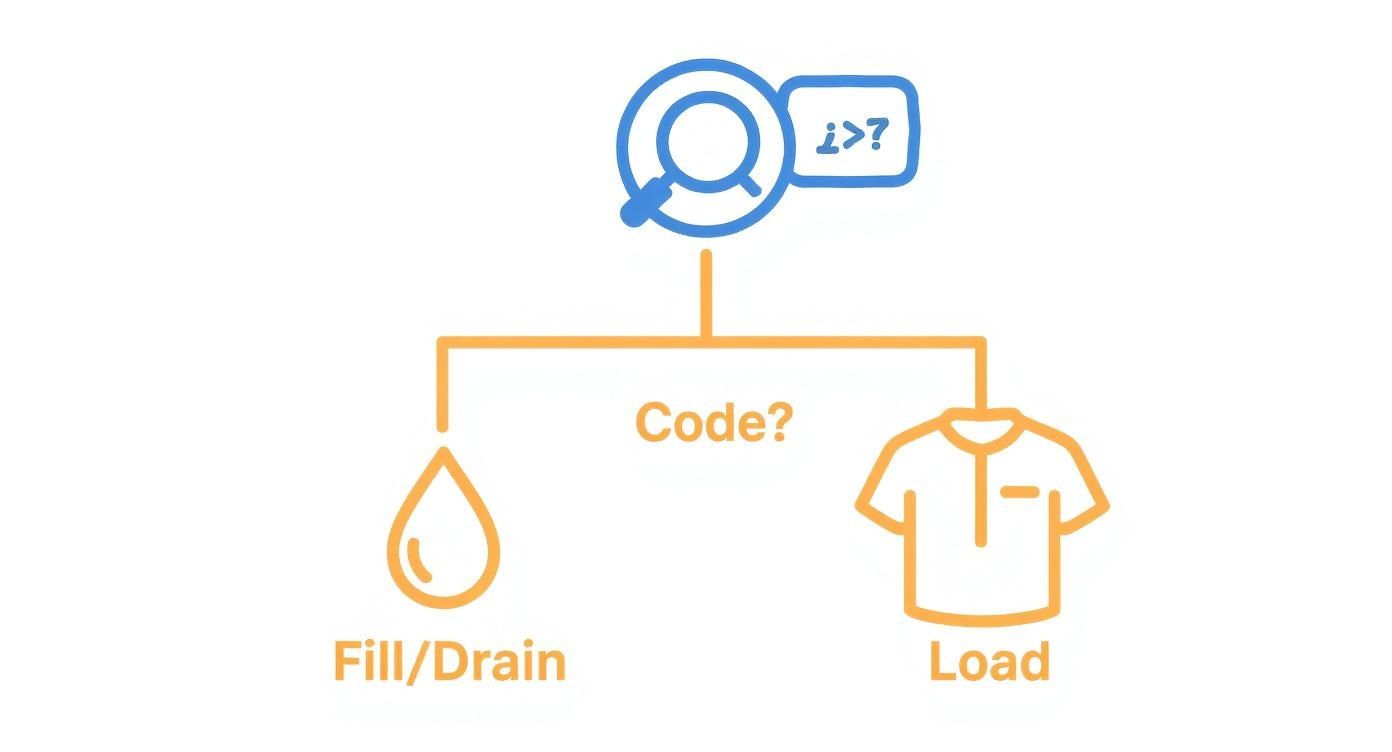
As you can see, most common errors fall into two main paths: problems with water flow or issues with the laundry load itself. Identifying which path your code belongs to is the fastest way to start troubleshooting common washing machine problems. By categorizing the error first, you can move forward with confidence and find the specific, detailed solutions waiting for you in this guide.
Solving Water Supply and Drainage Error Codes
Water-related issues are, hands down, one of the most common headaches for washer owners. When your Whirlpool machine flashes a code like LF (Long Fill) or F9E1 (Drain Problem), it’s signaling a problem with the most basic parts of its job: filling up and emptying out. Getting to the bottom of these codes is the first step to getting your laundry day back on track.
These errors pop up when the machine is either taking way too long to fill with water or failing to drain it all out within its expected timeframe, which is typically about eight minutes. You'll know something's up when the cycle stalls, you find a puddle of water left in the drum, or the machine just stops and beeps at you. The good news? A lot of the causes are simple fixes you can handle yourself.
Diagnosing The LF or F8E1 Long Fill Error
The LF (sometimes displayed as F8E1) code means your washer has timed out waiting for water. It’s a built-in safety measure to stop the machine from trying to run a cycle without enough water.
Before you start pulling anything apart, the first thing you need to do is prioritize safety.
Safety First: Always unplug your washing machine from the wall outlet before you move it or start inspecting hoses. Water and electricity are a dangerous mix, and this simple step eliminates the risk of electric shock.
Once it’s safely unplugged, you can start troubleshooting. Go through these steps in order:
- Check the Water Supply: It sounds almost too simple, but make sure the hot and cold water taps connected to your washer are turned on all the way. You'd be surprised how often this is the culprit.
- Inspect Inlet Hoses for Kinks: Gently pull the washer away from the wall to get a good look at the fill hoses. If they're bent, twisted, or squashed, water can't flow through properly. Straighten them out.
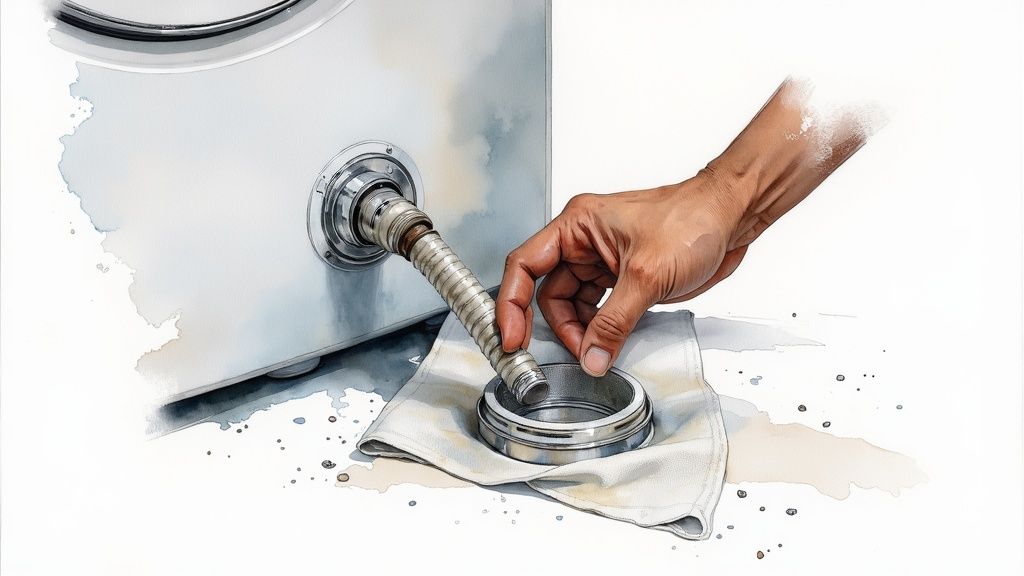
- Clean the Inlet Screens: Each inlet hose has a small filter screen where it connects to the back of the washer. Over time, these screens get clogged with sediment and mineral buildup, especially if you have hard water. Unscrew the hoses, use a pair of pliers to gently pull the screens out, and give them a good scrub with a small brush under running water. Pop them back in, and you're good to go.
Troubleshooting The F9E1 or F03 Drain Error
The F9E1 (or F03) error flags the opposite problem—your washer isn't draining the water out like it should. In fact, our repair data shows that F03 errors account for 18-22% of all Whirlpool washer service calls in our area, so it’s a very frequent issue.
A blockage somewhere in the drain path is almost always the cause. Here’s how you can track it down:
- Examine the Drain Hose: Just like with the fill hoses, check to see if the drain hose is kinked or clogged. Make sure it's positioned correctly in your standpipe or laundry sink, with no sharp bends restricting flow.
- Check the Drain Pump Filter: Most front-load models have a small access door on the bottom-front corner of the machine. Behind it, you'll find a filter designed to catch things like lint, coins, and buttons before they can wreck the drain pump. Grab a shallow pan and a towel, place them under the filter, and then unscrew it. Be ready for some water to come out! Clean out any gunk you find.
- Ensure Proper Standpipe Height: The drainpipe in your wall, known as the standpipe, needs to be at the right height—usually between 99 cm (39") and 244 cm (96"). If it's too low, water can siphon out on its own. If it’s too high, the pump might not be strong enough to push the water all the way up and out.
If you’ve tried all these steps and the error code won't go away, the problem might be a bit more serious. It could be a faulty water inlet valve or a failing drain pump. For a deeper dive, take a look at our guide on what to do when your washing machine won’t drain or spin. When a code just won't clear after these checks, it usually means a part has failed and it's time to call in a pro.
Fixing Load Imbalance and Overload Codes
There's nothing quite like the loud thump-thump-thump of a washing machine coming to a dead stop mid-cycle. If this sounds familiar, you've likely encountered two of the most common Whirlpool washer error codes: OL (Overload) and uL (Unbalanced Load). These codes are notorious for popping up when you’re washing bulky items like bedding, a big load of towels, or heavy winter coats.
Think of these codes as your washer’s self-preservation system. A heavy, lopsided load spinning at high speeds can create violent vibrations, putting serious strain on the drum, suspension, and bearings. The OL and uL codes are your machine’s way of hitting the brakes before any real damage can occur.
What Causes OL and uL Errors
So what's the difference? The OL code means the machine detected too much weight before the cycle even began, or the motor is struggling to turn the heavy, waterlogged laundry. On the other hand, the uL code usually shows up during the spin cycle when the load has shifted and become dangerously off-balance.
These errors are especially common here in Canada during the winter. Repair data from local service centres shows that OL and uL codes make up about 31% of all Whirlpool washer errors between November and March. That number drops to just 19% in the summer—a clear sign of the impact our heavy winter gear has on our machines.
How to Fix Unbalanced and Overloaded Loads
Thankfully, fixing these codes is usually a quick, tool-free job. It all comes down to helping your washer find its balance.
- Pause and Redistribute: The second you see a uL code, hit the Pause or Cancel button. Open the door and manually untangle the laundry, spreading items evenly around the drum. If you have a top-loader, arrange the clothes around the agitator or wash plate.
- Adjust the Load Size: Getting an OL code? You've probably just tried to stuff a bit too much in. Open the door and remove a few heavy items. Washers work best when they're about three-quarters full, which gives the clothes room to tumble properly.
- Mix Item Sizes: Try to avoid washing one massive item on its own, like a single duvet or a heavy bathmat. Tossing in a few smaller items, like hand towels or t-shirts, will help balance the load as it spins.
- Restart the Cycle: Once you've adjusted everything, close the door and press Start. The machine should be able to pick up where it left off.
Pro Tip: When you’re washing waterproof or water-resistant items like rain jackets or mattress protectors, always use a lower spin speed. These materials can trap water, creating a super-heavy, lopsided spot that’s practically guaranteed to trigger a uL error.
Troubleshooting Persistent uL Errors
If you’ve tried all the tricks above and you’re still getting a uL error with every other load, the problem might be with the machine itself.
- Check if the Washer is Level: Grab a spirit level and place it on top of your washer. Check it front-to-back and side-to-side. If it’s not perfectly level, adjust the feet at the bottom until the machine is stable and doesn't rock. An unlevel washer makes any minor imbalance much worse.
- Inspect Suspension Rods or Shocks: Modern washers rely on suspension rods (in top-loaders) or shock absorbers (in front-loaders) to handle vibrations. If one of these parts is worn out or broken, the drum will wobble uncontrollably and trip the uL sensor. You can read more about these differences in our guide to top-load vs. front-load washer efficiency. Replacing these is a job often best left to a professional technician.
Cracking the Lid and Door Lock Error Codes
Nothing stops a wash cycle faster than a door that won’t lock. When your washer refuses to start or just stops dead in its tracks, the culprit is often the lid or door lock mechanism. These aren't just simple latches; they're essential safety features that prevent the machine from spinning at high speeds with the door open. Codes like dL (Door Lock Failure) or F5E2 (Door Will Not Lock) are your machine's way of telling you there's a problem right there.
Think of it this way: the washer's main computer (the control board) sends a signal to the lock assembly, telling it to engage. If it doesn't get the right signal back confirming the door is secure, it slams the brakes on the whole operation and throws up an error. The cause could be as simple as a forgotten sock in the way or something more technical, like a worn-out switch inside the lock itself.
How to Diagnose dL and F5E2 Errors
Before you jump to conclusions about a broken part, it's best to work through a few simple checks. We'll start with the easiest, most common fixes and move toward the more technical stuff. This way, you can hopefully find the problem without taking the whole machine apart.
Important Safety Note: Always unplug your washing machine from the wall before you start poking around. The door lock assembly has live electrical components, and you don’t want to risk an electric shock.
Follow these steps to get to the bottom of your Whirlpool washer’s lock errors:
- Check for Obstructions: This is the number one cause, and thankfully, the easiest to fix. Get a good look at the door or lid area, especially around the rubber gasket (also called a bellow) and the lock itself. A small piece of clothing, a clump of lint, or even some built-up detergent gunk can physically block the latch from clicking into place.
- Inspect the Door Latch and Strike: With the door open, take a close look at the plastic latch piece on the door and the metal "strike" it goes into on the washer's frame. You're looking for any obvious cracks, breaks, or signs that it's been worn down. If either of these parts is damaged, the door simply can't align properly to lock, triggering the error.
Testing the Lid Lock Assembly
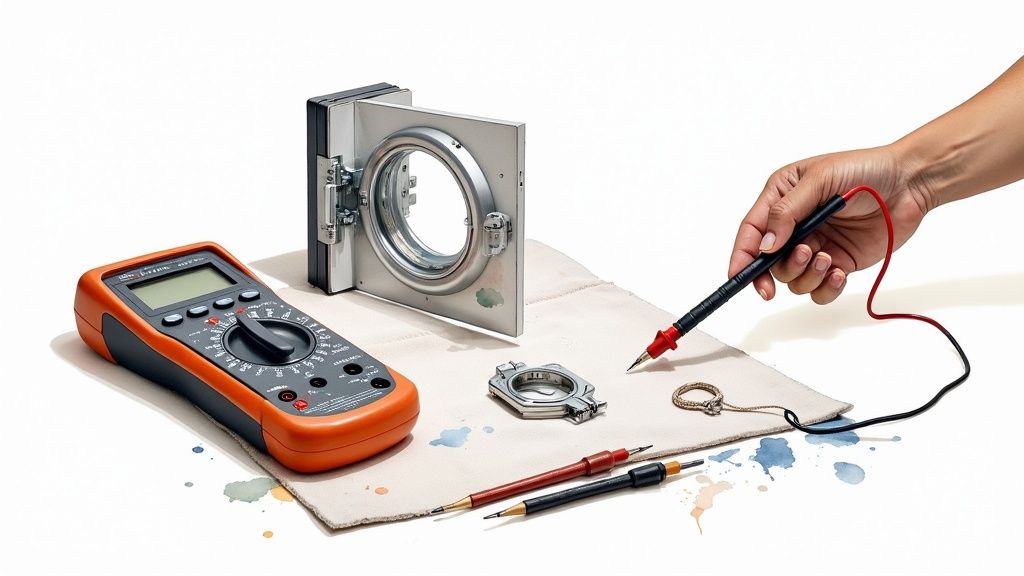
If a visual check doesn’t turn up anything, the problem might be electrical. The lock assembly contains a small switch that tells the control board when it's engaged. A quick continuity test with a multimeter will tell you if that switch is working.
You'll need a basic multimeter for this step.
- Access the Lock Assembly: Getting to the lock mechanism usually involves removing the top or front panel of the washer, depending on your model.
- Disconnect and Test: Once you can see the lock, unplug its wire connector. Set your multimeter to the continuity setting—it's the one that usually has a sound icon and beeps when the probes touch. Place one probe on each of the two terminals for the lid switch.
- Check for Continuity: When the door is open, the meter shouldn't make a sound or show a reading (it might display "OL" for "open line"). Now, manually push the switch or close the door latch with your finger. The meter should beep or show a reading close to zero. If it doesn't, the switch has failed, and the whole lock assembly needs to be replaced.
Swapping out a door lock assembly is a pretty straightforward job for a handy homeowner and usually takes about 30-45 minutes. But if you're not comfortable with wiring or taking your machine apart, it’s a quick and easy fix for a professional technician.
Troubleshooting Electronic Control and Sensor Errors
When your Whirlpool washer flashes an error code that has nothing to do with water or your laundry load, it's often pointing to the machine's brain: the electronic control board and its sensor network. Seeing a code like F1E1 (Main Control Error) or another "F# E#" combination can be unnerving. It definitely feels like a complex and expensive problem is brewing inside.
But hold on before you assume the worst. While these codes can mean a major component has failed, that’s not always the story. Modern washers are incredibly sensitive. A simple power surge, a temporary communication hiccup between the control board and a sensor, or a minor software glitch is often all it takes to trigger an error.
Before you start pricing out new parts, the very first and most effective step is usually the simplest one: a full system reset.
The Power of a Hard Reset
Think of a hard reset (or power cycling) like rebooting your computer when it freezes up. It completely wipes the machine’s short-term memory and forces it to re-run its internal diagnostics from a clean slate. This one action can solve countless minor electronic glitches without ever needing to pull out a toolbox.
You're essentially giving your washer a chance to forget the error and start over. It's the foundational first step you should always take for any electronic-related code before digging any deeper.
How to Perform a Hard Reset Safely
- Cancel the Cycle: Press the Stop or Cancel button to make sure the current cycle has ended.
- Unplug the Washer: Go right to the source and pull the washer's power cord directly from the wall outlet. Don't just flip a switch on a power bar—you need to cut all power to the unit.
- Wait Five Minutes: This is the most important part of the process, so don't rush it. You need to wait at least five full minutes. This gives the residual charge in the internal capacitors enough time to dissipate, which is what allows the control board’s memory to fully clear.
- Plug It Back In: Reconnect the power cord securely into the outlet.
- Start a New Cycle: Choose a short, simple cycle like "Rinse & Spin" and press Start. Now, watch to see if the error code comes back.
In a surprising number of cases, this is all it takes to clear the fault. If the code pops up again right away or during the next load, it’s a sign that the reset didn't fix it, and you're likely dealing with a more persistent hardware problem.
Differentiating Sensor and Control Board Issues
If a reset doesn't do the trick, the error code is probably pointing to a real failure in either a sensor or the main control board itself. A faulty sensor might be sending bad data, making the control board think there's a problem. On the other hand, a failing control board might be misreading perfectly good data from the sensors.
Distinguishing between the two without professional tools can be tricky, but your best tool is observation.
Is the error code always there, or does it show up randomly? Does it only appear during certain parts of a cycle? For example, an error that only happens during high-speed spins could point to an issue with a motor sensor. An error that shows up the second you power on the machine is more likely a control board failure.
While this guide is all about Whirlpool, you’ll find that similar diagnostic logic applies to other brands, as you can see in our breakdown of common LG washing machine error codes. Ultimately, if a hard reset fails and the error just won't go away, it’s a strong signal that a component needs a professional diagnosis and replacement.
When to Call a Professional for Repairs
While tackling a Whirlpool washer error code on your own can be rewarding, it's just as important to know when to put the tools down and call in a pro. Knowing your limits is the best way to keep a small hiccup from snowballing into a major, expensive repair—or worse, a safety risk. Forcing a repair you’re not equipped for can cause more damage to your machine or even lead to injury.
Sometimes, the washer itself will tell you it's time to get an expert involved. A recurring error code, for example, is a huge red flag that simple fixes like a reset or cleaning a filter haven't addressed the root cause. Ignoring these signs just kicks the problem down the road.
Signs It's Time for an Expert
Certain symptoms are clear giveaways that the problem is beyond a simple DIY fix. These signs often point to complex mechanical or electrical failures that demand specialized tools and the kind of know-how that only comes with experience.
It’s probably time to call a technician if you're seeing any of this:
- Persistent Error Codes: You've done the hard reset and followed all the troubleshooting steps for a specific code, but it just keeps popping back up. This usually means a component has failed and needs to be replaced.
- Burning Smells: Any strange smells, especially the acrid scent of burning plastic or rubber, point to a serious electrical or motor problem. Unplug your washer immediately and don't even think about using it until a professional has inspected it.
- Loud Grinding or Banging Noises: Sure, an unbalanced load can cause some thumping. But if you hear sharp, metallic grinding or violent banging, you could be looking at failed bearings, a broken motor part, or a damaged drum spider arm.
- Visible Water Leaks: If you've already checked that the hoses are tight and you still see water pooling underneath the machine, you might have a cracked tub or a bad internal seal. These are major jobs that require taking the whole machine apart.
- Major Disassembly Required: If your troubleshooting points to a part that requires dismantling the main drum, transmission, or the control board housing, it’s best to leave it to someone who does this every day.
Making the call for professional help isn't admitting defeat; it's the smartest move you can make. Our technicians at Repair My Appliance have the diagnostic tools and experience to pinpoint the exact cause of those stubborn Whirlpool washer error codes, ensuring a repair that's both safe and built to last.
DIY Fix vs. Professional Repair Checklist
Not sure if you should tackle it yourself or call us? This quick checklist can help you decide the best course of action for your Whirlpool washer problem.
| Symptom or Error Code | Recommended Action | Reasoning |
|---|---|---|
| Simple Error Code (e.g., F8E1) | DIY | Often a simple fix like checking water supply hoses or cleaning a filter. |
| Persistent/Recurring Code | Call a Technician | The underlying component has likely failed and requires professional diagnosis and replacement. |
| Unbalanced Load (uL) | DIY | Usually resolved by simply redistributing the clothes in the drum. No tools needed. |
| Loud Grinding/Screeching Noise | Call a Technician | Indicates a serious mechanical failure, such as bearings or motor issues, which are complex repairs. |
| Burning Smell or Smoke | Call a Technician (Immediately) | This is a serious safety hazard. Unplug the washer and do not use it. It points to a critical electrical fault. |
| Small Water Leak at Hose Connection | DIY | Often just requires tightening the hose connection or replacing a worn washer. |
| Large, Unexplained Puddle | Call a Technician | Suggests a cracked tub, failed pump, or internal seal leak, requiring significant disassembly. |
| Washer Won't Power On | DIY (Initial Check) | First, check the circuit breaker and power outlet. If those are fine, then it's time to call for help. |
| Repair Requires Major Disassembly | Call a Technician | Taking apart the drum, transmission, or main control unit is best left to experienced pros to avoid further damage. |
Ultimately, your comfort level is key. If a repair feels too complicated or risky, it probably is. Our team is always ready to help residents in Edmonton, Calgary, and Red Deer with fast, reliable Whirlpool washer repairs.
Frequently Asked Questions About Whirlpool Washer Errors
So, we've walked through the most common Whirlpool error codes, but you might still have a few questions about your specific situation. Let's tackle some of those lingering "what ifs" to give you a complete picture and help you make the right call for your machine.
Why Does My Washer Show a Code but Still Seem to Work?
Ever seen an error code flash for a second, then vanish while the washer carries on like nothing happened? That’s usually what we call an intermittent fault. It means a sensor picked up a temporary or borderline issue that resolved itself.
For example, a slightly lopsided load (uL) might have shifted and balanced itself out, or a brief drop in your home's water pressure could trigger a momentary LF (Long Fill) warning. While it’s great the machine recovered, don't just ignore it. If you see the same code popping up intermittently, it’s a clear sign that a part is on its way out and needs attention.
What Are the Risks of Ignoring a Whirlpool Error Code?
It’s always tempting to just clear a code and hope it goes away for good. But running a washer with a persistent error is a gamble that rarely pays off. Pushing the machine to work through a problem often leads to much bigger—and more expensive—damage down the line.
Think of it this way: an unaddressed draining issue (F9E1) can put a huge strain on the drain pump, eventually burning out the motor. Or, if you keep running loads with an imbalance error (uL), you could wreck the suspension rods or even the drum bearings. That turns a simple fix into a major mechanical overhaul. It's always safer and cheaper to get to the root of the problem right away.
How Much Do Common Whirlpool Washer Repairs Cost in Canada?
When a problem is beyond a simple DIY fix, it helps to know what to expect for professional repair costs. Prices can vary depending on where you are in Alberta and the exact part your machine needs, but here are some ballpark figures for common repairs.
- Drain Pump Replacement: If you're wrestling with a stubborn F9E1 code, a new drain pump usually costs between $250 and $400. This price typically includes both the new part and the labour to get it installed.
- Lid Lock Assembly Replacement: For errors like dL or F5E2, replacing the lid or door lock assembly will generally run between $220 and $350. This is a critical safety component, so having a pro install it ensures everything is working correctly and safely.
These estimates should give you a good starting point. Remember to always ask for an upfront quote before giving the green light for any repair work.
Get Expert Whirlpool Washer Repair in Alberta
If you’ve run through the DIY fixes and that pesky error code is still staring back at you, it’s probably time to bring in a professional. Our certified technicians have seen every Whirlpool washer error code imaginable and know how to get to the root of the problem for a fast, effective repair. We're proud to offer expert washer repair services to homeowners across Edmonton, Calgary, Red Deer, and the surrounding communities.
When you're dealing with a broken appliance, the last thing you want is a frustrating phone call. A good company's efficiency often starts with its customer service, which is why many in our industry rely on systems like an appliance repair answering service to handle calls smoothly.
Don't let a faulty washer throw a wrench in your routine any longer.
Need appliance repair? Visit RepairMyAppliance.ca or call 587-416-5888 for fast, professional service.