
Seeing your oven's temperature display suddenly drop can be alarming, but more often than not, it’s a sign of a smart appliance doing its job, not a broken one. If you’re worried about undercooked meals or a potential repair, you’ve come to the right place. We'll explain why this happens and help you tell the difference between normal operation and a real problem.
Think of it like the thermostat in your house—it doesn’t run the furnace non-stop. It cycles on and off to maintain a comfortable average temperature. Your convection oven works on the same principle, cycling its heating element and fan to keep the heat remarkably consistent.
Is It Normal for My Convection Oven Temperature to Fluctuate?
Yes, it's completely normal. The number you see on the digital display is a real-time snapshot of a dynamic heating process, not a fixed temperature set in stone.
Inside your oven, a heating element generates warmth while a powerful fan circulates that hot air for even cooking. This process is managed by a temperature sensor that constantly checks the heat levels. Once the oven hits your target temperature, the heating element often shuts off to prevent overheating. As the fan moves the air, the temperature naturally dips slightly, and that’s when you see the number on the display drop.
Once it falls below a certain point, the element kicks back on. This cycling is precisely what ensures your food cooks evenly without getting scorched.
What Science Says About Temperature Fluctuations
These temperature swings, or "oscillations," are an essential part of how modern ovens work. In fact, studies on convection technology show these fluctuations are critical for proper airflow and heat management.
One piece of food science research found that convection ovens can have temperature swings anywhere from 12.98% to 30.27% during a cooking cycle. In plain English, seeing the display drop by 15-30 degrees is perfectly normal behaviour.
This decision tree can help you quickly figure out if what you're seeing is a normal part of your oven's operation or a sign that something else might be going on.
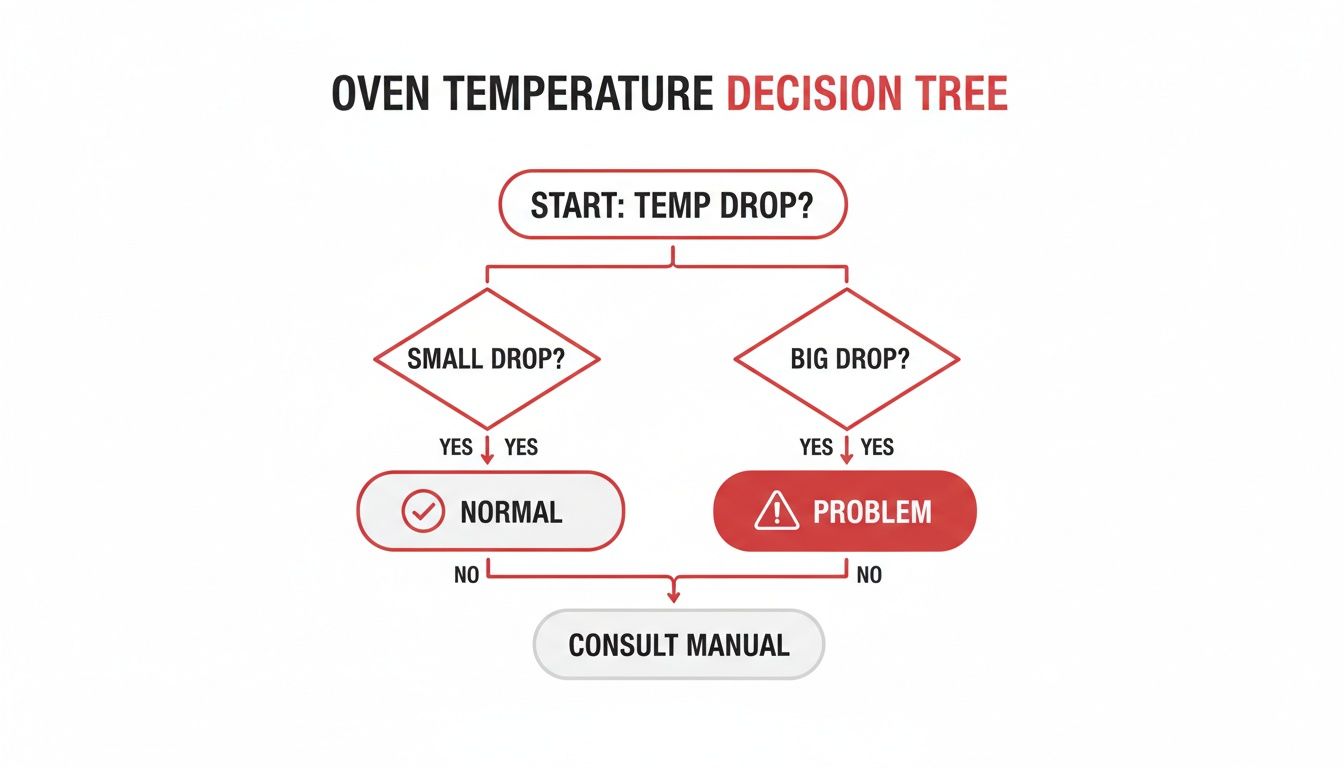
Sometimes, though, a temperature drop isn't just part of the normal cycle. The table below can help you tell the difference between a healthy oven and one that might need attention.
Normal Temperature Drop vs. Potential Problem
| Symptom | What It Usually Means | Action to Take |
|---|---|---|
| Temperature drops 15-30°F then recovers. | This is normal cycling. The oven is regulating its temperature to maintain an average. | No action needed. This is how it's designed to work! |
| Temperature drops significantly and doesn't recover. | Could be a faulty heating element, sensor, or control board issue. | Try resetting the oven. If it persists, it's time to call a technician. |
| The display shows an error code with the drop. | The oven's self-diagnostics have detected a specific fault. | Look up the error code in your owner's manual for guidance. |
| Temperature drops only when you open the door. | This is normal heat loss. A good oven will recover quickly once closed. | Keep the door closed as much as possible during cooking. |
| Food is consistently undercooked or burnt. | This suggests a calibration issue or a more serious problem with the thermostat. | Perform an oven thermometer test. If it's off, professional calibration may be needed. |
The main takeaway is that small, cyclical drops are expected. It’s the large, unpredictable drops or a failure to get back to temperature that often point to an underlying issue.
How Your Convection Oven Actually Heats Your Food
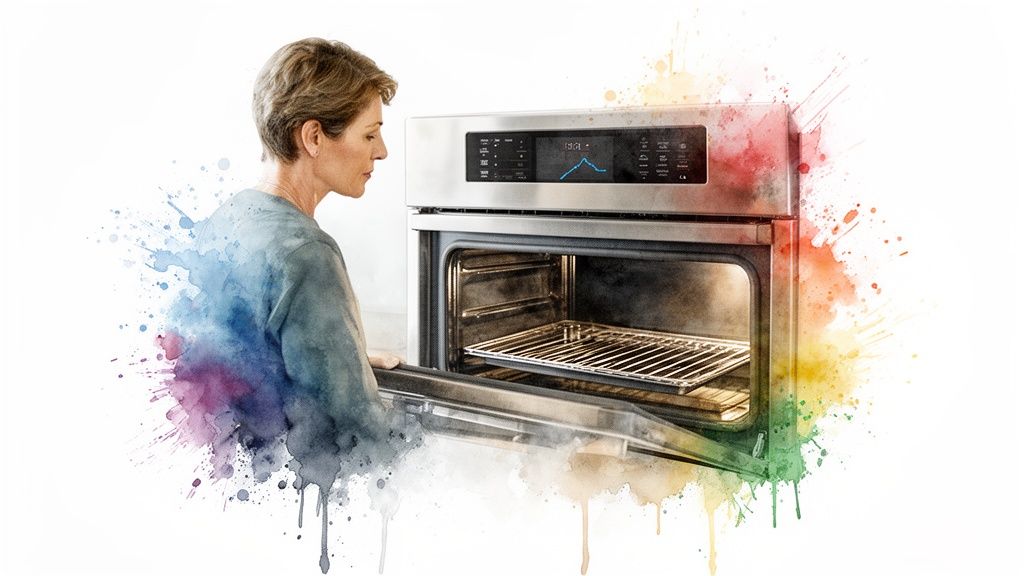
To understand why your oven's temperature display drops, it helps to think of it as a dynamic heating system—a team of parts working in concert to create the perfect cooking environment.
At the heart of it all, your convection oven has a few key players. You've got the heating element doing the heavy lifting, providing the raw heat. Then there's the convection fan, which pushes that hot air all around the oven cavity. This constant circulation is what zaps hot spots and gives you beautiful, even browning much faster than a conventional oven.
But these parts aren't just winging it. The whole operation is managed by an internal computer, usually called the control board. And the most critical piece of information this control board relies on comes from the temperature sensor.
The Role of the Temperature Sensor and Control Board
Think of the temperature sensor as the oven’s internal thermometer and the control board as its brain. The sensor's one job is to constantly measure the air temperature inside the oven and report its findings back to the control board. The board then takes that real-time number and compares it to the temperature you actually set.
Key Insight: The temperature you see on the display isn't a fixed target; it's a live reading of the current air temperature inside the oven as measured by the sensor. It's a snapshot of an ongoing cycle.
Based on what the sensor is telling it, the control board makes decisions every second. If the temperature dips too low, it signals the heating element to kick on. If it gets a bit too high, it tells the element to switch off. This constant dance of heating, sensing, and adjusting is what causes those normal temperature fluctuations you see on the display.
Understanding this teamwork is crucial because when one part isn't pulling its weight, the whole system can get out of sync. A faulty sensor, for example, might send bad data, leading the control board to make the wrong call. If you're curious, we have a detailed guide on how an oven sensor works. Knowing this helps you spot the difference between a normal dip and a sign that a component might need a closer look.
Common Reasons for a Dropping Temperature Display
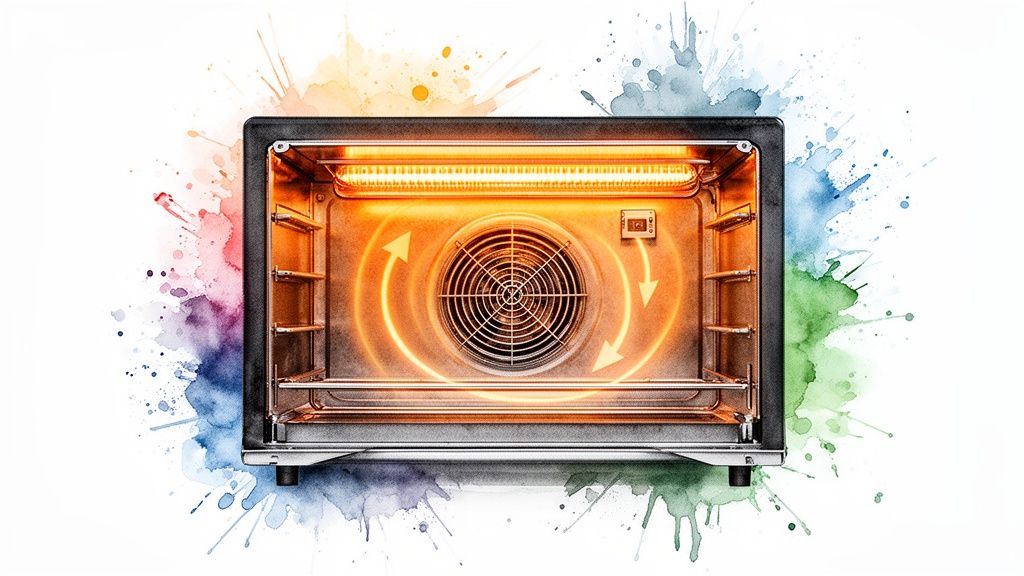
Before you assume a faulty part, it's good to know that many temperature drops are completely normal. They often mean your oven’s smart features are working exactly as intended.
Let's walk through a few common scenarios that explain why the number on your display might be dipping. These aren't faults—they're features designed to help you cook more efficiently and get better results.
The Initial Preheat Overshoot
Ever noticed your oven beeps to signal it's preheated, only for the display to drop a few degrees moments later? This is a clever design feature baked into most modern ovens.
During the preheat cycle, your oven will intentionally overshoot the target temperature. It gets a little extra hot to counteract the rush of cool air when you open the door to put your food in. After that initial heat blast, it settles back down to your set temperature, causing the display to dip.
- What you see: The oven beeps at 350°F, but a minute later, the display shows 335°F.
- What's happening: The oven is simply stabilizing after its intentional overshoot. This creates a consistent average temperature perfect for cooking.
This process ensures your food starts cooking at the right average temperature from the get-go.
Heat Loss From Opening the Door
Every time you open the oven door for a quick peek, a huge amount of hot air escapes. It's not unusual for the internal temperature to plummet by 50°F or more in just a few seconds.
Your oven's temperature sensor picks up on this sharp drop instantly and tells the heating elements to kick into high gear. The falling number on your display is just a real-time report of that heat loss. A healthy oven will get right back to work bringing the temperature up once the door is closed.
Pro Tip: Resist the temptation to open the door. Your oven's light and window are your best friends for checking on your food. Keeping the door shut maintains a stable cooking environment and saves energy.
Automatic Temperature Conversion
Many convection ovens come with a smart feature called auto-conversion or convection convert. Since convection cooking is more efficient—cooking food roughly 25% faster than conventional baking—this feature automatically tweaks the temperature for you.
If you punch in 350°F for a traditional recipe, the auto-conversion might immediately reduce it to 325°F. This can be confusing if you aren't expecting it, as the display will show a lower temperature than what you entered. Rest assured, this is your oven helping you, not malfunctioning.
Energy efficiency studies have shown how newer ovens manage heat with incredible precision to improve cooking results and save power. You can read the full efficiency study to see just how far this technology has come.
When a Temperature Drop Signals a Real Problem
Small, predictable temperature dips are normal for a convection oven. But when the temperature display takes a nosedive and struggles to climb back up, that’s a different story. These aren't just minor fluctuations; they’re red flags that a key component might be failing.
If your oven can't reach the temperature you set, takes forever to preheat, or the display drops by 50°F or more without recovering, it’s time to investigate. These symptoms are a recipe for disaster in the kitchen, leading to food that’s burnt on the outside and raw in the middle. It’s not just frustrating—it means your oven's heating system is compromised.
Telltale Signs of Common Failing Parts
When the temperature drop is severe and unpredictable, the issue usually traces back to one of a few hardworking parts. Each one gives off its own unique set of clues when it starts to fail.
Here are the most common culprits to watch for:
- Faulty Temperature Sensor: Think of this as the oven’s nerve centre. A bad sensor feeds the control board incorrect information, causing chaotic temperature swings. The oven might get scorching hot or stay lukewarm because its brain is making decisions based on faulty data.
- Dying Heating Element: The heating elements do all the heavy lifting. Over time, they can blister, crack, or break entirely. A failing element just can’t produce consistent heat, leading to those big temperature drops and half-baked meals. You might even see one element glowing bright red while the other is completely dark.
- Malfunctioning Control Board: This is the oven’s brain. When it starts to go, it can’t correctly read signals from the sensor or tell the heating elements what to do. The first signs are often an unresponsive display, erratic behaviour, or random error codes popping up.
- Struggling Convection Fan Motor: The fan is the key to even cooking. If the motor is failing, you’ll probably hear it—think grinding, squealing, or whining noises. Without that critical airflow, you get hot spots and an oven that can't hold a steady temperature.
To help you connect the dots, here’s a quick checklist to guide your diagnosis.
Troubleshooting Checklist for Common Faults
| Symptom Observed | Potential Faulty Part | Recommended Next Step |
|---|---|---|
| Temperature swings wildly, oven gets too hot or not hot enough. | Temperature Sensor | Visually inspect the sensor for damage. Test its resistance with a multimeter (if comfortable). |
| Oven doesn't get hot, preheats slowly, food is undercooked. | Heating Element | Visually inspect elements for blisters, cracks, or breaks. Check if both elements glow during preheating. |
| Unresponsive display, error codes appear, oven acts erratically. | Control Board | Try resetting the oven by turning off the circuit breaker for 5-10 minutes. If issues persist, it likely needs professional diagnosis. |
| Grinding or squealing noises, food is cooked unevenly. | Convection Fan Motor | Listen for unusual sounds when the convection fan is running. A noisy fan motor is a clear sign of wear. |
This table can help you narrow down the possibilities before deciding on your next move.
When to Suspect a Deeper Issue
Sometimes the problem isn’t a single component but something simpler, like heat loss. A worn-out or damaged door gasket, for example, lets heat constantly escape. Your oven is forced to work overtime, burning through energy without ever maintaining the right temperature.
Safety First: If you ever smell burning plastic or, in a gas oven, the distinct smell of gas, shut the appliance off immediately. These are serious hazards that demand a professional. You can learn more about the critical gas oven safety steps in our dedicated guide.
Knowing what these signs mean is the first step. It takes you from wondering if there’s a problem to understanding what’s likely going wrong, which is crucial when deciding whether to run a few safe checks yourself or call in a licensed technician.
Safe DIY Diagnostics You Can Perform at Home
Before you book a repair, there are a couple of straightforward, safe checks you can do yourself. These simple tests can give you a much clearer picture of what’s going on inside your oven, and you won’t need any special tools—just a basic oven thermometer.
By spending a few minutes on these diagnostics, you can figure out if your oven's temperature display is telling the truth or if a part has failed. This information empowers you to make a smarter decision about your next steps.
Test Oven Accuracy with a Thermometer
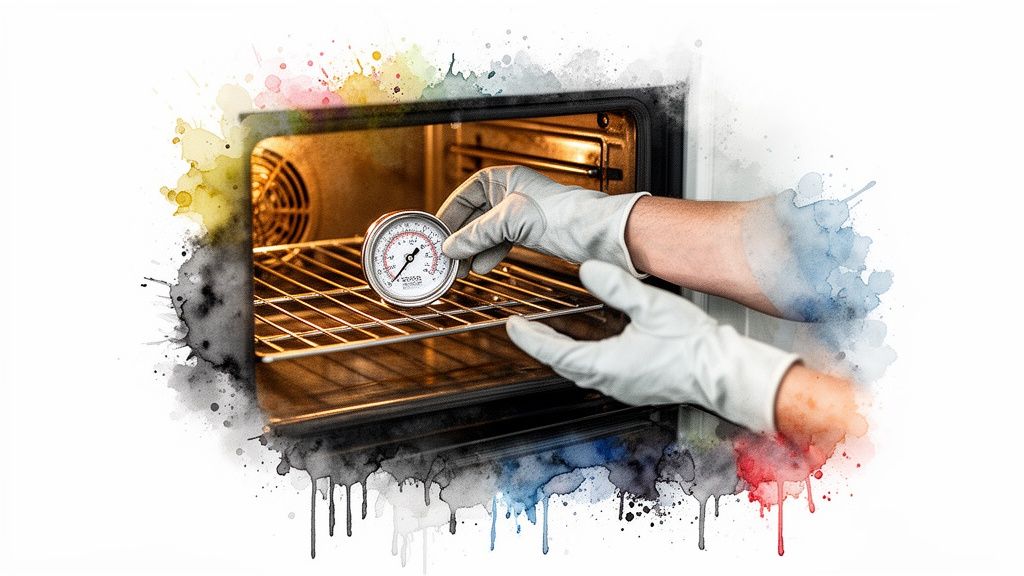
The best way to know if your oven is hitting the right temperature is to test it against a reliable thermometer. This simple check cuts right through the guesswork.
- Grab an Oven Thermometer: You can find these at most grocery or hardware stores.
- Place it in the Centre: Pop the thermometer on the middle rack where you can easily see it through the oven door.
- Preheat and Wait: Set your oven to bake at 350°F (177°C). Once it beeps to signal it's preheated, give it at least another 20 minutes for the internal temperature to stabilize.
- Read the Results: Take a look at the thermometer without opening the door. A small difference of 15-20 degrees is pretty normal. But if it’s off by 30°F or more, that’s a strong sign of a calibration problem or a failing sensor.
Important Takeaway: This test gives you solid proof. Being able to tell a technician, "My oven is running 40 degrees colder than the display," saves them diagnostic time and helps them pinpoint the problem faster.
Perform a Visual Inspection of the Heating Elements
Another great diagnostic you can do is a quick visual inspection of the heating elements. These are workhorses, and they’re often the first components to give out. Safety is everything here, so follow these steps carefully.
- Step 1: Shut Off the Power: This is non-negotiable. Unplug the oven from the wall or switch off the corresponding breaker in your electrical panel.
- Step 2: Open and Look: Once the oven is completely cool and the power is off, open the door. Take a close look at the bake element on the bottom and the broil element at the top.
- Step 3: Check for Damage: You're looking for anything that seems out of place. Obvious signs of failure include blisters, bubbles, cracks, or a complete break in the element. A damaged element simply can't heat properly, leading to major temperature problems.
If you find an element that’s clearly broken, that’s your culprit. It will need to be replaced. For homeowners comfortable with DIY repairs, our guide on how to replace an oven heating element walks you through the process safely.
Why a Professional Technician Is Your Safest Bet
So, you've done your diagnostic checks and the evidence points to a failing heating element, a fried control board, or another internal part. At this point, the smartest and safest move you can make is to put down the tools and pick up the phone.
Tackling complex electrical repairs on your own isn't worth the gamble. It can easily lead to serious personal injury, cause even more damage to your oven, or create a dangerous fire hazard in your home.
The Benefits of Expert Service
When you trust a licensed technician, you're getting an expert who shows up with specialized diagnostic equipment and access to genuine, factory-certified replacement parts. They have the training to pinpoint the exact cause of the temperature drop without the guesswork and multiple trips to the hardware store that often come with DIY attempts.
Before you book a service call, it’s always a good move to check your appliance’s coverage by understanding your appliance's warranty. It can save you some hassle by clarifying which repairs might already be covered.
A professional repair doesn’t just fix the immediate problem; it ensures your oven operates safely and efficiently for years. This investment saves you time, money, and stress in the long run.
Ultimately, hiring an expert is about more than a quick fix. There are many reasons why this is the best decision for your home and your peace of mind. You can explore the top five reasons to hire an appliance repair company in our detailed guide.
Your Local Alberta Appliance Repair Solution
Is an unpredictable oven throwing a wrench into your cooking plans? Don't let a faulty appliance ruin another meal. You need a fast, reliable solution from a local expert you can trust, and that's where we come in.
Our certified technicians are ready to provide same-day or next-day service across Alberta, covering communities like Calgary, Red Deer, and offering specialized oven repair in Edmonton. We show up prepared with the right tools and parts, ready to figure out the problem and get the job done right on the first visit.
For professional service that gets your oven back in top shape, contact our team today.
Need appliance repair? Visit RepairMyAppliance.ca or call us at 587-416-5888 for fast, professional service.
Frequently Asked Questions (FAQ)
Here are a few quick answers to the questions we get asked most often about convection oven temperature problems.
How do I know if my oven's temperature sensor is bad?
A faulty temperature sensor usually gives a few tell-tale signs. You might see an error code pop up on the display, like F2 or F3, or notice the temperature is wildly inaccurate—swinging by 50°F or more. If your oven gets way too hot and burns everything, or it barely heats up at all, the sensor is a prime suspect. Consistently burnt or undercooked food is another big clue that the sensor is sending the wrong signals to the main control board.
Can I still use my oven if the convection fan is broken?
Yes, you usually can. Just switch to a standard baking setting like "Bake" or "Roast" that doesn't use the fan. The main heating elements will still work just fine for regular cooking. Keep in mind, though, that without the fan circulating air, your cooking times will likely be longer. You might also find that food doesn't cook quite as evenly. It’s always best to get the fan repaired to get your oven back to working at its best.
How much does it cost to fix an oven that won't hold temperature in Alberta?
The final cost depends on which part has failed. A simple fix, like replacing a temperature sensor, is going to be much more affordable than a complex control board repair. At RepairMyAppliance.ca, we believe in being completely upfront with our pricing. Our process starts with a service call to properly diagnose the problem. From there, we'll give you a full, clear quote for the total repair cost before we do any work, so there are never any surprises.
Need appliance repair? Visit RepairMyAppliance.ca or call 587-416-5888 for fast, professional service.