

Ever had an appliance suddenly go dead after a minor power flicker? The unsung hero in this story is a tiny, crucial component called a fuse. Appliances need fuses to act as a safety device, protecting them from electrical damage and, more importantly, preventing potential fires.
Think of a fuse as a deliberate weak link in an electrical circuit. It's designed to sacrifice itself during a power surge or overload, breaking the connection before the sensitive, expensive parts of your appliance get fried. This guide will explain why that little component is so important and what types you might find in your home.
Your Appliance's Built-In Bodyguard Against Electrical Damage
Imagine you're running your microwave and coffee maker at the same time, and suddenly, everything goes silent. That abrupt power cut isn't just an annoyance; it's your appliance's fuse doing its job perfectly. A fuse is like a dedicated, single-use bodyguard for your electronics. It contains a small piece of wire specifically designed to melt and break the circuit the moment it senses a dangerous rush of electricity.
It's a simple but brilliant idea. A fuse stops a current overload from frying internal circuit boards, motors, and other critical parts. This little component turns a potentially catastrophic failure into a minor inconvenience, saving you from costly repairs and serious hazards.
The role of fuses in protecting Canadian homes is no small matter. According to the 2021 Ontario Electrical Safety Report, fires related to electrical distribution equipment accounted for a substantial portion of electrical fire incidents. This data underscores why fuses remain a key safety feature in modern appliances. You can dive deeper into the stats by checking out the full electrical safety report.
The Primary Purpose of a Fuse
At its core, a fuse has one vital job: to provide overcurrent protection. It makes sure the electrical current flowing through your appliance stays within a safe limit.
- Prevents Component Damage: It shields delicate electronics, like the control board in your oven, from being destroyed by unexpected power surges. When you understand how different components work, like an oven sensor, it becomes clear why this protection is so important. You can learn more about how an oven sensor works in our detailed guide.
- Mitigates Fire Risk: By stopping an overload in its tracks, a fuse prevents wires from overheating to the point where they could melt their insulation and ignite surrounding materials.
While fuses act as a critical bodyguard inside your appliances, it's always smart to have a wider range of other home fire safety equipment to protect your entire household.
A Guide to The Most Common Types of Appliance Fuses
Not all fuses are made the same. Just like you wouldn't use one key for every lock, manufacturers pick specific fuses for very specific jobs inside your appliances. Getting to know these different little "guardians" helps you understand the smart safety systems protecting your home.
Each type of fuse is designed to handle a particular threat, whether it’s a sudden blast of electrical current or a dangerous spike in heat. Let’s walk through the most common ones you're likely to come across.
Think of the fuse as the first line of defence. This diagram shows how it stands between a dangerous electrical surge and your valuable appliance, ready to sacrifice itself to keep the machine safe.
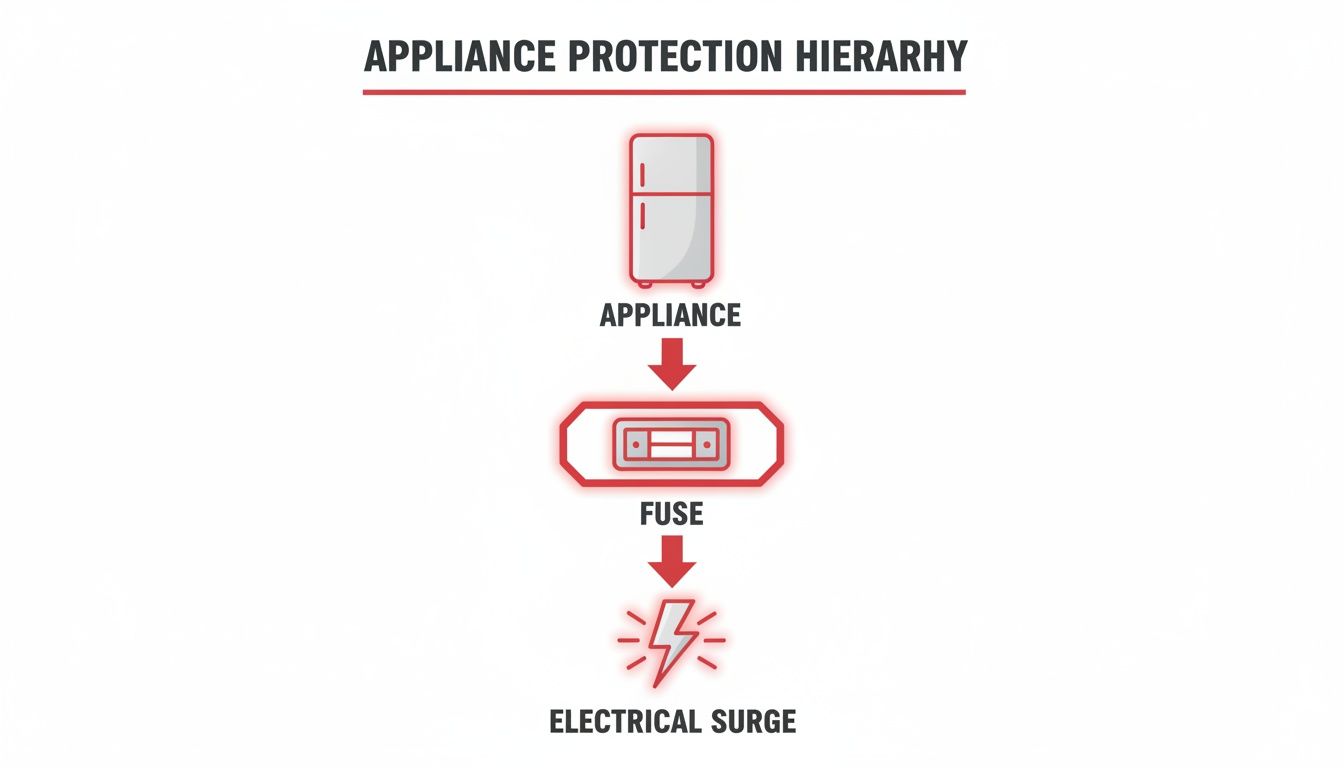
It’s a simple but powerful concept: the fuse is a critical, single-use component designed to fail so the rest of your appliance doesn't.
Thermal Fuses and Thermal Cutoffs
Think of a thermal fuse as a heat-sensitive bodyguard. Its main job isn’t to watch for electrical spikes but to react when things get way too hot. You'll find these in anything that generates heat, like your clothes dryer, coffee maker, or dishwasher.
If a part like a heating element goes haywire and starts to overheat, the thermal fuse contains a special alloy designed to melt at a very precise temperature. When it melts, the circuit is broken for good. This simple action prevents the appliance from getting hot enough to cause a fire. A thermal cutoff (TCO) is a similar one-shot safety device.
Cartridge Fuses (Glass and Ceramic)
These are probably what you picture when someone says "fuse." Cartridge fuses are small cylinders, usually made of glass or ceramic, with metal caps on each end. A tiny wire runs right through the middle.
- Glass Fuses: The big advantage here is that they're see-through. You can often tell if the fuse is blown just by looking for a broken or melted wire inside. They’re common in smaller electronics and appliances like microwaves.
- Ceramic Fuses: These are solid white and much tougher. They're built to handle higher currents and temperatures, making them the right choice for heavy-duty appliances with big motors or powerful heating elements, like your oven or some air conditioners.
The main difference comes down to their ability to handle a massive surge. A ceramic fuse can safely shut down a much larger fault current without shattering, which is why it's trusted in higher-power situations.
Blade Fuses
If you've ever glanced at the fuse box in your car, you’ve seen blade fuses. They are those colourful little plastic rectangles with two metal prongs that plug into a socket. Because they are compact and incredibly easy to swap out, they've become popular in many modern appliances, especially on control boards for things like refrigerators.
Their plastic body is also colour-coded by its amperage rating, which makes finding the right replacement a breeze. For instance, a 10-amp fuse is almost always red, while a 20-amp fuse is yellow.
To help you quickly identify what you might be looking at, here’s a simple breakdown of the most common fuse types and their roles.
Common Appliance Fuses and Their Functions
| Fuse Type | Appearance | Commonly Found In | Primary Function |
|---|---|---|---|
| Thermal Fuse / TCO | Small, often plastic or ceramic body with two wire leads. | Dryers, coffee makers, dishwashers, microwaves. | Senses and reacts to excessive heat to prevent fires. |
| Glass Cartridge Fuse | Small, transparent glass tube with metal end caps. | Microwaves, small electronics, control boards. | Protects against electrical overcurrent; easily inspected visually. |
| Ceramic Cartridge Fuse | Opaque, white ceramic tube with metal end caps. | Ovens, air conditioners, high-power appliances. | Handles higher currents and heat than glass fuses. |
| Blade Fuse | Colourful, plastic housing with two metal prongs. | Modern refrigerators, washing machines, cars. | Provides overcurrent protection; colour-coded for easy replacement. |
This table should give you a good starting point for figuring out what kind of fuse your appliance uses and what its specific job is.
Other Specialized Fuses
Beyond these common types, some appliances use more specialized protectors. A fusible link, for example, is just a short piece of special wire made to melt during an extreme overload. You’ll usually find these in high-current circuits.
Newer electronics might even have resettable fuses, often called PTCs. When too much current makes them overheat, their internal resistance skyrockets, blocking the electricity. Once the problem is fixed and they cool down, their resistance drops, and the circuit starts working again—no replacement needed.
Knowing whether your appliance has a simple glass fuse or a specialized thermal one is the first step in any diagnosis. For any issues involving gas or electric appliance repair, identifying the fuse type can help a technician get straight to the root of the problem.
How to Tell If an Appliance Fuse Is Blown
When an appliance suddenly quits on you, a blown fuse is often the first thing to check. Figuring out if this is the culprit is usually pretty straightforward, but you absolutely have to put safety first. The most obvious sign? An appliance that’s completely dead—no lights, no sounds, nothing.
Sometimes, though, the clues are a bit more subtle. Maybe just one function stops working while the rest seems fine. A classic example is a dryer that tumbles but won't heat up, which often points straight to a blown thermal fuse. Learning to spot these signs is the first step in getting your appliance back up and running.
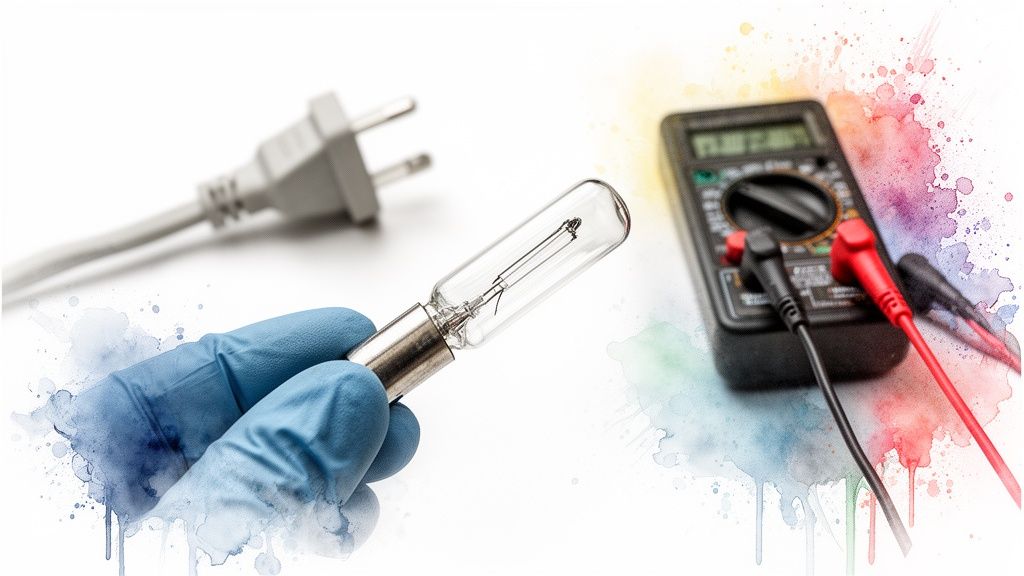
Before you even think about touching a fuse, the most critical step is to unplug the appliance from the wall. Don't just turn it off—disconnect it from the power source completely. Never, ever try to inspect or replace a fuse while the appliance is still plugged in.
Giving the Fuse a Visual Once-Over
With the appliance safely unplugged, it's time to find the fuse. Your owner's manual is your best friend here. Once you've located it, a quick visual check can often tell you everything you need to know.
- Glass Fuses: These are the easiest to diagnose. Just hold the fuse up to a light and look for the tiny metal wire inside. If that wire is snapped in two or has a visible gap, the fuse is blown. You might also spot a dark, smoky film on the inside of the glass—another dead giveaway.
- Ceramic and Blade Fuses: Since these fuses aren't see-through, a visual check is less reliable. The internal wire is hidden. However, look closely for any burn marks or charring on the outside of the fuse body. That's a sure sign it took a major hit from an overload.
If you think your dryer's heating element is the issue, our guide on what to do when a clothes dryer won’t turn on offers more specific troubleshooting steps. It can help you pinpoint the real problem before you even pull the fuse.
Using a Multimeter to Be Certain
For any fuse you can't see through, a visual check is just a guess. To know for sure, you'll need a multimeter. This tool gives you a definite yes or no by testing for continuity, which simply means checking if the electrical pathway inside the fuse is still complete.
Safety First: A multimeter is a fantastic diagnostic tool, but you have to use it right. Make sure the appliance is unplugged before you even think about removing the fuse to test it. This prevents any risk of electric shock.
Testing for continuity is simple:
- Turn your multimeter dial to the continuity setting. It usually has an icon that looks like a sound wave or a diode symbol (a triangle with a line).
- Touch the two metal probes together. The meter should beep, confirming it's ready to go.
- Now, place one probe on each metal end of the fuse.
- If you hear a beep, the circuit is closed, and the fuse is perfectly fine. If it stays silent and the screen reads "OL" (for open loop) or shows infinite resistance, the fuse is blown and must be replaced.
This quick test takes all the guesswork out of the equation. If the fuse passes the test, then it's not the problem. The issue is deeper inside the appliance, and that's usually the time to call in a professional technician for a proper diagnosis.
Understanding Why Simply Replacing a Fuse Is Not Enough
So, your appliance stopped working, and you've found the culprit: a blown fuse. It’s tempting to just pop in a new one and carry on with your day, but hold on a minute. More often than not, this is like putting a small bandage on a much bigger problem. A blown fuse is almost always a symptom, not the root cause.
Think of it like the check engine light in your car. The light itself isn’t the issue; it's a critical warning that something else—the engine, the exhaust, the sensors—needs your immediate attention. In the same way, a fuse blows because it has detected a dangerous electrical surge inside your appliance. If you ignore what caused it, the new fuse will just blow again. Even worse, it could fail to protect your appliance from serious, irreparable damage.
Just swapping out the fuse without digging deeper is a common mistake that can trap you in a frustrating cycle of repairs. Finding the real culprit is the key to a safe and lasting solution, which is a big part of deciding when appliance repair or replacement is the right choice.
Common Culprits Behind a Blown Fuse
So, what are these hidden problems that cause fuses to blow? Usually, it's a sign that something inside the appliance has gone wrong and is pulling far more electricity than it was ever designed to handle.
Here are the most frequent reasons a fuse will sacrifice itself to protect your appliance:
- Internal Short Circuit: This is a classic. It happens when a "hot" wire makes contact with a neutral wire or the metal frame of the appliance. This creates an easy, low-resistance path for electricity to flow, causing a massive surge of current that instantly blows the fuse.
- Failing Motor: The motors in appliances like washing machines and refrigerators wear out over time. As their internal windings degrade, they have to work much harder to do their job, drawing more and more power until it exceeds the fuse's limit.
- Worn-Out Heating Element: In dryers, ovens, and dishwashers, a failing heating element can short out against its own metal casing. This fault will pull an excessive amount of current and trigger the fuse to blow as a safety measure.
The Critical Danger of Using the Wrong Fuse
When a fuse keeps blowing, some people might be tempted to install a replacement with a higher amperage rating, thinking it will solve the problem. This is an extremely dangerous mistake.
Imagine replacing the small, controlled safety valve on a pressure cooker with a solid steel plug. The pressure would just keep building until something much bigger and more expensive explodes. That's exactly what you’re doing to your appliance's delicate circuitry.
The original fuse is specifically rated to protect the wiring and components inside. An oversized fuse won’t blow when it should, allowing a dangerous overcurrent to overheat wires, melt plastic components, and create a very real fire risk. In Alberta, improper fuse replacement is a major safety concern, often because homeowners accidentally use the wrong size fuse and eliminate that crucial electrical protection.
When a Blown Fuse Points to a Bigger Household Electrical Issue
So, the fuse in your microwave blows. Annoying, but it feels like an isolated incident. Then a day later, the dishwasher fuse goes, and before you know it, the new microwave fuse has blown again.
When you start seeing a pattern of repeated or multiple blown fuses, the problem might not be with your appliances at all. It could be a serious warning sign from your home's electrical system.
This kind of thing happens all the time in older homes across Alberta, from Calgary to Edmonton, where the wiring just wasn't built for our modern lives. Decades ago, a kitchen circuit might have only needed to power a fridge and a toaster. Today, that same circuit is often struggling to keep up with a high-wattage microwave, an air fryer, a coffee maker, and a dishwasher all running at once.
Overloaded Circuits and Aging Infrastructure
What feels like a run of bad luck with your appliances could actually be your main fuse panel crying out for help. An overloaded circuit is the number one culprit behind recurring electrical issues. When your home’s system can’t deliver the power being demanded, it protects itself the only way it knows how—by blowing a fuse at the main panel or causing internal appliance fuses to fail under the strain.
This is more than just an inconvenience; it's a major safety issue. Fuse-related electrical problems are a huge reason for appliance breakdowns in older Canadian homes. Kitchen appliances are power-hungry: electric ranges can draw up to 50 amperes, dishwashers need 15-20 amperes, and refrigerators really need their own dedicated circuit. In homes with older fuse-based systems, these demands often overwhelm the wiring, leading to a domino effect of appliance failures. You can discover more insights about these cascading appliance failures on sardisappliancerepair.ca.
A professional technician is essential in these situations. They have the diagnostic tools to determine if the fault lies within a single appliance or if your entire home circuit is overloaded, posing a serious fire risk.
When to Call for a Professional Diagnosis
It's crucial to figure out if you're dealing with an appliance problem or a household electrical problem.
Call a professional technician if you notice:
- Multiple Fuses Blowing: Fuses in different appliances are failing around the same time.
- Repeat Failures: The same fuse in one appliance blows again and again after being replaced.
- Lights Dimming: Your lights flicker or dim when a large appliance like a dryer or oven kicks on.
- Tripping Breakers: The main circuit breakers or fuses in your home's electrical panel are tripping frequently.
An expert can safely diagnose the root cause, making sure both your home and your appliances are protected.
FAQs About Appliance Fuses
Got questions about your appliance's fuse? You're not alone. Here are some of the most common things homeowners ask us, along with straightforward advice to help you figure out what to do next.
Can I use a higher amp fuse to stop it from blowing?
No, you absolutely should not. Putting a fuse with a higher amp rating into any appliance is a major fire hazard. Think of a fuse as a purpose-built weak link—it's designed to fail before your appliance's expensive electronics do.
A fuse's amperage rating is precisely calculated to protect the sensitive components inside. Swapping it for a higher-rated one is like removing the safety net. It allows way too much current to surge through the machine, which can quickly overheat wiring, fry circuit boards, and start a fire.
Always replace a blown fuse with one that has the exact same amperage and voltage rating. If the new fuse pops right away, it’s a clear sign of a bigger problem that needs a professional technician to diagnose safely.
Is a blown fuse covered by a home warranty?
It really depends on the fine print of your home warranty policy. Many standard plans do cover electrical component failures that happen from normal wear and tear, and a blown fuse can sometimes fall under that umbrella.
However, policies often have exclusions. If the fuse blew because of an external event—like a neighbourhood power surge or a problem with your home's main electrical panel—it likely won't be covered. The best thing to do is pull out your policy documents or give your warranty provider a quick call to be sure.
Why did the fuse in my brand-new appliance blow?
It’s definitely frustrating when a new appliance fails, but it can happen. A fuse in a new machine might blow for a few different reasons. It could be something external, like a sudden power surge, or an issue with the outlet it's plugged into not providing stable power.
Less commonly, it could be a small manufacturing defect in either the appliance or the fuse itself.
Before you do anything else, try plugging the appliance into a different outlet on a separate circuit. If the fuse blows again, stop right there. The unit is almost certainly covered by the manufacturer's warranty, so contact them or a certified technician right away. Don't attempt any repairs yourself, as you could easily void your warranty.
When should I call a professional for a blown fuse?
You should call a professional technician if:
- You replace a blown fuse and the new one blows immediately.
- You aren't comfortable or sure how to safely access and test the fuse.
- The visual inspection and multimeter test show the fuse is fine, but the appliance still won't work.
- Fuses in multiple appliances (or the same one repeatedly) are blowing, which could signal a larger electrical issue in your home.
Trying to sort out appliance electrical issues yourself can get complicated, and frankly, a bit risky. If you find yourself constantly dealing with a blown fuse or another electrical glitch, it’s a clear sign to call in the pros. Our certified technicians are here to provide a safe, reliable fix. For more tips on what to look for, check out our guide on how to find the best local appliance repair near you. If you suspect the problem is with your home's wiring, it may be time to contact a residential troubleshooting electrician.
Need appliance repair? Visit RepairMyAppliance.ca or call 587-416-5888 for fast, professional service.