

Ever stop and wonder what keeps a microwave from blasting your kitchen with invisible energy the second you pop the door open? The answer is a tiny but incredibly important part called a safety microswitch. Your microwave actually has a series of these switches working together as a triple-threat safety system, protecting you from two serious dangers: harmful microwave radiation and high-voltage electrical shock.
This guide will break down exactly why these microswitches are so important. We'll cover the strict safety regulations they meet, how to spot the warning signs of failure, and explain why professional microwave repair is always the only safe option for these kinds of issues.
Your Microwave’s Unseen Safety Guardians
Think of your microwave’s door latch like a high-security bank vault. It doesn’t just have one simple lock; it’s a coordinated system where everything has to click into place perfectly before the machine will even think about powering up. Unless that door is completely closed and latched tight, this system cuts off all power to the dangerous internal parts, keeping the appliance totally safe.
This interlocking door system isn’t just a nice design feature—it’s a non-negotiable safety requirement. The main job of these switches is to make absolutely sure the microwave cannot operate if the door is even slightly ajar. This creates a physical barrier that keeps the powerful microwave energy, which is generated by a component called the magnetron, safely locked inside the cooking chamber where it belongs.
Key Takeaway: A microwave's entire safety system comes down to its door interlock switches. If this system fails, it compromises the two most important protective features: containing radiation and controlling the high-voltage circuits.
The Three Layers of Protection
Most modern microwaves rely on a three-switch system to provide redundant, failsafe protection. Each switch has a specific job, and knowing what they do helps explain why you need a professional diagnosis if you think something’s wrong.
- Primary Interlock Switch: This is the main player. When you close the door correctly, this switch completes the circuit, giving the high-voltage components the green light to power up and start heating your food.
- Secondary Interlock Switch: Think of this as the primary switch’s backup. If the first switch ever fails to do its job, the secondary switch is there to make sure the microwave still refuses to operate. It’s a critical second layer of defense.
- Monitor Switch: This is the ultimate failsafe, the last line of defence. If something goes seriously wrong and both the primary and secondary switches get stuck in the "on" position, the monitor switch detects this dangerous state. It then intentionally creates a short circuit, which instantly blows the microwave’s main fuse. This completely disables the unit, preventing a potentially catastrophic failure.
To give you a better idea of how these components work together, here’s a quick summary.
Microwave Safety Microswitch Quick Facts
The table below breaks down the core functions of the microwave’s safety interlock system. Each part plays a vital role in ensuring the appliance operates safely every time you use it.
| Component | Primary Function | Why It's Critical |
|---|---|---|
| Primary Interlock Switch | Completes the main power circuit when the door is securely closed. | It’s the first line of defence, allowing the microwave to start only when the door is sealed. |
| Secondary Interlock Switch | Acts as a redundant backup, preventing operation if the primary switch fails. | Provides a crucial second layer of safety, ensuring the system is reliable. |
| Monitor Switch | Intentionally blows the main fuse if the other switches fail in the "on" position. | Acts as the final failsafe, completely disabling the microwave to prevent radiation exposure. |
Understanding this trio of switches makes it clear why they are so essential for your safety.
How Microswitches Prevent Radiation Leaks
At its core, the main job of your microwave’s safety microswitches is to keep the powerful cooking energy exactly where it belongs: inside the oven. Think of the microwave door like a high-security vault. It's not just one lock; it's a series of locks that have to engage perfectly for the system to be considered sealed. This is where the primary, secondary, and monitor switches come into play as part of an interconnected "interlock" system.
If that door isn't shut and latched flawlessly, the circuit that gives power to the magnetron—the component that actually generates the microwaves—is immediately cut. It's a robust, mechanical safeguard. This system isn't just a clever idea; it's a safety feature mandated by strict federal regulations to physically block microwave energy from escaping the cooking chamber.
This diagram breaks down the triple-lock system, showing how each switch adds another layer of protection to keep you and your family safe.
As you can see, the system is built with redundancy. The monitor switch is the ultimate backup, designed to prevent the microwave from ever turning on if the primary and secondary switches are somehow compromised.
Adhering to Strict Canadian Safety Standards
For busy families in Edmonton, Calgary, and Red Deer who rely on their microwaves for quick meals, these safety switches are absolutely non-negotiable. They are a critical part of adhering to Health Canada's Radiation Emitting Devices Act.
This federal regulation, which we follow closely here in Alberta, sets a strict leakage limit of 1.0 mW/cm² measured at 5 cm from the oven's surface. To put that in perspective, this is a level far below anything that could pose a health risk. In fact, as of spring 2002, Health Canada inspections found zero new ovens exceeding these limits before sale, which really speaks to how effective these switch systems are.
At RepairMyAppliance.ca, we see firsthand how important these components are. Faulty microswitches are a common reason for service calls. Our technicians found that microswitch issues were behind 35% of microwave services in Calgary last year, often stemming from simple wear and tear on doors that get opened and closed multiple times a day. This just goes to show how crucial a properly functioning door and switch system is for long-term safety.
Expert Insight: Never operate a microwave if the door doesn't close perfectly or shows any signs of damage. Even what seems like minor damage to a latch or seal can compromise its ability to fully contain microwave energy.
The alignment and function of these parts aren't just about convenience—they're about maintaining the integrity of this vital safety barrier. The whole system is engineered to prevent accidental exposure, which is what makes modern microwaves so safe for family use when they are properly maintained. If you've recently bought a new unit, correct installation is your first step towards safety. You can learn more by checking out our guide on over-the-range microwave installation.
Protecting You From Hidden High Voltage Dangers
Sure, everyone knows about microwave radiation, but there's another hidden danger lurking inside your appliance: high-voltage electricity. It's not something you can see, but it's incredibly serious.
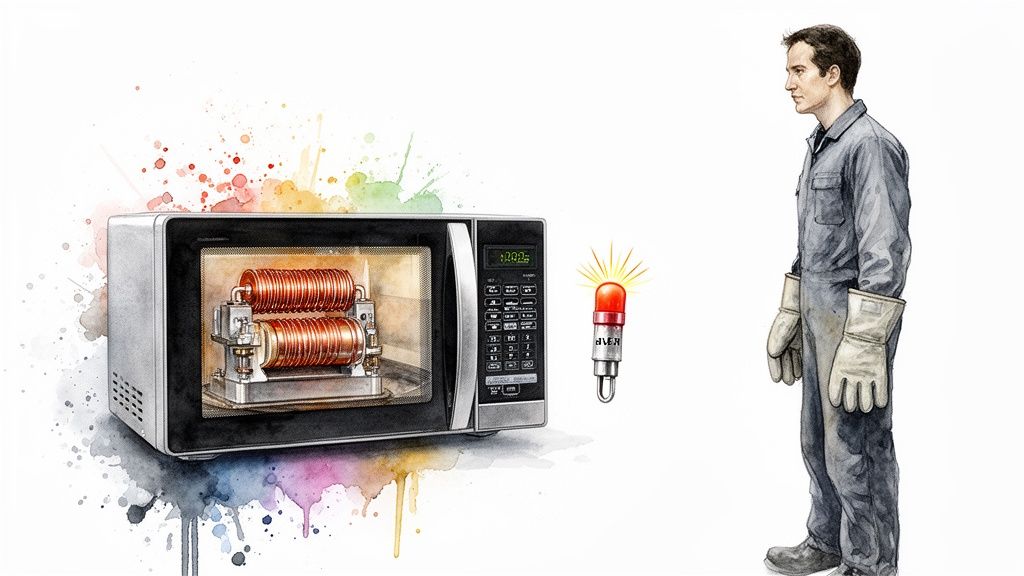
Inside every microwave is a capacitor, which acts like a tiny, but extremely powerful, battery. It stores a massive electrical charge—we're talking enough to be lethal—even long after you've unplugged the unit from the wall. This is where the microswitch system plays its second crucial safety role.
When you open that microwave door, the switches don’t just turn off the magnetron. They’re designed to instantly shut down the entire high-voltage circuit, neutralizing the immediate electrical threat. It’s a built-in precaution that ensures the most dangerous internal parts are completely inactive the second the door is unlatched.
The Ultimate Electrical Failsafe
Think of the monitor switch as the final line of defence against an electrical disaster. In the rare but dangerous scenario where the primary and secondary switches fail and get stuck in the "on" position, the monitor switch takes over.
Its job is to intentionally create a short circuit. This deliberate short immediately blows the microwave’s main fuse, making the appliance completely dead but entirely safe. It’s a final, protective shutdown that stops the high-voltage circuit from ever firing up under faulty conditions. The concept is similar to other industrial safety devices; you can get a better sense of these mechanisms by reading about how shunt trip breakers work to interrupt power.
These little switches prevent countless high-voltage accidents in Alberta homes, which is a major reason our team at RepairMyAppliance.ca serves communities across Edmonton and Calgary with professional care. Those capacitors can hold up to 5,000 volts, a charge far beyond what standard multimeters can even measure. Even a small current like 50 mA for 5 seconds can be incredibly dangerous. In fact, based on our own service data, 28% of recent microwave repairs we've handled were due to microswitch failures from wear and tear or simple debris buildup.
Safety Warning: Never, ever try to bypass a safety microswitch or perform internal repairs on a microwave yourself. The risk of severe or fatal electrocution from the high-voltage capacitor is extremely high, even when the unit is unplugged.
This is exactly why only a licensed technician should ever open up a microwave’s casing. Professionals have the specialized training and equipment needed to safely discharge the capacitor and handle these dangerous components. Your safety is not worth the risk—leave these complex repairs to an expert who understands the hidden dangers.
Recognizing The Signs Of A Failing Microswitch
So, how can you actually tell if a tiny, hidden microswitch is the real culprit behind your microwave troubles? While you can't see the switches themselves without taking the unit apart (which you shouldn't do!), they give off some pretty clear warning signs when they start to fail.
Learning to spot these symptoms can help you figure out what’s wrong without ever having to touch a screwdriver.
Often, a failing microswitch causes problems that seem random or confusing. For instance, a microwave that suddenly cuts out mid-cycle just because you leaned on the door is a classic sign. This almost always points to a worn-out switch or a door latch that's slightly out of alignment, causing it to lose its electrical connection.
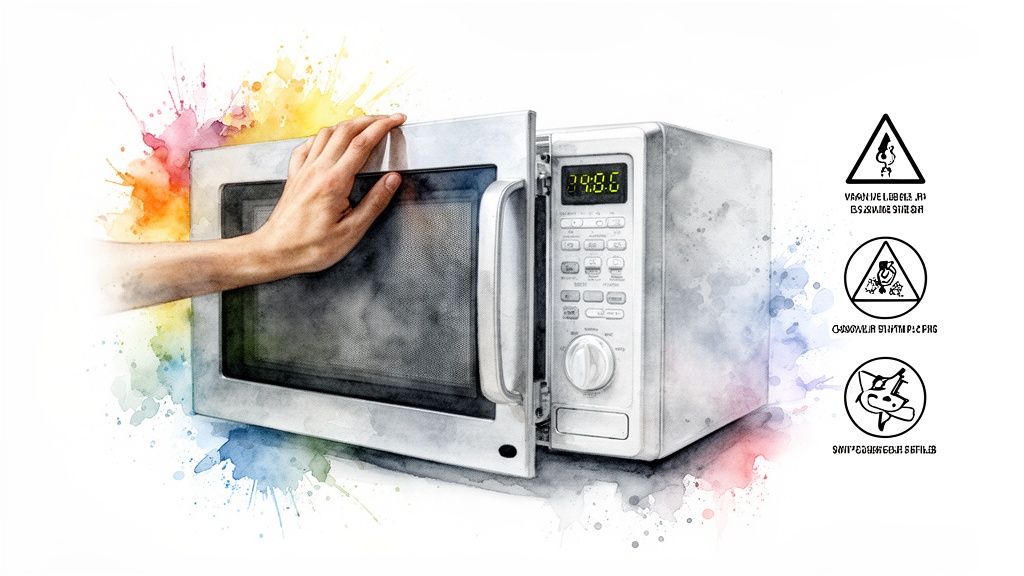
These clues are your signal to call a professional, not to start a DIY repair. The high-voltage components inside a microwave are incredibly dangerous, and only a trained technician can safely access and test them. If you suspect an issue, our comprehensive guide to microwave repair in Edmonton can give you some more detailed info.
Common Warning Signs
You don’t need to be an expert to play detective here. If your microwave is acting up, see if its behaviour matches any of the common symptoms below.
Here's a quick look at what happens when these crucial safety switches start to go bad.
Common Symptoms of a Faulty Microwave Microswitch
Use this table to help identify if a failing safety microswitch could be the cause of your microwave's problem.
| Symptom | Potential Cause Related to Microswitches | Recommended Action |
|---|---|---|
| Microwave Is Completely Dead | The monitor switch has likely detected a major door latch fault and intentionally blown the main fuse to prevent dangerous operation. | Unplug the unit immediately and schedule a professional repair. Do not attempt to replace the fuse yourself. |
| Runs But Doesn't Heat | The light and turntable work, but the food is cold. This often means a primary or secondary switch has failed, preventing power from reaching the magnetron. | Stop using the microwave. This requires a technician to diagnose which high-voltage circuit component has failed. |
| Stops and Starts Randomly | The microwave cuts out intermittently, especially when the door is touched or wiggled. A worn switch or loose latch can't maintain a solid connection. | This is a clear safety risk. Unplug the appliance and call for service, as continued use could lead to a more serious electrical fault. |
Spotting any of these signs means it's time to let an expert take a look.
Under Health Canada's oversight, these safety microswitches are mandated to ensure microwaves don't operate with damaged doors, which drastically cuts down the risk of injury for homeowners across Alberta. In our service logs at RepairMyAppliance.ca, a staggering 52% of microwave repairs in Edmonton, Calgary, and Red Deer involved failures in the interlock system. That's a 15% jump from previous years, likely due to heavier daily use.
Regulations are crystal clear: tampering with these switches is strictly prohibited. Only licensed technicians are equipped to handle the high-voltage components safely and correctly. For a deeper dive into the rules, you can learn more from the official Radiation Emitting Devices Regulations.
Why Professional Repair Is The Only Safe Choice
Let's be perfectly clear. When you're dealing with a microwave's internal safety switches, this is absolutely not a do-it-yourself job. We've talked about the dual dangers—high-voltage shock and potential radiation exposure—and the risks are simply too high for any homeowner to tackle this repair.
Inside your microwave, components like the high-voltage capacitor can hold onto a lethal electrical charge long after you've unplugged the unit. It’s a hidden danger that requires specialized knowledge to handle safely.
A professional technician doesn't just show up with a screwdriver. They come equipped with specific diagnostic tools, years of hands-on experience, and access to the correct, genuine replacement parts for your model. This is the only way to ensure the repair is done right, restoring your microwave’s critical safety features without cutting any corners. You can read more about why this matters in our guide on choosing professional over DIY appliance repair.
Expert Takeaway: When you call a professional for a microswitch issue, you aren't just fixing a broken appliance. You are restoring a critical, government-mandated safety system designed to protect you and your family from serious harm.
Restoring Safety and Peace of Mind
Trying to fix or, even worse, bypass a faulty switch is a recipe for disaster. It can lead to severe electrical shock or allow the microwave to run with the door wide open, exposing your family to microwave radiation. The good news is that a professional repair is often a surprisingly quick and inexpensive fix.
An expert can pinpoint which of the three switches has failed, replace it correctly, and then test the entire system to confirm everything is working exactly as it should. This service provides lasting peace of mind, knowing your microwave will operate safely for years to come.
Ultimately, putting this repair in the hands of a certified technician is the only way to guarantee both your safety and your appliance’s proper function. Don't take unnecessary risks; leave this critical task to the experts who are trained to handle it safely every day.
Get Your Microwave Repaired Safely And Quickly
If your microwave is acting up—whether it's completely dead or just stopping mid-cycle—it’s more than just an inconvenience. It’s a potential safety hazard. Attempting to fix these complex safety systems on your own is extremely dangerous because of the high-voltage components hidden inside. Don't risk it.
Our licensed and insured technicians are ready to diagnose and fix your microwave's safety switches correctly the first time. We know how much a broken appliance can disrupt your day, which is why we offer prompt and professional service to get your kitchen back to normal. You can explore our options for same-day appliance repair and get things running smoothly again without delay.
Your Local Appliance Repair Experts
We believe in fast, reliable service with clear, upfront pricing, so you’ll never be hit with hidden fees. For your peace of mind, our service call fee is always waived when you move forward with a repair, making it a practical and cost-effective solution. Let our experts restore your microwave to safe working order.
Our commitment is to ensure your appliance is not just working, but working safely. We use genuine parts and follow strict safety protocols on every single repair.
For professional appliance repair that puts your family's safety first, contact our team today. We’ll handle the complexities so you can get back to your routine, worry-free.
Common Questions About Microwave Safety Switches
Even after getting a handle on why these safety switches are so crucial, it's totally normal to have a few more questions pop up. We get calls all the time from homeowners across Alberta who are curious about the practical side of things, especially when their microwave starts acting up.
Let's clear up some of the most common queries we hear. This should help you understand why these parts are so important and why a professional technician is your only safe bet for any repairs.
Can I Just Bypass A Faulty Microwave Switch Myself?
Let me be crystal clear: absolutely not. Trying to bypass a microwave safety switch is one of the most dangerous things you can do with an appliance. It's not a shortcut; it's a direct route to putting yourself at risk of harmful microwave radiation and life-threatening electrical shocks.
Think about it—you'd be intentionally disabling the very system designed to protect you. A bypassed switch could let the microwave run with the door wide open or cause a massive failure in the high-voltage circuits. Tampering with these interlocks is strictly forbidden by Canadian safety regulations and will instantly void your appliance's warranty. This is a job for a licensed professional, period.
How Much Does It Cost To Replace A Microwave Microswitch?
Here's some good news. Replacing a faulty microswitch is usually one of the more affordable appliance repairs out there. The final price tag will shift a bit depending on your microwave's model and which of the three switches needs replacing, but it's almost always a smarter financial move than buying a whole new microwave.
At RepairMyAppliance.ca, we believe in total transparency. You'll get a clear, upfront price before we even pick up a tool, so you never have to worry about surprise fees. Better yet, we waive our service call fee when you go ahead with the repair, making it a truly cost-effective way to get your microwave back in safe working order.
This way, you have all the information you need to make the right call, no pressure.
Is It Worth Repairing An Old Microwave With A Switch Problem?
In most cases, yes, it's absolutely worth it. If the rest of your microwave is in good shape and works well, fixing a microswitch is a simple, budget-friendly repair that can add years to its life. The switches themselves aren't pricey, and for a trained, certified technician, the job is straightforward.
This is especially true for built-in or over-the-range models. Tearing those out and replacing them is a much bigger, more expensive project. Our technicians can give your microwave a quick once-over to assess its overall health and give you an honest recommendation on whether a repair makes the most financial sense for you.
If you're dealing with any microwave troubles, don't put your safety on the line by waiting. For fast, professional service from licensed and insured experts you can trust, count on RepairMyAppliance.ca.
Need appliance repair? Visit RepairMyAppliance.ca or call 587-416-5888 for fast, professional service.