

If you’ve bought a new refrigerator recently, you've probably noticed a change under the hood. The old standard, R134a, is out, and a new refrigerant called R600a is in. This isn't just a minor tweak; it's a major shift driven by a global push for better energy efficiency and environmental responsibility.
In simple terms, most refrigerators now use R600a because it has a near-zero impact on global warming and makes your appliance more energy-efficient, which is great news for your electricity bill. While you might hear that it's flammable, the tiny, sealed amount used in your fridge makes it overwhelmingly safe for everyday home use.
The Great Refrigerant Switch: R600a vs. R134a
The move from R134a to R600a (also known as isobutane) is a big deal in the world of home appliances. For decades, R134a was the go-to coolant, but it came with a heavy environmental price tag. Its Global Warming Potential (GWP) is a staggering 1,430, making it a prime target for new environmental regulations.
R600a, on the other hand, has a GWP of just 3. That’s not a typo. The difference is massive, and it’s the number one reason manufacturers made the switch. This wasn't a trend—it was a necessary step to meet stricter global standards and shrink the carbon footprint of millions of households.
Key Differences at a Glance
For homeowners, this industry shift brings some pretty practical perks that go beyond just being green. The unique properties of R600a lead to a more efficient cooling process, which you'll notice in your home and on your bills.
To make things simple, here’s a quick rundown of what sets these two refrigerants apart.
R600a vs R134a At a Glance
| Feature | R600a (Isobutane) | R134a (Tetrafluoroethane) |
|---|---|---|
| Global Warming Potential (GWP) | 3 (Very Low) | 1,430 (Very High) |
| Energy Efficiency | Higher | Lower |
| Amount Needed | Less (e.g., 50-60 grams) | More |
| Operating Pressure | Lower | Higher |
| Flammability | Flammable (but used in tiny, safe amounts) | Non-flammable |
| Environmental Impact | Minimal | Significant |
As you can see, R600a comes out way ahead on the factors that matter most today: efficiency and environmental safety.
What This Means for Your Kitchen
- Higher Energy Efficiency: R600a is simply better at transferring heat. This means your fridge's compressor doesn't have to work as hard or run as often, saving you money on power.
- Quieter Operation: Because it runs at lower pressures, an R600a system often produces less noise. You'll likely notice your new fridge is quieter than your old one.
- Smaller Refrigerant Charge: A typical R600a fridge only needs a tiny amount of refrigerant, often just 50-60 grams. This small quantity not only reduces manufacturing costs but also minimizes any potential impact if a leak ever occurred.
This shift helps to understand the broader context of refrigerant replacements happening across many industries. If you're trying to figure out if it's time to upgrade an older appliance, our guide on deciding between appliance repair or replacement can offer some valuable perspective.
Ultimately, while the science is complex, the takeaway is simple: your new appliance is built to be safer for the planet and more efficient for your home.
How Global Climate Rules Changed Your Kitchen Appliances
The main reason your brand-new fridge runs on R600a instead of the older R134a has almost nothing to do with cooling power. It has everything to do with protecting the planet. This huge industry shift was pushed forward by global agreements and environmental rules designed to get rid of substances that damage our climate.
At the core of this whole issue is a concept called Global Warming Potential (GWP).
Think of GWP as a "heat-trapping score" for any gas. It's a simple way to measure how much heat a gas can trap in the atmosphere compared to good old carbon dioxide (which has a baseline GWP of 1). The higher the GWP number, the worse that gas is for global warming.
Here’s where it gets interesting. The old standard, R134a, has a shockingly high GWP of 1,430. That means it's 1,430 times more potent at trapping heat than carbon dioxide. In stark contrast, the modern replacement, R600a, has a GWP of just 3.
That massive difference—1,430 versus 3—is the single biggest reason R134a became obsolete for new home appliances. Manufacturers were legally and ethically forced to find a much greener alternative.
The Push from Regulations
Appliance makers didn't just decide to switch on a whim. This was a mandatory change, driven by international treaties like the Kigali Amendment to the Montreal Protocol. These agreements set aggressive deadlines to phase out high-GWP substances like R134a.
Those global commitments trickled down to local regulations that really sped things up. California, for example, has been a major force for change. The state's Air Resources Board (CARB) set strict targets to slash greenhouse gas emissions, putting high-GWP refrigerants directly in the crosshairs. As part of these plans, California banned refrigerants like R134a in many new products starting in 2022. You can discover more about California's climate initiatives and see how they've shaped the market.
Because most major brands sell their appliances all across North America, these tough rules in one major market effectively set a new standard for everyone. It just became easier and more cost-effective to build every single refrigerator to meet the strictest environmental laws, rather than making different models for different places.
A Greener Future by Design
This regulatory pressure gave manufacturers a clear choice: adapt or get left behind. The result is the refrigerator sitting in your kitchen today. It uses R600a not just because it's allowed, but because it's a critical part of building more sustainable, responsible appliances for the future.
Unlocking Better Performance and Lower Energy Bills
While the environmental perks of R600a are a huge win, the benefit you'll notice first is on your monthly utility bill. The switch to isobutane wasn't just about going green; it was about engineering a smarter, more efficient appliance that saves you money.
This modern refrigerant lets your fridge work smarter, not harder. It’s like a cyclist trading in a heavy, clunky mountain bike for a sleek, lightweight road bike. With the new bike (R600a), every push of the pedal translates into more speed with less effort.
R600a has superior thermodynamic properties compared to the older R134a, meaning it absorbs and releases heat far more effectively during the cooling cycle. Because it’s so good at its job, the compressor—the engine of your fridge—doesn’t need to run as long or as often to keep your food perfectly chilled.
How Better Science Leads to Real Savings
This isn't just theory; it’s a measurable upgrade. In technical terms, R600a has a higher Coefficient of Performance (COP), which is just a fancy way of measuring how much cooling you get for the electricity you use. A higher COP means the appliance consumes less power to do the same job.
This efficiency boost is a big reason why so many R600a refrigerators earn the ENERGY STAR® certification, a clear sign of significant savings over the appliance's life.
Key Takeaway: A refrigerator using R600a requires less energy to do its job. Less energy used means a lower electricity bill for your household, plain and simple.
Less Is More: The Power of a Smaller Charge
Another major factor here is the sheer amount of refrigerant needed. R600a systems use a tiny charge—often just 50 to 60 grams, which is less than two ounces. That’s a fraction of what older R134a systems needed.
This tiny charge has a few great knock-on effects for your appliance:
- Quieter Operation: The system runs at lower pressures, so you'll hear the compressor kick on much less. No more startling hums from the kitchen.
- Reduced Wear and Tear: A compressor that runs less often and under less strain is one that's likely to last longer.
- Lighter Appliances: Less refrigerant and smaller components can lead to a more streamlined and lightweight design.
When your fridge works less to stay cold, it's not just saving energy—it's also reducing the chances of a breakdown. If you ever find your appliance is struggling to keep its cool, our guide on how to fix a refrigerator that is not cooling can give you some starting points. Ultimately, the move to R600a is all about connecting advanced science to real-world benefits, like a quieter home and more money in your pocket.
Answering the Big Question: Is R600a Safe in Your Home?
Let's get right to the heart of the matter. The word "flammable" is understandably a bit unsettling when you're talking about an appliance that runs 24/7 in your kitchen. It’s true—R600a is isobutane, a type of flammable hydrocarbon.
But here’s the crucial context: its safety in your refrigerator boils down to two simple but critical factors: the tiny amount used and the tough, sealed system that keeps it contained.
The actual charge of R600a in a modern fridge is minuscule, usually somewhere between 50 and 60 grams. To give you a real-world picture, that's often less fluid than you’d find in a single disposable lighter.
This small amount is locked away inside a hermetically sealed cooling system. This isn't just a simple pipe; it's a high-pressure, incredibly durable network of copper and steel tubing, engineered to last the entire lifespan of your appliance without leaking.
Putting the Risk into Perspective
When you hear "flammable," it's easy to picture a major hazard, but the reality is far less dramatic. We all use products with much greater potential risks every day without giving it a second thought.
- Aerosol Cans: That can of hairspray or air freshener under your sink? It contains flammable propellants in much larger quantities than the R600a in your entire fridge.
- Propane BBQs: A standard backyard barbecue tank holds thousands of grams of propane, another flammable hydrocarbon, just a few feet from your house.
- Natural Gas Stoves: If your home uses natural gas, you have a direct line of a flammable substance running right into your kitchen.
Compared to these common household items, the tiny, self-contained charge of R600a in your fridge presents a remarkably low risk. The system is designed so that even in the extremely rare event of a leak, the refrigerant would simply dissipate harmlessly into the air, becoming far too diluted to pose any kind of ignition threat.
Governed by Strict International Safety Standards
Appliance manufacturers aren't just winging it; they have to follow incredibly rigorous international safety standards. The design and construction of any fridge using a flammable refrigerant are governed by strict protocols, like the UL 60335-2-24 standard.
These standards dictate everything, from the required strength of the tubing to the precise placement of electrical components. Every potential source of ignition, like the compressor's relay, is specifically engineered and positioned to prevent a spark from ever getting near the refrigerant, even if the system fails.
The compressor itself is a sealed unit. You might notice it feels warm during normal operation, which is perfectly normal. However, if you're ever concerned about it getting excessively hot, our guide on what a hot fridge compressor means can give you more details.
The Bottom Line: Decades of engineering and billions of these refrigerators sold worldwide have proven that R600a is overwhelmingly safe for home use. The design standards are so strict that the risk of a leak causing a fire in a normal home environment is practically zero.
In short, the system is built with multiple layers of protection. Your fridge is engineered from the ground up to ensure the refrigerant stays exactly where it’s supposed to be—safely sealed inside the cooling circuit, working efficiently to keep your food fresh.
What Every Homeowner Needs to Know About Their R600a Fridge
Okay, now that we've covered the science and safety of R600a, let's talk about what this means for you in your own kitchen. As a homeowner, a little practical knowledge goes a long way. Knowing your way around your appliance can help you spot problems early and know exactly when it’s time to bring in a professional.
First things first: you'll want to confirm which refrigerant your fridge actually uses. This information is always printed on a compliance plate or sticker, which you can usually find on the inside wall of the fresh food compartment. Just look for a label that clearly says "Refrigerant: R600a" or "Isobutane."
This simple flowchart helps put the main safety question about R600a's flammability into perspective.
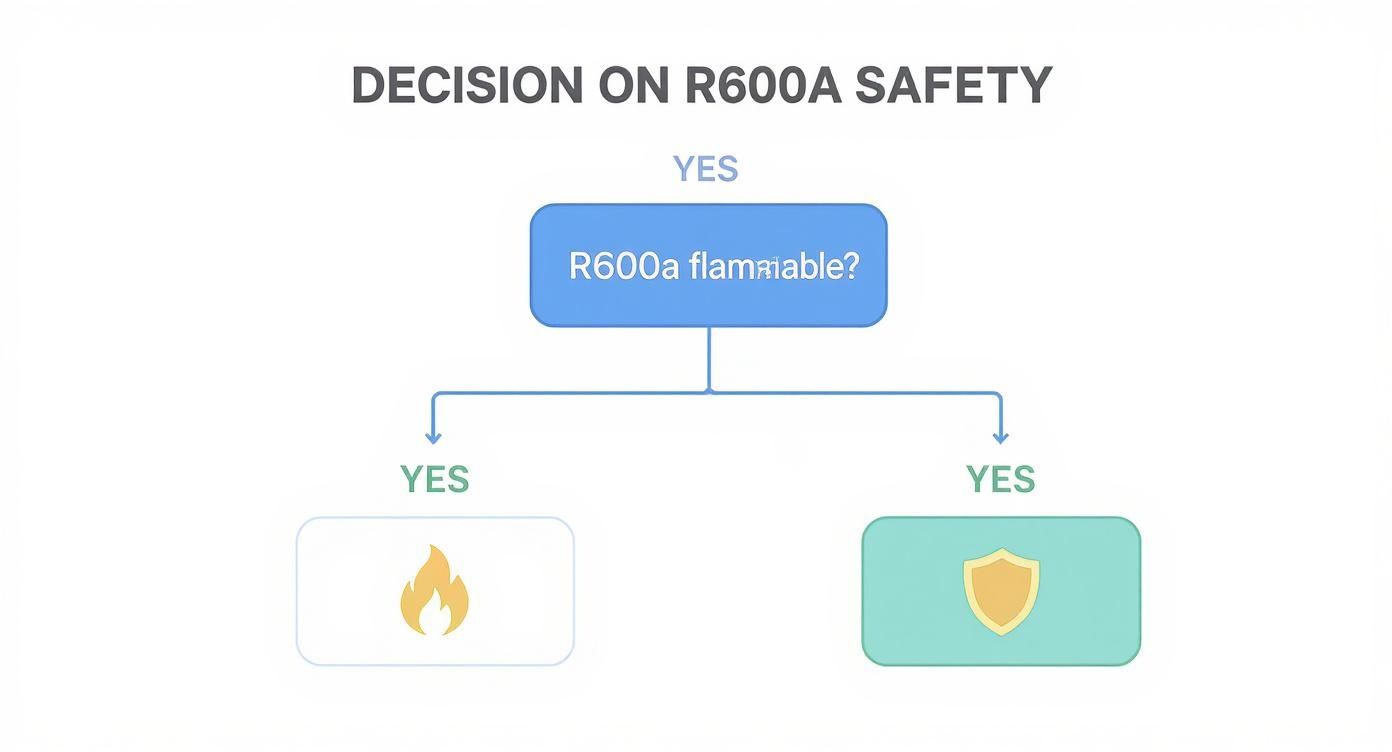
The bottom line is that while the refrigerant is flammable in its raw form, modern engineering standards and the tiny amount used make it perfectly safe for everyday home use.
Recognizing the Signs of a Refrigerant Leak
While a leak in the sealed system is extremely rare, it's a serious issue that needs immediate professional attention. A leak doesn't just impact your fridge's cooling performance; it can also shorten its lifespan. Knowing how long should a refrigerator last can help you weigh your options if a major repair is on the table.
Keep an eye out for these subtle warning signs:
- Your Fridge Isn't Cold Enough: This is the most obvious red flag. If your food feels cool but not truly cold—and you can hear the compressor running non-stop—you might be losing refrigerant.
- A Faint Hissing Noise: If you put your ear near the back of the fridge and hear a very quiet, continuous hissing sound, it could be gas escaping under pressure from a tiny crack in a line.
- Oily Residue: The refrigerant gas is mixed with a special oil that keeps the compressor lubricated. If you find an oily patch on the floor behind or under your fridge, it’s a strong indicator that both oil and refrigerant are leaking out.
Why You Must Never Attempt a DIY Repair
Crucial Safety Warning: Under no circumstances should a homeowner ever try to repair a sealed refrigerant system. R600a is flammable and requires specialized, spark-proof tools, a proper recovery machine, and extensive safety training to handle correctly.
Trying to fix it yourself isn't just a bad idea—it's incredibly dangerous and creates a significant fire risk. On top of that, it will immediately void any manufacturer's warranty you might have.
If you suspect a leak, the first thing to do is unplug the appliance. Then, make sure the area is well-ventilated by opening a window. Your next and only step should be to call a certified, licensed technician. For any problem involving the cooling circuit, professional service is the only safe and correct solution.
Your Guide to Safe Refrigerator Repair and Maintenance
When your fridge suddenly stops cooling, your first instinct might be to figure out what’s wrong. But with a modern R600a appliance, that instinct needs a healthy dose of caution. Because R600a is flammable, any repair involving the sealed cooling system is a job strictly for a trained and licensed professional. It’s not just about having the right know-how; it’s about having the right tools and safety protocols.
Attempting a DIY repair on a sealed system isn’t just risky—it’s extremely dangerous. Professionals use very specific, spark-proof equipment designed to handle flammable refrigerants, completely eliminating the risk of ignition.
This isn't your average tool kit. We're talking about:
- Intrinsically Safe Recovery Machines: These are specially built to be spark-proof, allowing technicians to safely remove R600a from the system without creating a fire hazard.
- Specialized Leak Detectors: Forget soapy water. Pros use sensitive electronic detectors calibrated specifically for hydrocarbons to pinpoint the exact source of even a microscopic leak.
- Proper Ventilation Gear: A critical first step is ensuring the entire work area is thoroughly ventilated to disperse any refrigerant that might escape during the service.
Simple Maintenance You Can (and Should) Do
While sealed system repairs are a firm "no-go" for homeowners, there are a few simple things you can do to keep your fridge running efficiently and head off potential problems.
- Clean the Condenser Coils: Dust, dirt, and pet hair love to collect on these coils (usually at the back or bottom of your fridge), making the compressor work overtime. Just unplug the fridge and give them a gentle vacuuming every six to twelve months.
- Ensure Proper Airflow: Your refrigerator needs some breathing room. Make sure you leave a few inches of clearance around the top, back, and sides of the unit so it can dissipate heat properly. Jamming it into a tight space is a recipe for an overworked appliance.
- Check the Door Seals: A leaky gasket is like leaving a window open in winter—it lets all the cold air escape. Test your seals by closing the door on a piece of paper or a banknote. If you can pull it out with zero resistance, the seal probably needs a good cleaning or even a replacement.
The Professional Promise: For any issue beyond basic cleaning—and especially if you smell something unusual or suspect a refrigerant leak—the only safe and effective move is to call a certified technician. They have the training and the specialized equipment to get the job done right, without putting you or your home at risk.
If you need expert help, our team is fully equipped to handle all types of professional refrigerator repair services in Edmonton, Calgary, and the surrounding areas. Trusting a professional ensures your appliance is fixed safely, restoring it to peak performance without compromising your family’s safety.
Common Questions About R600a Refrigerant
Got questions about R600a? You're not alone. Here are some straightforward answers to the things homeowners most often ask us.
Can I Top Off the R600a Refrigerant in My Fridge Myself?
In a word: no. This is a job strictly for the pros, and for good reason. Servicing a refrigerant system isn't like changing a lightbulb—it requires specialized tools, safety training, and a deep understanding of how sealed systems work.
R600a is flammable, and the system is designed to be completely sealed. If your fridge is low on refrigerant, it means there’s a leak somewhere. A licensed technician needs to find and professionally repair that leak before recharging the system. Attempting this yourself is extremely dangerous, won't fix the underlying problem, and will definitely void your warranty.
What Does an R600a Leak Actually Smell Like?
On its own, pure R600a (isobutane) is completely odourless. For safety, just like with natural gas for your furnace, manufacturers add a strong-smelling chemical to it so that leaks are easy to detect.
If you notice a faint but persistent "gassy" or chemical-like smell near your refrigerator, don't ignore it. This, especially when paired with your fridge struggling to stay cold, is a classic sign of a leak. Your first steps should be to unplug the appliance, open some windows to ventilate the kitchen, and call a professional for an inspection right away.
Can My Older R134a Refrigerator Be Converted to Use R600a?
This is another hard no. You should never try to "retrofit" or convert a refrigerator from one type of refrigerant to another. The entire system—from the compressor and electrical parts to the tubing itself—is engineered specifically for the pressures and chemical properties of the refrigerant it was built for.
Putting R600a into an R134a system is a recipe for disaster. The performance would be terrible, and it would almost certainly lead to a catastrophic failure of the compressor. It’s simply not safe or effective.
Is R600a More Expensive to Repair Than R134a?
The cost of the R600a gas itself is usually not the biggest part of a repair bill. However, because it's flammable, technicians need special spark-proof equipment and certified training to handle it safely, which can sometimes be reflected in the labour costs.
On the other hand, the old R134a refrigerant is being phased out. As it becomes scarcer, its price is likely to climb. The most important factor is hiring a qualified technician who is certified and properly equipped to work with flammable refrigerants—that’s how you ensure a safe and lasting repair.
Need appliance repair? Visit RepairMyAppliance.ca or call 587-416-5888 for fast, professional service.