
Ever looked at a 3-star Yelp rating and wondered if that's really the whole story? It often isn't. A business's reputation on Yelp can be skewed by an overly aggressive review filter that hides real feedback, the simple fact that unhappy people are often louder than happy ones, and the ongoing problem of fake posts.
Think of Yelp's rating not as a perfect report card, but as one piece of a much larger puzzle. This guide will help you understand what's happening behind the scenes so you can make a truly informed decision.
The Hidden Factors Skewing Yelp Ratings
When you're searching for a reliable appliance repair technician in Alberta, you need to know you can trust them. Yelp seems like a good place to start, but if you take that star rating at face value, you might be getting a distorted picture.
There are powerful, often invisible, forces at play that can warp a company's reputation on the platform. Understanding these hidden factors is the key to choosing the right professional for your home.

A Yelp profile is more than just an average of customer scores. It's a complex ecosystem where algorithms, human psychology, and business pressures collide—and the result doesn't always reflect the reality of a company's day-to-day service.
The Power of the Algorithm
At the heart of Yelp is its automated review filter. This algorithm is designed to sift through reviews and show you the most "helpful" or "reliable" ones. The problem? Its rulebook is a secret, and its decisions can make or break a small business's rating.
One of the biggest issues is how it treats reviews from new users. Imagine a homeowner who was so impressed with a local repair service that they created a Yelp account just to leave a glowing review. That genuine, heartfelt praise will likely get flagged and hidden in the "not recommended" section, simply because the account is new.
This unfairly penalizes businesses whose customers aren't already frequent Yelp users.
In fact, Yelp itself admits its software filters about 22% of all submitted reviews into this nearly invisible category. That means almost one out of every four reviews is sidelined and doesn't count toward the main star rating.
Psychological Biases in Action
It's also just human nature. We are psychologically wired to react more strongly to a negative experience than a positive one. This is known as negativity bias.
A customer who has a frustrating experience is far more motivated to go online and write a detailed, one-star review than the dozens of other customers who received perfectly good, professional service that same week. Those happy customers simply move on with their lives.
This means a few loud, negative voices can easily drown out a quiet majority of satisfied clients. For a repair company, a single difficult job or miscommunication can lead to a lasting mark on their record that drags down their average for years, even if it’s an outlier. This is why it's so important to understand what makes Calgary's trusted appliance repair services reliable beyond just one platform's score.
Key Factors Distorting a Business's Yelp Reputation
To help you see past the star rating, we've broken down the main reasons a Yelp profile might not be telling you the whole truth about a business.
| Factor | How It Skews Reputation | What Alberta Consumers Should Know |
|---|---|---|
| Aggressive Review Filter | Hides legitimate positive reviews from new or infrequent users, artificially lowering a business's score. | You may need to manually search for "not recommended" reviews to get a more balanced view. |
| Negativity Bias | Unhappy customers are more motivated to post, making negative experiences seem more common than they are. | Look for patterns of complaints, not just isolated incidents. Consider the total number of reviews. |
| Fake or Malicious Reviews | Competitors or disgruntled individuals can post fake negative reviews to intentionally harm a business's rating. | Be skeptical of overly vague or extremely emotional reviews, especially from profiles with no other activity. |
| Business Response Limitations | Businesses often can't share full details when responding to a complaint due to customer privacy policies. | Read the business's response carefully; their tone can reveal a lot about their professionalism. |
Looking at these factors, it becomes clear that a Yelp rating is just a starting point, not the final word.
Decoding Yelp’s Aggressive Review Filter
Think of Yelp’s review filter like an overzealous bouncer at a club, turning away perfectly good people just because they’re new to town. That’s the simplest way to understand this powerful—and often frustrating—automated system. It’s designed to weed out spam, but its methods are a closely guarded secret.

This algorithm automatically shuffles a huge number of reviews into a section it calls “not currently recommended.” These reviews aren’t deleted, but they might as well be. They’re effectively buried where most people will never see them, and they don’t count toward the business’s overall star rating.
The real problem? The filter’s logic often penalizes the exact kind of small, local businesses we have here in Alberta. A company might get a genuine, glowing review from a first-time customer who was so impressed they created a Yelp account just to share their experience. But to the algorithm, that looks suspicious, and the review gets hidden.
Why Do Legitimate Reviews Get Hidden?
Yelp’s system is built on hundreds of signals, and it heavily favours content from established, active users. While this is meant to stop fake reviews, it means a lot of perfectly good feedback gets caught in the crossfire.
The filter tends to be skeptical of reviews from:
- New or Bare-Bones Profiles: An account with no profile picture, no friends, and no review history is often flagged as less credible.
- Infrequent Yelpers: Someone who only pops in to leave a review once every few years is less trusted by the algorithm than a daily user.
- Out-of-Town Reviewers: If a user’s history is all Toronto-based and they suddenly review an appliance shop in Red Deer, the filter might get suspicious.
This creates a tough situation for many local businesses. Their happiest customers are often busy homeowners who don't live on review sites. When they finally take the time to leave positive feedback, it gets sidelined. This leaves a potentially skewed, more negative collection of reviews to shape the company’s public image.
Yelp’s automated recommendation software is a "black box," meaning no one outside the company knows the exact formula. This lack of transparency makes it impossible for a business to figure out why a real, positive review was hidden.
The Impact on Alberta's Small Businesses
For a family-owned appliance repair shop in Calgary or Edmonton, every single review matters. Losing even a couple of five-star reviews to the filter can drag down their overall rating—the first thing a potential customer sees. This is especially damaging for a new business trying to build a solid reputation from scratch.
These companies rely on word-of-mouth and positive feedback to grow, but Yelp’s system can feel like a game where the rules are always changing. That's why it's so important for homeowners to know that the star rating doesn't always tell the whole story. Digging a little deeper often reveals a much more accurate picture of the local appliance experts in your community.
How to Find and Read Hidden Reviews
The good news is, you can look past the algorithm. Finding these filtered reviews is simple, though it does take an extra click.
- Go to the business’s Yelp page.
- Scroll down past all the main, recommended reviews.
- Near the very bottom, you'll find a small, greyed-out link that says something like “reviews that are not currently recommended.”
- Click that link to see every review the filter has tucked away.
When you’re reading these, use your own judgment. You might spot a few that seem off, but you’ll also likely find detailed, authentic stories from real customers. Taking this one extra step gives you a much more complete and honest look at a business before you make a decision.
Spotting Fake and Manipulated Reviews
Beyond Yelp's own filtering, the world of online reviews has a darker side you need to be aware of: fake and manipulated reviews. These aren't just minor annoyances; they're a deliberate attempt to mislead you, either by artificially boosting a business's rating or by maliciously trying to sink it.
Learning to spot these fakes is an essential skill for any homeowner trying to find a trustworthy service provider. Think of it as becoming your own review detective.
This problem is more widespread than you might think. Some studies estimate that around 20% of Yelp reviews are fabricated, a figure that heavily impacts local service businesses. When you consider that 91% of consumers trust online reviews as much as a personal recommendation, it's clear how these fakes can stack the deck. You can read the full research about review reliability to see just how deep the issue goes.
The Two Faces of Fake Reviews
Fake reviews generally fall into two categories, and both are equally damaging to your ability to make an informed choice.
- Paid-for Positive Reviews: Some businesses, desperate for a higher star rating, will pay for glowing five-star reviews. These are often written by people who have never used the service and are packed with generic, over-the-top praise.
- Malicious Negative Reviews: This is a dirty trick used by unethical competitors or even disgruntled former employees. They create fake profiles to post one-star attacks filled with vague or fabricated complaints, all to scare potential customers away.
Both tactics poison the well, making it harder to trust any of the reviews you read.
Telltale Signs of a Fake Review
The good news? Fake reviews often leave behind clues. If you train your eye to look for certain red flags, you can get much better at separating fact from fiction.
Here are the most common signs to watch for:
- Vague and Generic Language: A real customer will usually drop in specifics—the technician's name, the appliance they fixed, or a detail about the service call. Fake reviews often use empty phrases like "Great service!" or "Best company ever!" without anything to back it up.
- Extreme or Overly Emotional Wording: Be wary of reviews that use absolute terms like "perfect," "flawless," or, on the other end, "total scam" and "nightmare." Real experiences are rarely so black-and-white.
- Suspicious Reviewer Profiles: This is a big one. Click on the reviewer’s profile. If they have only ever left one review (the one you're reading), have no profile picture, and no friends on the platform, that’s a major red flag.
- A Sudden Flood of Similar Reviews: If a business with a long history of getting one or two reviews a month suddenly gets ten five-star (or one-star) reviews in a single day, be skeptical. This often points to a coordinated campaign.
Scenario: Imagine a reliable Calgary appliance shop that suddenly gets hit with three one-star reviews in two days. All three profiles are brand new, lack detail, and use similar angry language. This pattern strongly suggests a targeted attack, not genuine customer dissatisfaction.
How to Be a Savvy Review Reader
Your critical thinking is your best defense against being misled. Don’t just scan the star ratings; take a few minutes to actually read the content and look for patterns.
- Focus on the Middle-Ground Reviews: The most honest and detailed feedback often comes from the three- and four-star reviews. These customers typically give a balanced look at what went well and what could have been better.
- Look for Consistent Themes: Ignore the outliers. Instead, look for recurring themes across multiple reviews over a long period. If several different customers mention that the technician was punctual and professional, that’s a much more reliable signal than one glowing or scathing review.
- Cross-Reference with Other Platforms: Don't put all your eggs in the Yelp basket. Checking Google, HomeStars, and the Better Business Bureau gives you a far more complete picture.
By applying these detective skills, you can filter out the noise and manipulation. This lets you focus on the authentic customer feedback that truly reflects a business's reputation.
The Problem with Relying Only on Yelp Reviews
We’ve all been there. You need a service, you pull up Yelp, and you scan the star ratings. But relying on a single source of information can give you a flat, one-dimensional snapshot—and it might not even be the whole story.
Why Negativity Shouts Louder Than Praise
It’s a simple psychological truth: people are far more likely to share a negative experience than a positive one. Think about it. When an appliance repair goes smoothly, you’re relieved, your fridge is cold again, and you get on with your life. But when things go wrong? That frustration needs an outlet, and online reviews are the easiest place to vent.
This is a well-known phenomenon called negativity bias. Our brains are wired to focus more on negative events. This creates a natural skew in the review ecosystem where a handful of unhappy customers can easily drown out a much larger, silent majority of satisfied ones. A few loud voices can paint a picture that looks far worse than reality.
One Bad Day Can Last for Years Online
For an appliance repair company in Alberta, a single tough day can leave a digital scar. Imagine a technician gets stuck in traffic on the Deerfoot, a crucial part is delayed by a snowstorm, or a complex diagnostic takes longer than planned.
To a homeowner with a broken freezer, this can feel like a major failure. That one resulting review can sit on the company’s profile for years, shaping the opinions of hundreds of potential customers who have no context for what happened.
A study of online reviews found that customers are 21% more likely to leave a review after a negative experience than a positive one. This built-in bias is a powerful force that shapes the overall tone of any review platform.
How Businesses Can (and Can’t) Respond
When a business gets a bad review, its ability to respond is more limited than you might think. A professional response is critical. It shows other potential customers that the business is paying attention and cares about fixing problems. Learning how to effectively respond to negative reviews is an essential skill for any local business.
But here’s where their hands are often tied:
- Privacy is paramount: A company can't share all the details of your service call to defend itself. This means they often can’t tell their full side of the story.
- No asking for good reviews: Yelp’s policies strictly forbid businesses from soliciting reviews. While this is meant to keep feedback "organic," it also prevents companies from encouraging their many happy (and quiet) customers to add some balance.
How to Read Between the Lines
So, what’s a savvy homeowner to do? Learn to read between the lines. Don’t just take a negative review at face value—look at how the company replied.
Is the response calm and professional? Do they acknowledge the customer's frustration and offer to solve the problem offline? That’s a great sign. It shows they’re committed to customer service.
On the other hand, a defensive, argumentative, or generic response is a red flag. The way a company handles criticism often tells you more about their character than the original complaint ever could. Spotting these details is key when you're deciding on hiring the best appliance repair company for the job.
Building a Complete Picture Beyond Yelp
Relying only on Yelp for a company's reputation is like asking a single stranger for directions. You might get where you're going, but what if there was a better route you missed? To truly understand who you're hiring, you have to shift from being a passive review-reader to an active researcher.
This means digging a little deeper and looking for patterns across a few different platforms. When you cross-reference what people are saying, you build a much more reliable, three-dimensional picture of a company. It’s the best way to feel confident you’re making the right call for your home, whether you're in Edmonton, Red Deer, or anywhere else in Alberta.
The review process itself is more subjective than you might think. A person's own experience and interpretation heavily influence what they end up writing.
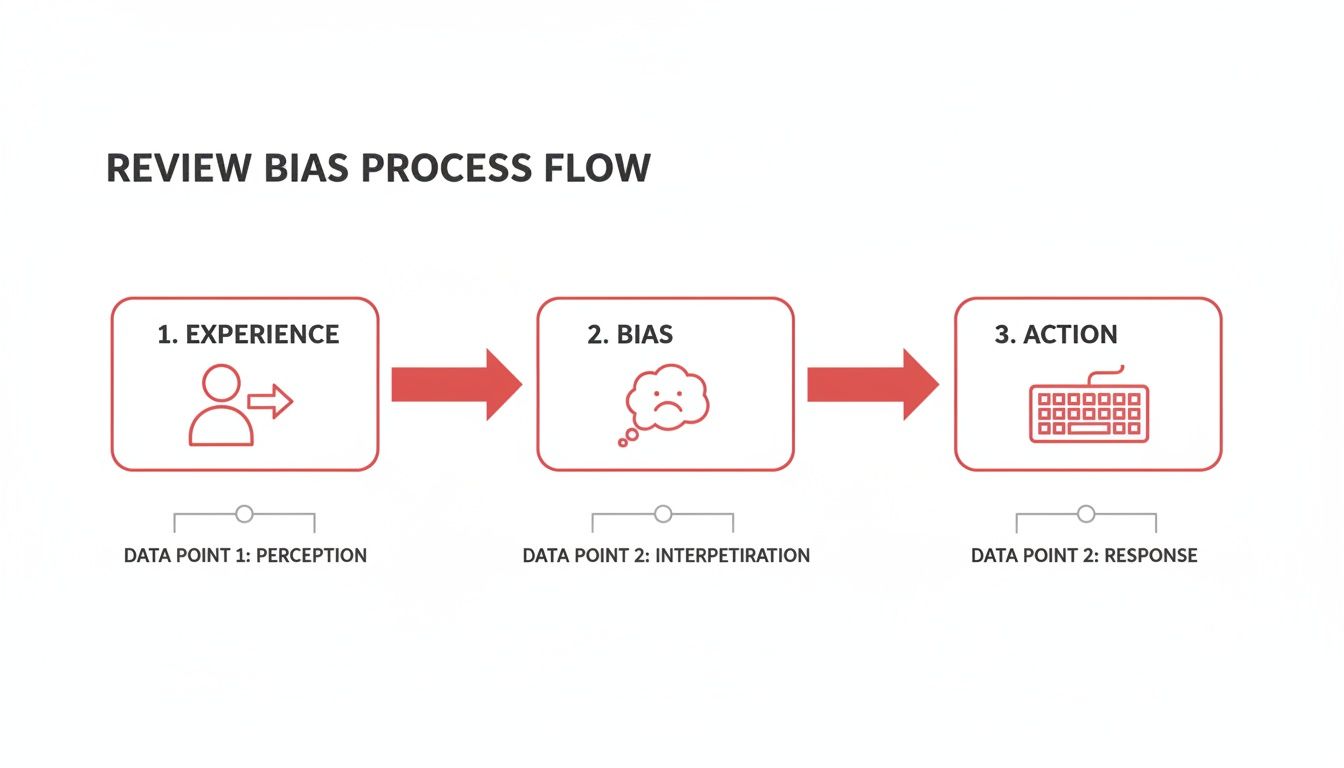
As you can see, the final review that gets posted online is the last step in a chain of personal perceptions. It's not just a raw report of the facts.
Diversify Your Research Sources
To get around the quirks of Yelp, it's a good idea to see what homeowners in Alberta are saying on other platforms. Each one gives you a slightly different angle on a business.
- Google Reviews: This is usually the first stop for most people. Because Google Reviews are built right into search and maps, they get a ton of traffic and a high volume of reviews. While they have their own issues with fake reviews, the sheer number of them often makes it easier to spot consistent trends.
- HomeStars: Here’s a Canadian-specific site that’s all about home services, from appliance repair pros to roofers. What’s great about HomeStars is its focus on verified reviews, where homeowners have to show proof they hired the company. Its "Star Score" gives you a more tailored quality signal for the trades.
- Better Business Bureau (BBB): The BBB offers a totally different kind of insight. It’s less about star ratings and more about how a company handles conflict. You can see their official rating (A+ to F), check for any formal complaints, and—most importantly—see how the business responded. This tells you a lot about their professionalism when things go wrong.
When you look at multiple sources, you're checking for consistency. If a business has glowing reviews everywhere else but a terrible rating on Yelp, that's a huge red flag—not for the business, but for Yelp's algorithm. That discrepancy is a clue that the filter is likely hiding legitimate reviews.
Reputation Check Cross-Reference Guide
| Platform | Strengths | Weaknesses | Best For Checking |
|---|---|---|---|
| Google Reviews | High volume of reviews; integrated with maps and search, making it easy to access. | Can be prone to fake or low-effort reviews; less industry-specific. | Overall public sentiment and spotting general trends in customer service. |
| HomeStars | Industry-specific (Canada); features verified reviews and trust scores. | Smaller review pool than Google; less known outside the home services industry. | The quality of workmanship and reliability for specific home repair projects. |
| Better Business Bureau (BBB) | Formal complaint history; shows how a business resolves disputes officially. | Not a review site in the traditional sense; many good businesses may not be accredited. | A company's professionalism, accountability, and complaint resolution process. |
Using a mix of these platforms gives you a well-rounded view that a single site just can’t provide.
Questions to Ask Service Providers Directly
Online reviews can only take you so far. The final, and arguably most important, step is to pick up the phone and talk to the company yourself. A good, reputable provider will be happy to answer your questions.
Here’s a simple checklist to run through before you book a service call:
- Are Your Technicians Licensed and Insured? This is non-negotiable. In Alberta, anyone working on a gas appliance needs to be certified. You also want to confirm they carry liability insurance—this protects your home in case of accidental damage.
- What Are Your Warranty Terms? Get specific. Does the warranty cover parts, labour, or both? How long does it last? A company that stands by its work with a solid warranty (like 90 days to one year) is showing confidence in its service.
- Can You Explain Your Pricing Structure? Ask about their service call fee, hourly rates, and if they provide a firm quote before starting any work. Transparency is key to avoiding a surprise bill.
- What Is Your Parts Sourcing Policy? Do they use Original Equipment Manufacturer (OEM) parts, or aftermarket ones? OEM parts are made specifically for your appliance model, which usually means better performance and a longer lifespan. This is especially important for tricky repairs, like when you need to figure out how to fix a refrigerator that's not cooling and want the fix to last.
By combining multi-platform research with a direct conversation, you stop guessing and start making an informed decision. For an even deeper dive into how these platforms stack up, check out this a comprehensive comparison of Google Reviews vs. Yelp to see which ones give you the most accurate picture.
Common Questions About Yelp Reviews
After digging into how Yelp works, a few questions always seem to pop up. Let's clear the air with some straight answers so you can feel more confident navigating online reviews and making smart choices for your home.
Does Yelp Remove Bad Reviews if a Business Pays for Advertising?
This is the big question that’s been debated for years. Yelp is very firm on its official policy: advertising does not influence organic ratings or which reviews get filtered.
They state there is a solid wall between their sales team (who sell ads) and their content moderators (who manage reviews). The goal is to stop any "pay-to-play" situation where a business could pay to have negative feedback disappear.
For you, the homeowner, the best approach is to take their policy at face value but remain skeptical. Judge a company by the actual content of their reviews and how professionally they respond, not whether they have an "Ad" tag next to their name.
Can a Business in Alberta Legally Sue Me for a Bad Yelp Review?
Yes, technically a business in Alberta can sue a customer over a bad review, but winning is extremely difficult. The lawsuit would fall under defamation, meaning the business has to prove your review contains false statements of fact that directly harmed their reputation. Honest opinions are generally protected speech in Canada.
There's a huge legal difference between sharing your opinion and stating a lie as a fact:
- This is an opinion (and protected): "In my experience, the technician seemed rushed and the repair didn't last."
- This is a statement of fact (and potentially defamatory): "The technician intentionally used faulty parts to scam me."
Because these lawsuits are expensive and difficult to win, they’re very rare. The key takeaway? Always be truthful. Stick to describing your personal experience and frame your feedback as your opinion to stay on safe legal ground.
What Should I Do if My Positive Review Was Unfairly Filtered by Yelp?
It’s incredibly frustrating to spend time writing a thoughtful, positive review only to have it vanish into the "not recommended" section. While there's no official way to appeal the decision, you can take a few steps to make your reviews more likely to stick.
Yelp's system trusts reviewers who look like real, active members of its community. If your review got filtered, it’s probably because your profile is new or doesn't have much activity.
A review's visibility is often tied to the reviewer's profile strength. The algorithm favours users with a complete profile, a history of multiple reviews, and engagement with other users.
To build up your profile's credibility, try this:
- Complete Your Profile: Add a profile picture and some basic info. A profile that looks like it belongs to a real person is seen as more trustworthy.
- Build Your Review History: Write a few more honest reviews for other local businesses you've used recently—maybe a favourite coffee shop or a local park.
- Engage with the Platform: Click the "Useful," "Funny," or "Cool" buttons on other reviews you find helpful. This signals to Yelp that you're an active user.
There's no guarantee this will work, since the filter is completely automated. But taking these steps makes your profile look more like an established user's, which can help your future reviews stick.
Need appliance repair? Visit RepairMyAppliance.ca or call 587-416-5888 for fast, professional service.