
The unmistakable "rotten egg" smell of gas in your home is an emergency that demands immediate, calm action.
While natural gas itself is odourless, utility companies add a chemical called mercaptan to give it that distinct sulfur-like smell. This is an intentional safety measure. If your nose picks up even a faint whiff, trust it. Don't second-guess yourself—it's time to act. This guide will walk you through the exact steps to keep your family safe.
What To Do Immediately When You Smell Gas
Your number one priority is to prevent ignition. Natural gas becomes explosive when mixed with air, and the smallest, unseen spark can be enough to trigger a disaster. Every action you take—or don't take—must be focused on preventing that spark.

1. Evacuate Everyone Immediately
The first and most critical step is to get all people and pets out of the house. Do not waste a single second gathering personal items or trying to find the source of the leak. The gas could be more concentrated than you realize, and your safety depends on getting out quickly.
As you leave, only if it is directly in your path, open a door or window to help ventilate the space. Do not go out of your way for this; your priority is getting outside to a safe distance, at least 100 metres away (e.g., across the street or at a neighbour's house).
2. Do Not Create Any Sparks
Knowing what to avoid is just as vital as knowing what to do. Any of the following actions can create an ignition spark and must be avoided at all costs:
- Do not touch electrical switches. Don't turn lights on or off.
- Do not use any electronics. Leave your cell phone where it is. Do not use a landline phone.
- Do not plug in or unplug anything. This simple action can create a dangerous electrical arc.
- Do not use any open flames. This includes lighters, matches, candles, or cigarettes.
- Do not start your car if it’s parked in an attached garage.
To keep things clear in a stressful moment, here's a quick-reference table.
Emergency Gas Leak Do's and Don'ts
| Action | What to Do (DO) | What to Avoid (DON'T) |
|---|---|---|
| Response | Evacuate everyone and pets immediately. | Try to find the source of the leak yourself. |
| Ventilation | Open a door or window only if it's on your way out. | Waste time opening multiple windows. |
| Ignition | Leave the house as quickly as possible. | Touch light switches, use phones, or unplug appliances. |
| Flames | Get to a safe location away from the home. | Light matches, lighters, or use any open flame. |
| Communication | Call for help from a safe distance (neighbour's, outside). | Make calls from inside the house. |
Remember, the goal is to eliminate every possible ignition source until professionals arrive.
3. Make the Emergency Call from a Safe Location
Once you and your family are a safe distance from your home, it's time to call for help. Use your cell phone now or ask to use a neighbour's phone.
First, call your local gas utility's 24-hour emergency line. For most of Alberta, this is ATCO. They will dispatch a crew immediately to shut off the gas supply from the outside and make the area safe.
Second, call 911. The fire department is equipped to handle gas leak situations and will ensure the scene is secure for the entire neighbourhood.
Once the utility company has given the all-clear and confirms the leak is from your oven, you'll need a certified technician for the repair. At that point, you can safely contact our team for professional help by visiting our contact page.
Understanding the Real Dangers of a Gas Leak
Once you've evacuated and called for help, you might wonder why the response is so urgent. A gas leak presents two massive threats to your home and family: the risk of explosion and serious health issues.
Natural gas is incredibly flammable. It won't ignite on its own, but when it mixes with the air in an enclosed space like your kitchen, it creates a highly explosive mixture. That's why the number one rule is to prevent any kind of spark.
The Immediate Threat of Explosion
The danger zone for natural gas is when its concentration in the air is between 5% and 15%. Any less, and there isn't enough fuel to burn. Any more, and there isn't enough oxygen. The problem is, you have no way of knowing the concentration, and it can change in seconds.
This is exactly why you cannot touch a light switch, use your phone, or unplug an appliance. The tiny, invisible electrical arc inside a switch is more than enough to ignite the gas-air mixture and cause a catastrophe.
Key Takeaway: A gas leak turns the air in your home into fuel. The only safe response is to treat every gas smell as an immediate explosion risk.
Health Risks Beyond the Flame
While an explosion is the most terrifying outcome, inhaling gas also poses serious health risks. Natural gas displaces the oxygen in a room, which can lead to asphyxiation. Symptoms include dizziness, nausea, and fatigue. In severe cases, you could lose consciousness.
Furthermore, recent research has highlighted health risks from pollutants emitted even when gas appliances operate normally. Peer-reviewed studies show that even when turned off, gas stoves can leak hazardous pollutants like benzene, a known carcinogen, raising indoor concentrations to levels higher than those found in secondhand smoke.
This is why proper ventilation and regular maintenance are not just suggestions—they are essential for your family's health. If you see signs of poor combustion, like a sputtering or gas range orange flame, it’s a clear warning that your oven isn't burning fuel efficiently and needs immediate professional attention.
How to Find and Shut Off Your Gas Supply Safely
Knowing how to shut off your home's gas supply is a fundamental safety skill, just like knowing where the main water shutoff is. If you smell gas and have already evacuated, turning off the flow can stop a dangerous situation from escalating while you wait for professionals.
This means knowing the location of two different shutoff valves: one for your oven and the main valve for your entire house.
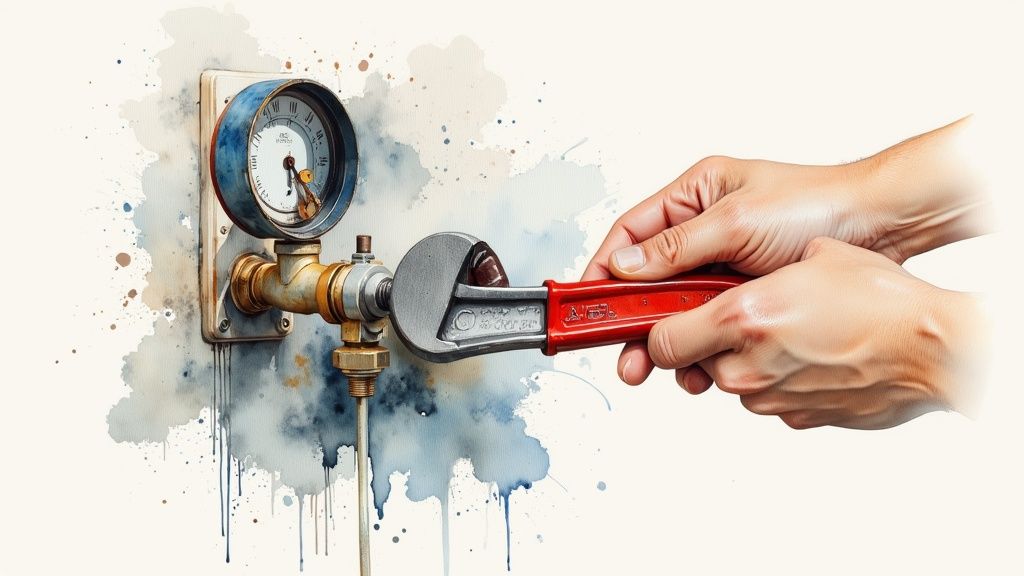
The best time to locate these valves is right now, before you need them in a panic. Take a few minutes after reading this to find both shutoff points. A little preparation can save critical time during a real emergency.
Locating Your Oven's Gas Shutoff Valve
The most direct place to stop the gas is at the appliance valve. This valve only controls the gas going to your oven, so you won't cut the supply to your furnace or hot water heater.
It is almost always located directly behind the oven. You will likely need to gently pull the oven away from the wall to access it. You are looking for a small valve with a lever-style handle.
- ON Position: The handle will be parallel with the gas pipe, allowing gas to flow.
- OFF Position: To shut it off, give the handle a quarter-turn so it's perpendicular (making a "T" shape) to the pipe. This blocks the gas flow completely.
You should not need any tools for this; it's designed to be turned by hand.
Expert Safety Tip: When pulling your oven out, do so slowly and carefully. The flexible gas line is durable but not invincible. Avoid kinking or bending it sharply, as this could damage the line and create another leak.
Finding the Main Gas Shutoff at the Meter
If you can't get behind your oven or the gas smell is overpowering, your next move is to shut off the gas to the entire house at the main meter.
Your gas meter is usually mounted on an outside wall of your house. The shutoff valve is located on the pipe coming up from the ground before it enters the meter. This valve is a rectangular tang.
- ON Position: The rectangular tang runs parallel with the pipe.
- OFF Position: Use an adjustable wrench to turn it a quarter-turn in either direction until the tang is perpendicular to the pipe.
This main valve requires more force to turn. It’s a good idea to keep an adjustable wrench stored near the meter or in an easily accessible spot so you’re not searching for one during an emergency.
The Most Important Rule After Shutting Off the Gas
This is the single most critical piece of advice here: While you can turn the gas OFF, you must NEVER attempt to turn it back ON yourself.
Once the main gas supply is shut off at the meter, only a qualified professional from your utility company (like ATCO) or a licensed gas fitter is authorized to turn it back on. They must perform safety checks to confirm there are no leaks and safely relight the pilot lights on your appliances.
Trying to restore gas flow yourself is incredibly dangerous. You could create an air pocket in the lines that causes an explosive ignition, or you could miss an underlying leak. Leave this task to trained experts.
Identifying Common Causes of Gas Oven Leaks
Understanding what can go wrong with your gas oven is the first step toward prevention. A gas leak is rarely a random event; it's almost always linked to a failing part or an old installation.
Leaks often start in components that are under constant stress from heat and movement or have simply aged. Recognizing the early signs—beyond just the smell—allows you to address a small issue before it becomes a serious safety risk.
Degraded Supply Lines and Seals
One of the most common sources of a gas leak is the flexible supply line connecting your oven to the wall. Over time, these lines can degrade. This is especially true if the oven is moved for cleaning, which can cause the material to crack or the connections to loosen.
Internal seals and gaskets inside the oven, like those in the control valve or burners, can also wear out. As they become brittle from age and heat, they can no longer create a perfect seal, letting tiny amounts of gas escape. It’s an issue our technicians frequently see during stove and oven repair service calls.
Faulty Igniters and Burner Issues
A functional igniter is crucial for your oven’s safety. When you turn on the oven, the igniter heats up to light the gas. If that igniter is weak or broken, the gas valve may still open, but there’s nothing to ignite the gas.
This unburned gas then builds up and can seep into your kitchen. You might notice your oven is taking a very long time to preheat or won't light at all, sometimes accompanied by a faint gas smell.
Clogged or misaligned burners can also disrupt the gas-and-air mixture. This not only wastes fuel but can lead to incomplete combustion, potentially causing the flame to extinguish and allowing raw gas to leak.
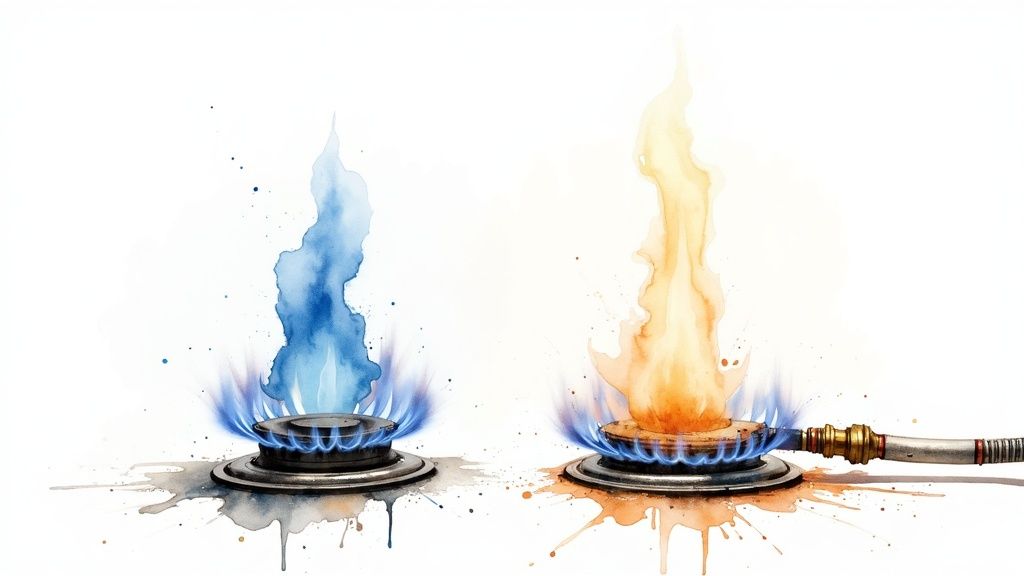
Expert Insight: A quick visual check can tell you a lot. A healthy flame should be a steady, vibrant blue. If you see lazy, yellow, or orange flames, that’s a clear warning sign that something is wrong with the combustion process and you need a professional to take a look.
Broader Health Considerations
Beyond the immediate risk of a leak, it's worth remembering that gas appliances can affect your home's indoor air quality. This is particularly relevant in areas where gas cooking is common. For example, in California, where about 70% of households cook with natural gas, studies have shown a noticeable impact on indoor pollution.
Gas stoves are a major source of indoor nitrogen dioxide (NO2), a pollutant linked to respiratory issues. In some cities, these appliances can contribute up to one-third of a person's indoor NO2 exposure. This highlights why proper ventilation and regular maintenance are so important for keeping your home both safe and healthy.
Proactive Maintenance for Long-Term Gas Oven Safety
The best way to handle a gas leak is to prevent it from happening in the first place. Instead of only reacting to danger, you can take control with a solid maintenance routine. This not only keeps your oven running efficiently but also serves as your best defence, protecting your home and family.

A few good habits and an annual professional check-up can make a world of difference, turning potential hazards into non-issues.
Schedule Annual Professional Inspections
Just like a tune-up for your car or furnace, your gas oven needs expert attention once a year. A qualified technician can identify subtle problems you might miss, such as hairline cracks in a supply line, weakening internal seals, or an inaccurate thermostat.
During an inspection, a technician will:
- Check all connections for tightness and signs of wear.
- Test the igniter to ensure it’s firing strongly for reliable ignition.
- Clean and inspect the burners for clogs that interfere with proper combustion.
- Calibrate the oven temperature to ensure it's cooking safely and accurately.
This yearly service is a small investment that provides significant peace of mind. And remember, while it can be tempting to learn how to fix an oven issue on your own, gas appliance repairs should always be left to a professional.
Master the Art of Proper Cleaning
Keeping your oven clean is about more than just aesthetics; it's a critical safety step. Built-up food debris and grease can clog burner ports and disrupt the gas flow. This leads to inefficient burning and can even cause the flame to go out, allowing raw gas to escape.
To clean your burners correctly, use a soft brush or a pin to gently clear debris from the small gas ports. Avoid using harsh chemicals or spraying water directly on the igniter, as it is a sensitive component that can be easily damaged.
Visual Health Check: Your oven’s flame is a report card on its health. A steady, consistent blue flame indicates efficient combustion. If you see lazy, flickering flames that are yellow or orange, that's a red flag. It’s a clear sign of a problem that needs immediate attention from a professional.
Prioritize Ventilation Every Time You Cook
This is non-negotiable. Every single time you turn on your gas oven or a burner, you must turn on your range hood. A good hood does more than just remove cooking odours; it vents harmful byproducts of combustion, like carbon monoxide and nitrogen dioxide, out of your home.
While there has been significant discussion about indoor air quality and gas stoves, the key takeaway is always ventilation. A 2023 literature review commissioned by industry groups in California found no credible evidence linking natural gas cooking to significant respiratory risks when effective ventilation is used. Your range hood is one of your most important safety tools—use it.
Install a Dual-Sensor Early Warning System
To create a complete safety net, your home needs the right detectors. It's critical to know that a standard smoke detector or a carbon monoxide (CO) alarm will not detect a raw natural gas leak.
For total protection, you need two different types of detectors:
- Explosive Gas Detector: This is specifically designed to detect natural gas (methane) and propane. Since natural gas is lighter than air, it should be installed near the ceiling.
- Carbon Monoxide (CO) Detector: This alarm detects the deadly, odourless gas produced by incomplete combustion. You should have these on every level of your home, especially outside sleeping areas.
For enhanced safety, consider installing wireless interconnected smoke and CO detectors. When one alarm sounds, they all sound, providing an immediate, house-wide alert.
Common Questions About Gas Oven Safety
Once the immediate danger has passed, it’s natural to have questions. As technicians, we hear many of the same concerns from homeowners. Getting clear, expert answers is the best way to feel confident and prepared.
What Does a Natural Gas Leak Actually Smell Like?
On its own, natural gas is odourless and invisible. That’s why utility companies add a chemical called mercaptan, which gives the gas a distinct smell most people describe as sulphur or rotten eggs.
This smell is your built-in alarm system. It's designed to be unpleasant and impossible to ignore. If you catch even a faint whiff of it, you must treat it as a serious gas leak. Don't waste precious seconds trying to find the source—just get out.
Expert Insight: Have you ever noticed a smell when you first enter a room, but then it seems to fade? This is called olfactory fatigue. Your nose adapts to scents over time. This is precisely why even a faint gas smell is a major red flag—the concentration might be much stronger than you think.
Is It Safe to Stay Home if the Gas Smell Is Faint?
Absolutely not. There is no such thing as a "safe" gas smell in your home, no matter how weak it seems.
A faint odour might indicate a small leak, but that leak could worsen instantly. More importantly, gas doesn't spread evenly. It can pool in pockets, often in low-lying areas or enclosed spaces like inside a cabinet. A weak smell in the middle of the kitchen could mean a highly concentrated, explosive mixture is building up out of sight.
The only safe response is to evacuate everyone immediately and call for help from a safe distance.
Who Should I Call First: The Gas Company or an Appliance Repair Pro?
This is a critical question, and the order is essential for safety.
Your very first call—made from outside your home—must be to your gas utility's 24/7 emergency line. In Alberta, that would be ATCO. After that, call 911.
The gas company's job is to handle the immediate public safety threat. Their crews are trained to find the leak's source, shut off the gas supply, and ensure the area is safe. They deal with gas lines and infrastructure.
Only after the utility company has secured the scene and confirmed the leak is coming from your oven should you call a qualified appliance repair service like Repair My Appliance. Our role is to diagnose and repair the appliance itself so it’s safe to use once the utility company gives the all-clear.
My Carbon Monoxide Alarm Is Silent, but I Smell Gas. Should I Still Worry?
Yes, you should be extremely concerned. This is a common and dangerous misunderstanding. A carbon monoxide detector and an explosive gas detector are two different devices that sense completely different dangers.
-
A Carbon Monoxide (CO) Detector alerts you to carbon monoxide, a deadly, odourless gas created when fuel burns incompletely. It warns you if a running appliance like a furnace or your oven is malfunctioning.
-
An Explosive Gas Detector is designed to detect raw, unburned fuel like natural gas (methane) or propane before ignition.
Your CO alarm will not go off because of a raw natural gas leak. The "rotten egg" smell is your primary alert system for a gas leak and requires immediate evacuation. Never let a silent CO alarm give you a false sense of security.
Time to Call in the Professionals?
When dealing with a potential gas leak from your oven, this is not the time for a DIY fix. Playing it safe is always the right call, and that means bringing in a certified technician who can diagnose the problem quickly and handle the repair safely.
If you suspect a problem with the gas line itself, your first call should always be to professional gas line repair services. Once the area is confirmed to be safe, an appliance-specific technician can take over. Understanding the top reasons for hiring a professional makes the decision even clearer.
Need appliance repair? Visit RepairMyAppliance.ca or call 587-416-5888 for fast, professional service.