


Ever get sticker shock looking at a new fridge or dishwasher? If you've found yourself wondering why appliances are getting more expensive, you’re not alone. The short answer is a perfect storm of tangled supply chains, soaring material costs, and advanced technology all colliding to push prices up. This guide breaks down the real reasons behind the price hikes and gives you practical advice on how to save money, whether you choose to repair or replace.
The Perfect Storm Driving Up Appliance Prices
That shiny new oven you're considering has been on a long, complicated, and increasingly expensive journey to get to the showroom floor. Over the last few years, a mix of global events and industry shifts has made manufacturing much tougher, and those costs inevitably get passed down to you, the consumer.
This isn't just about standard inflation. It’s a multi-layered problem where one issue creates a domino effect across the entire production line. A shortage of a single microchip can bring an assembly line to a screeching halt. A spike in steel prices makes the appliance's frame more expensive to build. A congested shipping port can leave thousands of finished products sitting in containers for weeks.
Understanding these interconnected factors is the first step toward making smarter decisions in today's appliance market.
The Three Core Drivers of Higher Costs
To really understand what’s going on, it helps to break the price hikes down into three main categories. Each one plays a unique but related role in the final price you pay:
- Global Supply Chain Disruptions: From factory slowdowns to shipping logjams, getting parts and finished appliances from point A to B has become much slower and far more expensive.
- Raw Material and Labour Costs: The price of basic materials—like steel, copper, and plastic—has shot up. At the same time, wages for skilled manufacturing and logistics workers have also climbed, adding another layer of expense.
- Technological Advancements: Today’s "smart" appliances are packed with Wi-Fi, sensors, and touchscreens. All that advanced tech requires sophisticated components and significant research, which adds a premium to the price tag and often makes future repairs more complex.
This infographic gives you a quick visual of how these three forces—supply chains, materials, and technology—all funnel into the main issue of rising appliance prices.
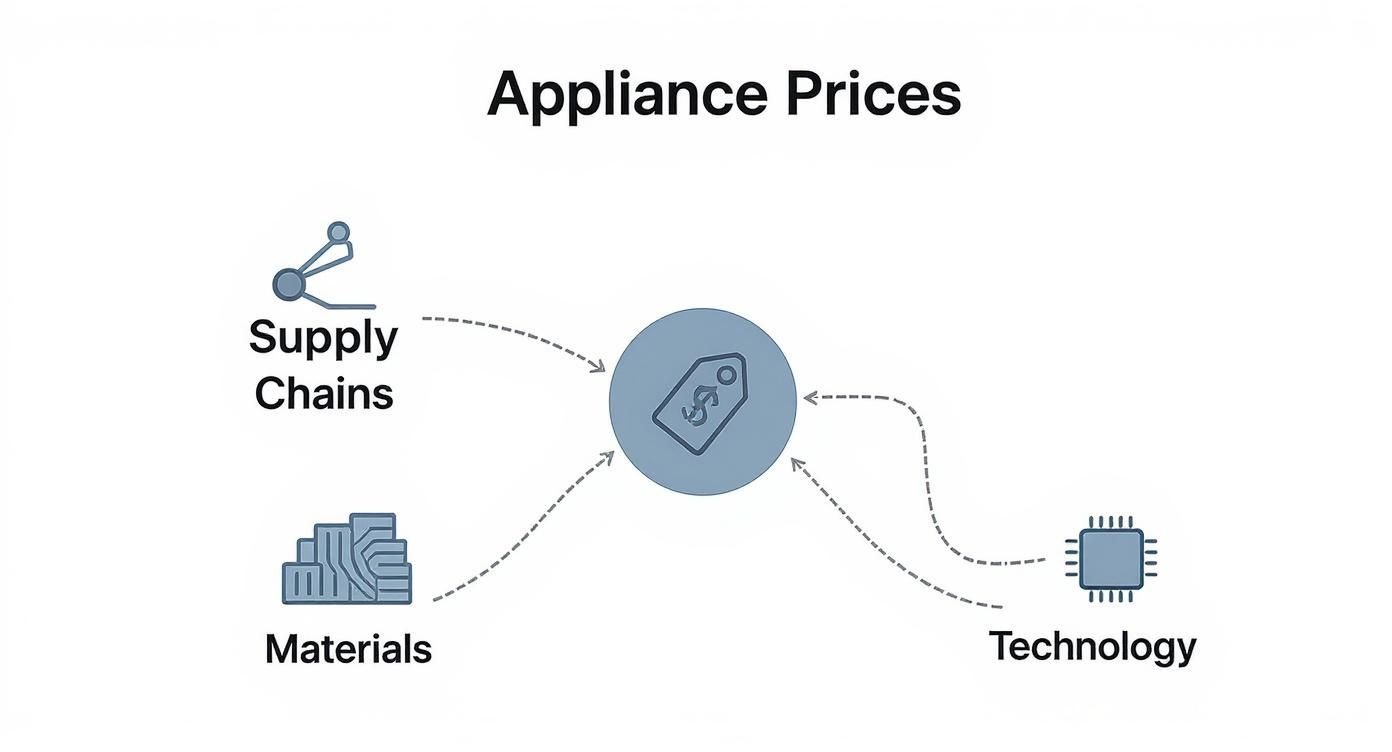
As you can see, each of these branches represents a major cost pressure that builds up to the final sticker price. These factors also have a knock-on effect on how long an appliance might last. For more on that, you can check out our guide on how long a refrigerator should last.
Now, let's dig a little deeper into each of these drivers to give you a complete picture of what’s happening and how you can make smarter choices for your home.
How Global Supply Chain Snags Hit Your Wallet

It can be tough to connect a factory shutdown on the other side of the world to the price tag on a new dishwasher in Calgary. But the reality is, your modern appliance is a global product, and its journey to your home is far more complex than most of us imagine.
Think of the global supply chain as a massive, intricate highway system. When a major road closes unexpectedly, it doesn’t just stop traffic in one spot—it creates jams and delays everywhere down the line.
Recent years have pulled back the curtain on just how fragile this system is. From pandemic-related factory pauses to shortages of shipping containers and logjams at major ports, every single delay adds cost. These aren't just minor hiccups; they create a powerful ripple effect that lands squarely in your wallet.
For instance, when demand for home goods shot through the roof, it created unprecedented bottlenecks. Suddenly, there weren't enough ships to move products, and ports were completely overwhelmed. The cost to ship a single container skyrocketed, sometimes by over 500%. That extra expense doesn't just vanish—it gets baked right into the final price of that new fridge or stove.
A Single Part Halts the Whole Line
To really understand why appliances are getting more expensive, picture a car factory. If they run out of steering wheels, it doesn't matter that they have thousands of engines and doors ready to go. The entire production line stops. The exact same principle applies to appliances.
A modern refrigerator is assembled from hundreds of components sourced from all over the world. A tiny microchip might come from Taiwan, the compressor from South Korea, and the steel from China. If even one of those parts gets delayed, the entire assembly plant here in North America can grind to a halt.
This production standstill means fewer appliances get made, leading to scarcity. And when supply can’t keep up with demand, prices naturally go up. It’s a classic case of economics playing out in real-time at your local appliance store.
The result for homeowners is a double whammy: longer wait times for the specific model you want, and higher prices for the ones that are actually in stock. When your own fridge or washer breaks down, waiting weeks—or even months—for a replacement just isn't an option. This urgency often forces homeowners into a tough spot, especially when a sudden failure requires a quick fix like a same-day appliance repair to bridge the gap.
The Numbers Tell the Story
This combination of high demand and logistical chaos has had a real, measurable impact. Between 2013 and 2021, the average household spending on major appliances in North America more than doubled. This surge is a direct reflection of how supply chain disruptions limit availability and drive up retail prices—a trend that continues to affect Canadian households. You can see more insights on appliance industry spending trends from ConsumerAffairs.com.
At the end of the day, these global snags aren't just abstract problems on the news. They are the concrete reasons why your next appliance is likely to cost more and take longer to arrive than you're used to.
The Hidden Cost of Smart Technology and Features

It’s not just your imagination—appliances today are a world away from the straightforward machines of a decade ago. Your new fridge might have a touchscreen to show you recipes, your washer can be started from your phone, and your oven might use AI to perfect your roast chicken. But this leap in convenience comes with a significant price tag.
The integration of smart technology is a major reason why appliances are getting more expensive. Each new feature, from Wi-Fi connectivity to intricate sensor arrays, represents another layer of cost. This starts long before the appliance is even built, with millions of dollars poured into research and development (R&D) to dream up and test these new capabilities.
From there, manufacturers have to source specialized components like microprocessors, LCD screens, and wireless modules. These are more expensive and often have more volatile supply chains than traditional mechanical parts. All this added complexity on the assembly line also drives up manufacturing costs.
Breaking Down the Smart Premium
To really see the price difference, let's compare a basic, reliable appliance with its "smart" counterpart. Imagine a standard, no-frills dishwasher versus one that connects to an app, features soil sensors, and has a sleek digital display.
- The Standard Model: It’s built with proven, durable parts focused on one job: washing dishes effectively. Its cost is mostly tied to materials like steel and the motor.
- The Smart Model: This one has everything the standard model does, plus a Wi-Fi chip, multiple electronic sensors, a computer processor, and a sophisticated control panel. It also needs ongoing software development and server support to keep the app working.
This added layer of tech is exactly where the extra money goes. When you look at what drives up appliance costs, adding premium smart features can make even smaller devices, like the most expensive air fryer models, significantly pricier than their basic counterparts.
The "smart premium" isn't just a one-time charge. These advanced electronics also introduce more potential points of failure. A traditional appliance might just need a simple mechanical part replaced, but a smart one could suffer from a software glitch or a fried circuit board—repairs that are often far more complex and costly.
Cost Impact of Modern Appliance Features
The table below breaks down how these high-tech additions inflate the final price you pay. It’s a clear look at the premium for convenience.
| Feature | Standard Appliance | Smart Appliance | Typical Cost Increase |
|---|---|---|---|
| Connectivity | Manual controls, no remote access. | Wi-Fi/Bluetooth enabled for app control, voice commands, and remote diagnostics. | $150 – $400+ |
| Display & Interface | Basic knobs, dials, and simple LED indicators. | Full-colour LCD touchscreens, intuitive digital menus, and customizable settings. | $100 – $300+ |
| Internal Sensors | Basic temperature and cycle sensors. | Advanced sensors for load size, soil level, humidity, and food recognition. | $75 – $250+ |
| Software & AI | No software component. | AI-driven cycles, recipe integration, energy optimization, and firmware updates. | $50 – $200+ |
As you can see, each "smart" upgrade stacks on top of the base cost, quickly turning an affordable appliance into a significant investment.
Innovation Comes at a Price
The push for smarter, more connected homes is only speeding up. The global kitchen appliances market is projected to grow from USD 242.32 billion in 2025 to USD 366.72 billion by 2032, fuelled by this demand for innovation. While conventional appliances still dominate the market because of their affordability, the trend toward feature-rich products is undeniable.
Major brands like Bosch invest heavily in high-end design and smart features, which means higher development and material costs that are ultimately passed on to you.
This creates a trade-off for homeowners. The convenience of preheating your oven from the grocery store is appealing, but is it worth the added upfront cost and the potential for more complex repairs down the line? Understanding what’s behind these features helps you make an informed decision. Sometimes, a complex issue in a high-tech appliance might seem daunting, but a professional diagnosis can pinpoint the problem, as we cover in our ultimate guide to Bosch appliance repair in Calgary.
The Rising Price of Raw Materials and Labour

Before an appliance ever gets smart features or fancy finishes, it starts as a simple pile of raw materials. The soaring cost of these essential building blocks—steel, plastic, copper, and glass—is one of the biggest reasons why appliances are getting more expensive.
Think of it like building a house. If the price of lumber, concrete, and wiring shoots up, the final cost of the house has to follow. Appliance manufacturers are in the same boat. When the market price for stainless steel doubles, that cost gets baked right into every refrigerator, oven, and dishwasher coming off the line.
These aren't just minor bumps in the road. Global demand, supply chain snags, and shifting energy costs have created a perfect storm, making the very foundation of manufacturing more expensive.
The Human Element Driving Up Costs
Beyond the metal and plastic, there’s the crucial human element: labour. From the engineers designing the circuit boards to the skilled workers on the assembly line, every step requires people—and the cost of that skilled labour is climbing.
Worker shortages in key manufacturing hubs and rising wage expectations mean it simply costs more to build each appliance. This includes everyone from the quality control inspectors to the logistics teams who get the finished products from the factory to the showroom floor. Every salary increase adds to an appliance's final sticker price.
This double-whammy of pricier materials and more expensive labour creates a costly foundation before an appliance even leaves the factory floor.
Even in major manufacturing centres, production is struggling to keep up. Take California, which has the most appliance manufacturing sites in the US. The industry there still saw a -1.5% annual decline in growth between 2020 and 2025. This production dip, combined with higher demand from a strong housing market, squeezes supply and naturally pushes prices up. You can dig deeper into the manufacturing landscape at IBISWorld.com.
When both the parts and the people needed to assemble them cost more, the end result is a higher price tag for you. This is a fundamental economic shift, and it’s why exploring all your options—especially reliable repairs—has become more important than ever. Our guide on Calgary's trusted appliance repair services can give you some valuable perspective when your own appliance breaks down.
Making the Smart Choice: Repair or Replace?
When one of your essential appliances suddenly breaks down, you're faced with an immediate and often stressful question: fix it or buy a new one? With the price of new appliances on the rise, this decision carries more weight than ever. A snap judgment can hit your wallet hard, but taking a moment to think it through can help you make a calm, confident choice.
Your first move should always be to get a professional diagnosis. You can't make a smart decision without knowing exactly what’s wrong and what the fix will cost. A clear repair quote is the single most important piece of information you need to move forward.
Applying the 50% Rule
Here’s a great rule of thumb that many homeowners rely on: the 50% Rule. It's simple and surprisingly effective. If the cost to repair your appliance is more than half the price of a brand-new, comparable model, it’s probably time to replace it.
Let's say your eight-year-old dishwasher needs a $450 repair. A similar new model would set you back about $800. Since the repair is more than half the cost of a replacement, investing in a new, more efficient machine with a fresh warranty is almost certainly the better long-term move. This simple rule helps you avoid throwing good money after bad on an aging appliance that might just break down again next year.
Key Factors to Consider Before Deciding
Beyond the sticker price, a few other factors should play into your decision. Running through this quick checklist will give you a much clearer picture of the best path forward for your home.
- Appliance Age: How old is the unit? Most major appliances have a lifespan of about 8-15 years. If your machine is already pushing that limit, a major repair might just be a temporary fix.
- Frequency of Repairs: Is this a one-off problem, or has the repair technician become a regular visitor? If you're constantly calling for service, those costs are adding up and signalling that the appliance is on its last legs.
- Energy Efficiency: Older appliances, especially fridges and washing machines, are notorious energy hogs compared to today's models. A new, more efficient unit could deliver real savings on your utility bills, helping to offset the purchase price over time.
- Cost of a New Model: Take a look at what’s out there. Sometimes, the features you want have become standard and much more affordable, making an upgrade a more attractive option than you might think.
The goal is to find the solution that gives you the most value and reliability. While you're weighing your options, don't forget that buying refurbished options to save costs can also be a savvy move. For a more detailed walkthrough, check out our guide on deciding between appliance repair or replacement for more insights to help you choose with confidence.
Your Questions Answered About Appliance Costs
Navigating the world of appliance shopping can feel like a maze, especially with today’s prices. To help you make sense of it all, we’ve tackled some of the most common questions we hear from homeowners every day.
Will Appliance Prices Go Down Soon?
It’s the question on everyone’s mind, but unfortunately, experts don’t see a big price drop on the horizon.
While the worst of the supply chain bottlenecks have eased up, the higher costs for raw materials, skilled labour, and new smart technologies are now baked into the manufacturing process. Instead of prices falling, we expect them to level off. This new reality makes smart shopping and timely repairs more crucial than ever for managing your household budget.
When Is the Best Time of Year to Buy Appliances?
Patience can pay off big time. If you can time your purchase, you stand to save a significant amount of cash. Keep an eye out for these major sales events, which consistently offer the best deals:
- Holiday Weekends: Long weekends like May Two-Four, Canada Day, and Labour Day are prime time for retailers to roll out promotions.
- Black Friday & Cyber Monday: November is still the heavyweight champion for deep discounts across a huge range of models.
- End-of-Month Sales: Don't underestimate the last few days of the month. Retailers are often trying to hit sales targets, which can give you a bit more negotiating power.
Are Extended Warranties Worth the Cost?
This is a classic dilemma. With today's appliances packed with more complex electronics, an extended warranty can be tempting.
Our take? It really depends on the appliance. If you’re investing in a high-end “smart” model with expensive circuit boards or fancy touchscreens, that extra coverage could be a lifesaver. For a more basic, workhorse model, the standard manufacturer's warranty is often enough. The most important thing is to read the fine print before you buy so you know exactly what’s covered—and what’s not.
Need appliance repair? Visit RepairMyAppliance.ca or call 587-416-5888 for fast, professional service.